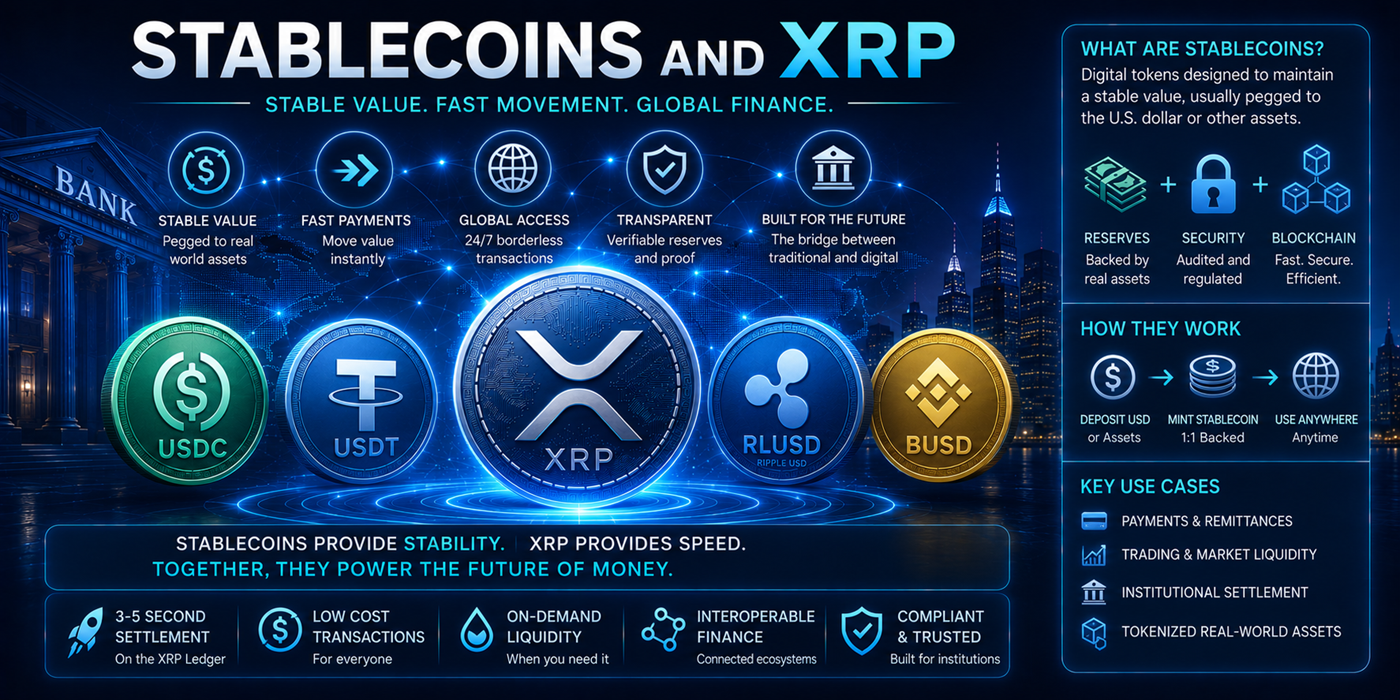
Stablecoins are digital tokens designed to track the value of another asset, most commonly a national currency such as the U.S. dollar. They are one of the most important bridges between traditional finance and the digital asset world.
XRP and stablecoins are often discussed together because future digital finance may involve multiple forms of value moving across fast, efficient, compliant, and liquid financial rails.
A stablecoin is a digital token designed to remain stable relative to a reference asset. For example, a dollar-backed stablecoin aims to stay close to one U.S. dollar in value.
Stablecoins are important because they give people and institutions a way to move dollar-like value across digital networks without constantly converting back into traditional bank money.
Stablecoins can act like digital versions of currency inside crypto markets, apps, wallets, exchanges, and payment systems.
Stablecoins may be used for faster payments, transfers, settlement, and movement of value across digital platforms.
Stablecoins often provide liquidity in digital asset markets by giving traders and users a stable unit for exchange.
Stablecoins are one of the clearest examples of tokenized value because they represent traditional currency on digital rails.
Stablecoins are designed for price stability. XRP is often discussed around settlement, liquidity, and value movement. They can serve different roles in digital finance.
Stablecoins and XRP may both move across blockchain networks and digital financial systems, depending on the platforms and use cases involved.
Stablecoins may provide dollar-like liquidity, while XRP may be studied as a bridge asset or settlement-focused digital asset.
A future digital financial system may include stablecoins, tokenized assets, XRP, XRPL, banking rails, compliance systems, and institutional custody.
| Topic | Stablecoins | XRP |
|---|---|---|
| Main Purpose | Maintain stable value relative to a reference asset. | Move value quickly and efficiently across digital rails. |
| Price Behavior | Designed to remain close to the value of the asset they track. | Market-priced digital asset with volatility and risk. |
| Common Role | Digital dollars, trading pairs, payments, settlement, on-chain cash. | Liquidity, settlement, payments, bridge asset discussion, XRPL activity. |
| Risk Type | Reserve, issuer, redemption, regulatory, custody, and depeg risk. | Market, regulatory, adoption, liquidity, competition, and volatility risk. |
Ripple USD, commonly discussed as RLUSD, is part of the larger stablecoin conversation connected to Ripple, XRP, institutional finance, and digital payments.
For readers studying XRP, RLUSD is important because it shows how stablecoins and XRP may coexist in the same broader ecosystem. Stablecoins can represent stable digital value, while XRP may continue to be studied for liquidity, settlement, and value movement.
No. Stablecoins are designed to maintain stable value relative to another asset. XRP is a market-priced digital asset with a different role and risk profile.
Stablecoins and XRP may serve different purposes. Stablecoins provide stable digital value, while XRP is often studied for liquidity, settlement, and bridge asset use cases.
No. Stablecoins can involve reserve risk, issuer risk, regulatory risk, redemption risk, custody risk, and technology risk.
Institutions may study stablecoins because they can provide digital cash-like settlement, payment efficiency, market liquidity, and programmable financial movement.
Explore Ripple USD and how it fits into the stablecoin and XRP ecosystem.
Learn how stablecoins fit into the broader world of tokenized value.
Understand why stablecoins and XRP both connect to liquidity discussions.
Study the larger shift from traditional money systems toward digital financial rails.
Explores the idea of digital money becoming real money in a changing financial world.
Connects ISO 20022, XRP, and the next financial revolution.
Studies institutions, liquidity, and the changing world of digital finance.
A grounded guide to XRP valuation, utility, risk, and realistic assumptions.
Stablecoins matter because they help connect traditional currency value to digital networks. XRP matters because the future of digital finance may also need fast settlement, liquidity, and efficient value movement. Together, they belong to the larger story of future money.