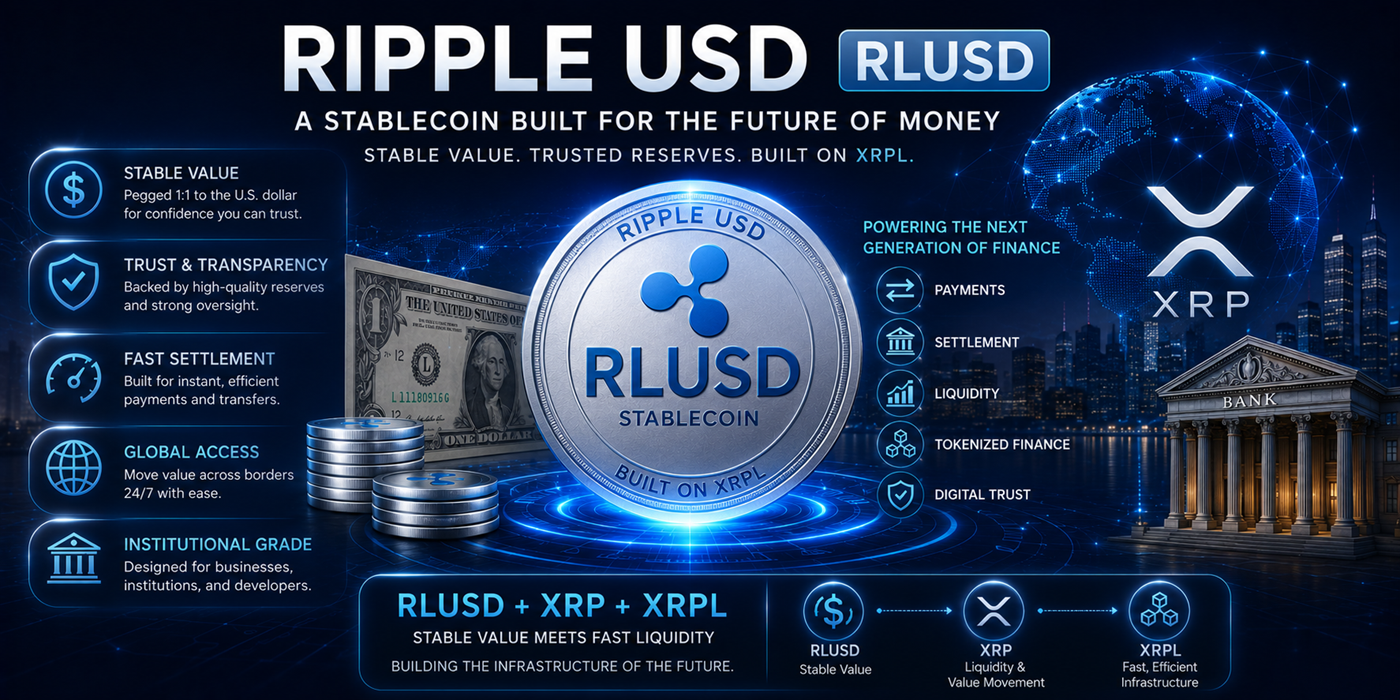
Ripple USD, often referred to as RLUSD, is part of the growing stablecoin conversation connected to Ripple, XRP, the XRP Ledger, institutional finance, digital payments, liquidity, and the future of money.
For XRP learners, RLUSD is important because it helps show how stable digital value and fast digital settlement may work together inside a broader financial ecosystem.
RLUSD is best understood as a stablecoin concept connected to Ripple's larger digital finance ecosystem. Stablecoins are designed to maintain stable value, usually by tracking a reference asset such as the U.S. dollar.
XRP and RLUSD may serve different roles. RLUSD belongs to the stable value side of digital finance, while XRP is often discussed around liquidity, settlement, and movement of value.
RLUSD represents the stablecoin side of the ecosystem: digital dollar-like value designed for stability, payments, and settlement use cases.
XRP is a market-priced digital asset often discussed around liquidity, settlement, fast value movement, and bridge asset concepts.
The XRP Ledger can be studied as a digital network where XRP, issued assets, and other forms of value may move.
Together, stablecoins, XRP, XRPL, institutions, liquidity, and payment rails form part of the larger future money conversation.
Stablecoins help bring currency-like value into digital environments, making payments, trading, and settlement easier to understand.
Institutions often prefer assets with clearer value references, compliance structures, custody options, and transparent financial controls.
Stablecoins may support faster payment and settlement use cases where users want a stable unit of account.
RLUSD may contribute to the broader liquidity conversation by providing stable digital value alongside XRP's value movement role.
| Topic | RLUSD | XRP |
|---|---|---|
| Category | Stablecoin | Digital asset / cryptocurrency |
| Primary Idea | Stable digital value | Fast value movement and settlement |
| Price Behavior | Designed to track a stable reference value | Market-priced and volatile |
| Common Use Case | Payments, settlement, digital dollars, liquidity | Liquidity, bridge asset discussion, XRPL settlement, value transfer |
| Main Risk | Issuer, reserve, redemption, regulation, custody | Market, adoption, regulation, volatility, competition |
Some people ask whether stablecoins make XRP unnecessary. A better way to think about it is that stablecoins and XRP may serve different functions. Stablecoins can provide stable value, while XRP may continue to be studied for fast settlement, liquidity, and movement between systems.
In future digital finance, multiple asset types may coexist: stablecoins, tokenized assets, XRP, real-world assets, institutional custody products, payment rails, and compliance systems.
No. RLUSD is a stablecoin concept. XRP is a market-priced digital asset. They may both be discussed inside the same ecosystem, but they are not the same thing.
Not necessarily. Stablecoins and XRP can serve different roles. Stablecoins focus on stable value. XRP is often discussed around liquidity, settlement, and digital value movement.
Stablecoins can support digital payments, settlement, liquidity, and institutional use cases where users want currency-like value on digital rails.
No stablecoin should be treated as risk-free. Stablecoins may involve issuer risk, reserve risk, redemption risk, regulatory risk, custody risk, and technology risk.
Learn the broader stablecoin category and how stable digital value works.
Explore realistic thinking about XRP, RLUSD, liquidity, and valuation.
Understand why liquidity connects XRP, stablecoins, payments, and institutions.
Study the broader shift from traditional money systems to digital financial rails.
A grounded look at XRP, stablecoins, utility, liquidity, and practical valuation thinking.
Explores digital money becoming real money in a changing financial world.
Connects ISO 20022, XRP, and the next financial revolution.
A deeper look at institutions, liquidity, and future digital finance.
RLUSD matters because future finance may need both stable digital value and fast value movement. Stablecoins can provide stability, while XRP remains part of the discussion around liquidity, settlement, and digital financial rails.