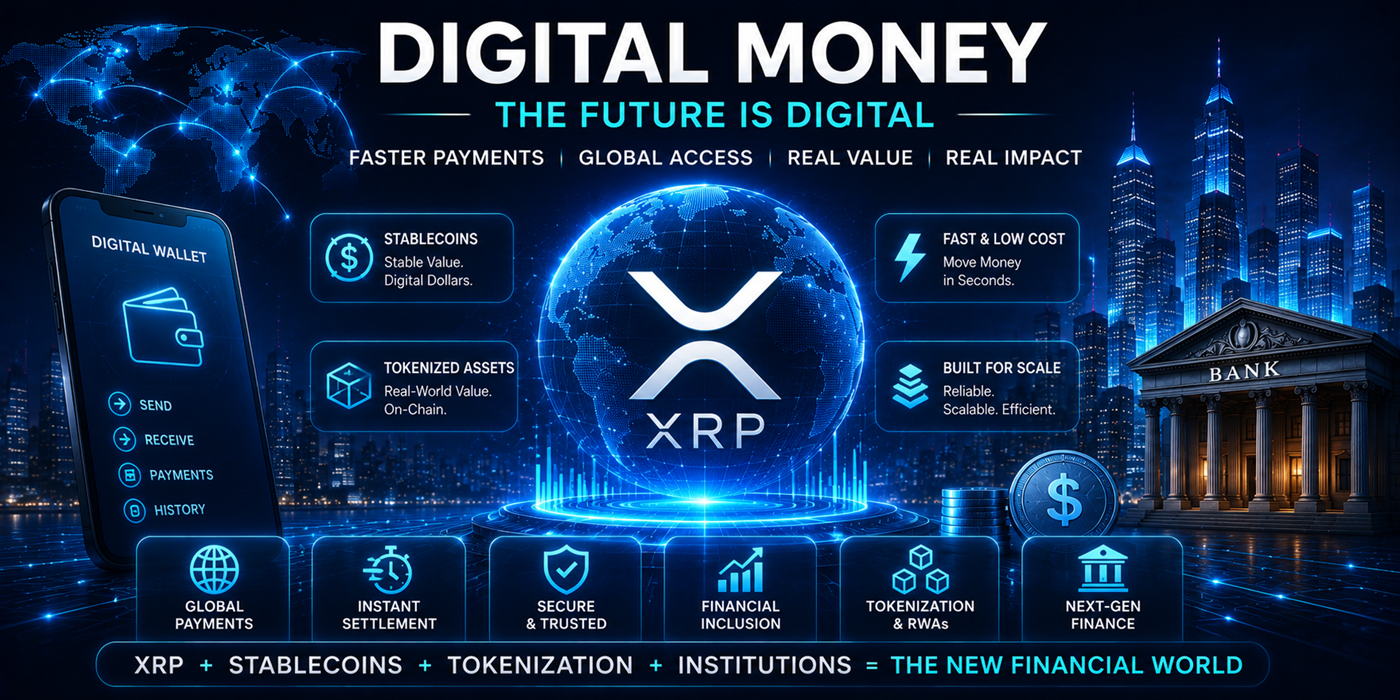
Digital money is the larger shift from paper-based, bank-centered, and slow-moving financial systems toward faster, programmable, data-rich, and globally connected financial rails.
XRP belongs to this conversation because the future of money may require faster settlement, stronger liquidity, tokenized assets, stablecoins, digital wallets, and modern payment systems.
Digital money is money or value that exists, moves, and settles through digital systems. Most people already use digital money when they pay with debit cards, banking apps, payment apps, or online transfers.
The next stage of digital money may include blockchain networks, stablecoins, tokenized assets, faster settlement, programmable payments, digital identity, and more connected global financial infrastructure.
Most modern money already moves digitally through bank accounts, cards, apps, and payment networks.
Stablecoins bring currency-like value onto digital rails and may support payments, trading, liquidity, and settlement.
Digital assets such as XRP and Bitcoin represent new forms of value outside traditional banking systems.
Real-world assets may be represented digitally, creating new models for ownership, transfer, settlement, and access.
XRP is often discussed because it can move across the XRP Ledger quickly and efficiently.
Digital money systems need liquidity so value can move between currencies, assets, markets, and institutions.
Settlement is the final completion of a transaction. XRP and XRPL are often studied in relation to faster settlement.
XRP belongs to the broader discussion about new financial rails that may operate faster and more efficiently than older systems.
| Topic | Traditional Money Systems | Digital Money Systems |
|---|---|---|
| Movement | Often depends on banks, processors, clearing systems, and intermediaries. | May move through digital ledgers, wallets, apps, APIs, and payment networks. |
| Settlement | Can take time depending on systems, countries, and intermediaries. | May be designed for faster settlement and real-time value movement. |
| Access | Often tied to bank accounts, geography, and traditional financial providers. | May expand through wallets, stablecoins, exchanges, tokenized assets, and digital platforms. |
| Data | Payment information may be limited or fragmented across older systems. | May include richer data, programmable rules, and more transparent records. |
Digital financial rails may move value faster than older payment and settlement systems.
Digital money may allow people, businesses, and institutions to interact across borders with less friction.
Future money systems may include programmable rules, smart contracts, automated payments, and tokenized financial instruments.
Stablecoins, XRP, tokenization, digital wallets, and blockchain networks are all part of the innovation wave.
Not entirely. People already use digital money through banks and payment apps. What is new is the growth of blockchain-based value, stablecoins, tokenized assets, and faster settlement networks.
XRP is a digital asset and cryptocurrency. It can be discussed as part of the broader digital money ecosystem because it moves value across a digital ledger.
Not necessarily. The future may involve banks, digital assets, stablecoins, payment providers, custodians, regulators, and blockchain networks working in overlapping systems.
Settlement is when a transaction is finalized. Faster settlement can reduce delays, improve efficiency, and support more modern financial systems.
Understand XRP as a digital asset built around value movement.
Learn how stable digital value fits into future finance.
Explore how assets may become digital tokens on modern financial rails.
Study how digital money may improve global value movement.
The Year Digital Money Becomes Real Money explores the shift toward future finance.
Connects ISO 20022, XRP, and the next financial revolution.
A simple guide to understanding XRP in a changing financial world.
A grounded look at XRP, utility, valuation, and digital finance expectations.
XRP matters because digital money is not only about storing value. It is about moving value, settling value, tokenizing value, and connecting financial systems through faster digital rails.