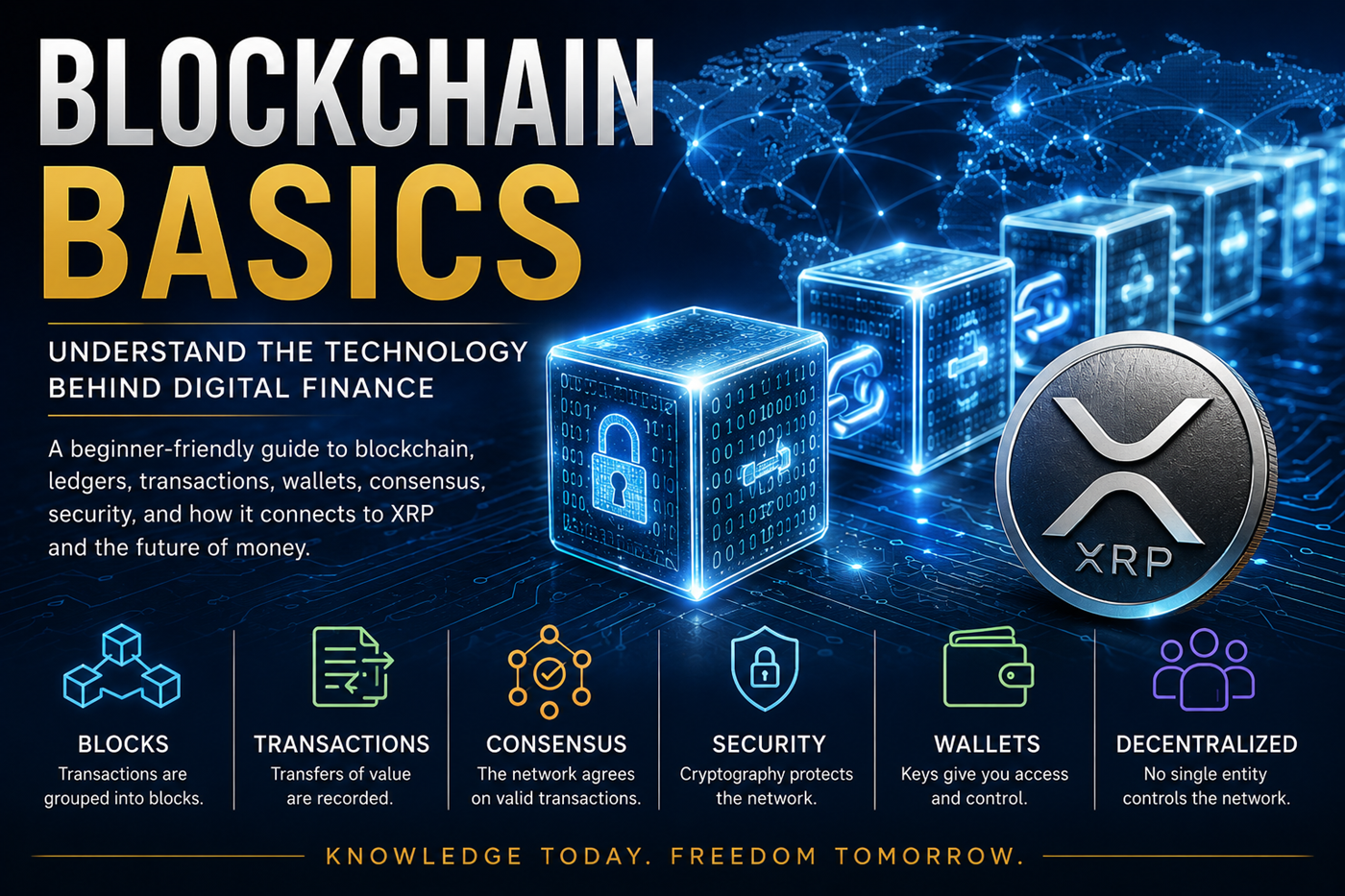
Before anyone can fully understand XRP, Bitcoin, Ethereum, or digital finance, it helps to understand the basic idea behind blockchain technology. A blockchain is a new way to record ownership, verify transactions, and share information across a network.
This page explains blockchain in plain English so beginners can build a stronger foundation before studying XRP, the XRP Ledger, wallets, valuation, and digital assets.
A blockchain is a digital record system that stores transactions across a network of computers. Instead of one company or bank controlling the entire record, many participants help maintain and verify the shared ledger.
The simplest way to think about blockchain is as a public digital ledger. A ledger is a record of who owns what and what transactions have occurred. Blockchain technology makes that ledger shared, transparent, and difficult to alter.
Many participants can view and verify the same transaction history.
Public blockchains allow transactions to be examined by anyone using blockchain explorers.
Cryptography helps protect ownership and prevents unauthorized changes.
Blockchain allows digital assets to be owned, transferred, and verified without physical certificates.
A transaction is an action recorded on the network. For example, one person may send a digital asset to another person. That transaction is checked, confirmed, and added to the shared record.
Many blockchains organize confirmed transactions into blocks. Those blocks are connected together in order, creating a chain of transaction history. That is where the term blockchain comes from.
Consensus is the process a blockchain network uses to agree on which transactions are valid. Different networks use different methods. Bitcoin uses mining. Ethereum uses proof-of-stake. The XRP Ledger uses a consensus process designed for fast settlement and efficiency.
Consensus allows a network to agree on the truth of the ledger without relying on one single central authority to approve every transaction.
| Traditional Database | Blockchain / Distributed Ledger |
|---|---|
| Usually controlled by one organization. | Shared across a network of participants. |
| Users rely on the owner of the database. | Participants verify transactions using network rules. |
| Can be private and closed. | Public blockchains can be transparent and open. |
| Changes may depend on internal systems. | Confirmed transactions become part of the shared ledger history. |
Blockchain assets are controlled through wallets and cryptographic keys. A wallet does not physically hold coins. Instead, it manages the keys that allow someone to access and move digital assets recorded on the ledger.
A receiving address that can be shared with others.
Secret information used to authorize transactions.
A recovery phrase used to restore wallet access.
Controlling your own keys instead of relying on an exchange.
XRP operates on the XRP Ledger, often called XRPL. The XRP Ledger is a public blockchain designed for fast, low-cost value transfer. Instead of relying on mining, it uses a consensus process that allows transactions to settle quickly.
Understanding general blockchain basics makes it much easier to understand why XRP is different from Bitcoin, Ethereum, and other digital assets. Each network has its own design, purpose, and tradeoffs.
Cryptocurrency is one use of blockchain technology, but blockchain can also support tokenization, payments, records, and digital ownership.
The assets remain recorded on the blockchain or ledger. The wallet controls access.
Bitcoin, Ethereum, and the XRP Ledger were designed with different goals and technical structures.
Each blockchain makes design choices that affect settlement speed, fees, scalability, and decentralization.
Blockchain is a shared digital ledger that allows value and information to move across a network. Once you understand ledgers, transactions, consensus, wallets, and keys, XRP becomes much easier to study.