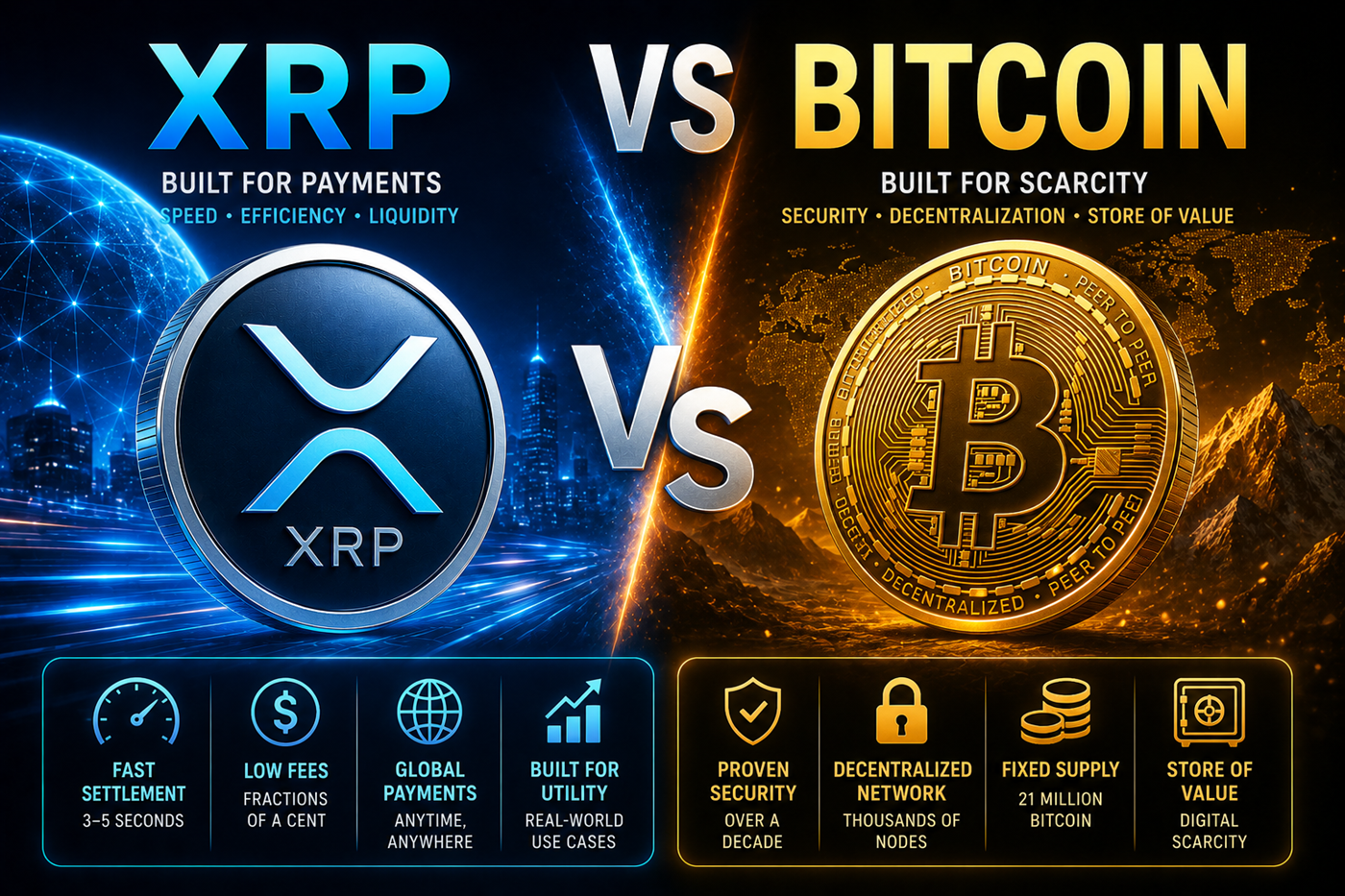
XRP and Bitcoin are both digital assets, but they were designed with different goals in mind. Bitcoin is often viewed as digital scarcity and a store-of-value asset. XRP is often viewed as a fast, low-cost asset built for value transfer, liquidity, and settlement.
Understanding the difference helps beginners avoid comparing them only by price. The better question is not simply which one costs more. The better question is what each asset was designed to do.
| Category | Bitcoin | XRP |
|---|---|---|
| Main Idea | Digital scarcity and decentralized money. | Fast, low-cost value transfer and liquidity. |
| Primary Narrative | Store of value and digital gold. | Payments, settlement, liquidity, and global finance. |
| Network | Bitcoin blockchain. | XRP Ledger. |
| Transaction Focus | Security and decentralization over speed. | Speed, efficiency, and settlement. |
| Supply Style | Fixed maximum supply issued through mining. | Fixed supply created at launch with ongoing ecosystem distribution. |
Bitcoin is widely understood as a scarce digital asset. Its value story is often connected to limited supply, decentralization, security, and long-term holding.
XRP is designed around fast settlement and efficient value transfer. Its value story is often connected to payments, liquidity, cross-border movement, and financial infrastructure.
This does not mean one asset must replace the other. They may serve different roles in the digital asset world. Bitcoin can be viewed as a long-term reserve-style asset, while XRP can be viewed as a utility-focused settlement asset.
Bitcoin prioritizes security and confirmation depth, which can make settlement feel slower for everyday payment use.
XRP is designed for fast ledger settlement, making it useful in payment and transfer conversations.
Bitcoin fees can vary depending on network demand and transaction conditions.
XRP transaction costs are typically very small, which supports frequent movement of value.
Bitcoin uses mining. Miners compete to add blocks to the blockchain and are rewarded through block rewards and transaction fees. This process is central to Bitcoin’s security model and supply issuance.
XRP does not use mining. The XRP Ledger uses a consensus process where validators help agree on valid transactions and ledger updates. This is one reason XRP transactions can settle quickly without proof-of-work mining.
Beginner takeaway: Bitcoin is mined. XRP is not mined. Bitcoin’s system is built around proof-of-work. XRP’s system is built around ledger consensus.
Bitcoin has a maximum supply of 21 million coins. New Bitcoin enters circulation through mining rewards until the issuance schedule eventually ends.
XRP had its supply created at launch. A portion has circulated through markets, ecosystem use, institutional holdings, and escrow-related release structures.
Supply matters, but supply alone does not determine value. Demand, utility, market sentiment, regulation, liquidity, adoption, and macro conditions all influence price.
That depends on the question. Bitcoin may be better understood as a scarce digital asset with a powerful store-of-value narrative. XRP may be better understood as a fast settlement asset designed for value movement and liquidity.
A serious investor does not need to treat every digital asset like it is competing for the exact same job. Different assets can serve different purposes. The key is understanding the role each one is trying to play.
Bitcoin is built around scarcity, security, and the digital gold narrative. XRP is built around speed, low cost, settlement, and value movement. They are both digital assets, but they are not designed for the same primary purpose.
Avoid judging assets only by price, hype, or social media predictions.
Avoid MistakesA beginner-friendly guide to XRP, Ripple, XRPL, and digital finance.
View BookExplore whether XRP could follow its own path toward major long-term recognition.
View BookA balanced guide to valuation, risk, liquidity, and realistic XRP expectations.
View Book