Start With the Objection
For many Christians, the idea of additional scripture feels unnecessary.
The Bible contains the Old Testament.
It contains the Gospels.
It contains the teachings of the apostles.
It tells of the Crucifixion.
It proclaims the Resurrection.
It teaches salvation through Jesus Christ.
So the question naturally follows:
If the Bible Tells Us About Jesus, Why Would We Need Anything Else?
That question deserves an answer.
But “we already have scripture” and “God cannot give additional scripture” are not the same claim.
Imagine Living Before the New Testament
Consider the question from another point in history.
Suppose you were a faithful Jewish believer before the birth of Jesus.
You already possessed sacred writings.
You had the Law.
You had prophets.
You had Psalms.
You had centuries of sacred tradition.
Then Jesus came.
Later, His followers produced additional writings.
The Gospels were written.
Paul wrote letters.
Peter wrote.
John wrote.
Other Christian writings circulated.
Eventually, writings recognized by Christians as the New Testament were placed alongside the older Scriptures.
Would “We Already Have Scripture” Have Been a Sufficient Reason to Reject the New Testament?
Christians today would say no.
God's earlier revelation did not prevent Him from giving more.
The Bible Is a Collection of Books
We often speak of “the Bible” as though it arrived as one completed book.
Historically, it did not.
The Bible is a library.
Its writings came from different periods, authors, communities, and circumstances.
Genesis did not arrive bound together with Revelation.
Isaiah did not possess a completed New Testament.
Paul did not carry a leather-bound sixty-six-book Bible through the Roman world.
The collection Christians now call the Bible developed over time.
That does not diminish its importance.
But it does matter when asking whether the existence of scripture automatically means there can never be more scripture.
Later Scripture Did Not Make Earlier Scripture False
When Isaiah spoke, the writings associated with Moses did not become false.
When Jeremiah spoke, Isaiah did not become useless.
When the Gospel of Matthew was written, the Old Testament did not cease to be scripture.
When Paul wrote to Christians in Corinth, the Gospel message did not invalidate the prophets who came before him.
Later revelation could stand beside earlier revelation.
Earlier scripture could remain true.
Later scripture could add testimony, instruction, warning, clarification, and witness.
That pattern exists throughout the biblical story.
Does the Bible Say the Canon Is Closed?
Christians who reject additional scripture often believe the biblical canon is closed.
In practical terms, that means no later writing can be added to the Bible as authoritative scripture.
That position has deep roots in Christian tradition.
But there is an important distinction between a theological conclusion about the canon and an explicit biblical statement.
The Bible does not contain a table of contents written by an apostle identifying every book that future Christians must recognize as the completed Bible.
Nor does it contain a sentence saying:
“After These Books Are Collected, God Will Never Give Scripture Again.”
The canon developed through history as communities recognized certain writings as authoritative.
That historical process should be distinguished from the separate question of whether God Himself retains the ability to reveal more.
What About Revelation 22?
One of the most frequently quoted objections to additional scripture comes near the end of the Book of Revelation.
At first glance, that may sound like a prohibition against any later scripture.
But notice the wording.
The warning concerns adding to “the words of the prophecy of this book.”
John is warning against altering the revelation he has given.
The passage does not explicitly say that God Himself can never reveal anything else.
The Old Testament Contains a Similar Warning
Deuteronomy contains similar language.
If that statement meant that no later revelation could ever be given, then much of the Old Testament after Deuteronomy would create a problem.
Isaiah came later.
Jeremiah came later.
Ezekiel came later.
The New Testament came later.
The more natural principle is that human beings should not alter what God has revealed.
Do not add your words to God's revelation is one principle.
God can never speak again is a different claim.
Does Additional Scripture Mean the Bible Is Not Enough?
Not necessarily.
A second witness does not have to exist because the first witness failed.
Imagine two people witnessing the same important event.
The existence of the second witness does not prove the first witness was inadequate.
It may strengthen the testimony.
It may provide another perspective.
It may preserve information the first witness did not record.
That is how Latter-day Saints understand the relationship between the Bible and the Book of Mormon.
Not Bible versus Book of Mormon.
Bible and Book of Mormon.
The Bible Itself Values Multiple Witnesses
The principle of multiple witnesses appears repeatedly in Scripture.
Important matters were not always meant to rest upon the testimony of only one person.
Jesus appealed to witnesses.
Paul referred to the principle.
The Resurrection itself is proclaimed through multiple witnesses.
So the idea of another witness is not inherently anti-biblical.
The real question is whether the proposed second witness is genuine.
The Bible Mentions Writings We No Longer Possess
The biblical text itself refers to writings that are not part of the Bible as we possess it today.
The Old Testament refers to works such as the Book of the Wars of the Lord and the Book of Jasher.
Chronicles refers readers to additional historical records.
The New Testament also gives indications that not every apostolic communication has survived within the canon.
Paul refers to correspondence with Christian communities beyond the letters preserved in the New Testament.
This does not prove that any particular missing writing was inspired scripture.
It does establish something simpler:
The Bible Never Claims to Contain Every Sacred Word Ever Written.
John Says Jesus Did More Than Was Written
Near the end of his Gospel, John makes an extraordinary statement.
John knew his Gospel was selective.
He did not claim to have recorded every action or every word of Jesus.
That does not mean missing teachings automatically exist in another modern book.
But it does remind us that the biblical record itself acknowledges that more happened than was written there.
Luke Says Others Had Written Accounts
Luke begins his Gospel by acknowledging that others had already undertaken to write accounts concerning the events surrounding Jesus.
That means multiple records circulated in the early Christian world.
Only some became part of the New Testament canon.
Again, this does not mean every religious writing was inspired.
It means early Christianity was never based on the assumption that only one written account of Jesus could exist.
What If God Dealt With Other Peoples?
The Bible records God's dealings primarily through a particular geographical and covenant history.
That history centers on Israel and ultimately on Jesus Christ.
But the world was much larger than the geographical world described in most biblical narratives.
Millions of people lived elsewhere.
Could God have spoken to any of them?
Could prophets have existed outside the narrative preserved in the Bible?
Could another people have preserved a record?
The Bible does not explicitly answer every one of those questions.
But neither does it say that God was forbidden from doing so.
The Book of Mormon Makes Exactly That Claim
The Book of Mormon says that God dealt with another branch of the house of Israel.
According to the record, Lehi's family left Jerusalem and eventually reached another land.
Prophets arose among their descendants.
They kept records.
They taught about the coming Messiah.
And after His Resurrection, Jesus Christ appeared among them.
The record was eventually abridged, preserved, and later brought forth through Joseph Smith.
That is an extraordinary claim.
But its basic concept is straightforward:
God spoke to one people.
God spoke to another people.
Both records testify of Jesus Christ.
The Book of Mormon Anticipates the Objection
Interestingly, the Book of Mormon itself anticipates people objecting to additional scripture.
In 2 Nephi 29, the text portrays people saying:
The chapter then challenges the assumption that God could speak to only one nation.
Its argument is essentially this:
If God is God over the whole earth, why assume He could reveal His word to only one people?
Of course, a book anticipating an objection does not prove the book is divine.
But it tells us how the Book of Mormon understands its own place beside the Bible.
“Because That I Have Spoken One Word...”
The same Book of Mormon chapter presents God as asking why people would assume one revelation prevents another.
That is one of the clearest statements of the Book of Mormon's theology of scripture.
God is not limited by the amount He has already revealed.
Again, that is the Book of Mormon's claim.
Whether the book has authority to make that claim is precisely what must be investigated.
Would Additional Scripture Contradict the Bible?
If a claimed revelation truly came from the same God, we would reasonably expect meaningful continuity.
That does not require identical wording.
Different prophets in the Bible did not always speak with identical language or emphasis.
But a new witness claiming divine origin should be examined carefully against earlier revelation.
Does It Point Toward the Same God and the Same Jesus Christ?
Does it reinforce earlier truth?
Does it clarify?
Does it contradict?
Are apparent differences explainable—or fundamental?
Those are better questions than rejecting a text merely because it came later.
Later Does Not Automatically Mean False
Chronology matters.
A claim written centuries after an event should not automatically be given the same historical weight as an early source.
But “later” and “false” are not synonyms.
The New Testament itself contains writings produced after the events they describe.
Historical claims must be evaluated by evidence.
A later record claiming to preserve older material creates an additional question:
Can Its Claim to Older Origins Be Supported?
That is one of the central questions surrounding the Book of Mormon.
Another Book Must Still Be Tested
Accepting the possibility of additional scripture does not mean accepting every book that claims divine origin.
History contains many claimed revelations.
Religions contain many sacred texts.
Some claims contradict others.
They cannot all automatically be accepted simply because their authors or followers call them scripture.
Possibility is not proof.
First question: Could God give additional scripture?
Second question: Did He?
Those are different questions.
How Would We Test a Claimed Scripture?
There is no single test that resolves every religious claim.
But several kinds of evidence can be examined.
What does the book claim about its origin?
What is known about how it appeared?
Are there witnesses connected with its origin?
Does the text fit its claimed historical setting?
Are there anachronisms or historical problems?
How does it relate to earlier scripture?
What does it teach about Jesus Christ?
What explanations are offered by critics?
How strong are the responses?
Does the text itself invite a spiritual test?
A serious investigation should not fear difficult questions.
The Book of Mormon Has Witnesses
The Book of Mormon was published with statements from people who said they had experiences involving the plates from which Joseph Smith said he translated the record.
Three men gave one statement.
Eight men gave another.
Their testimonies remain printed in editions of the Book of Mormon.
Those witnesses have been defended, criticized, analyzed, and debated.
Their existence does not automatically prove the Book of Mormon.
But anyone investigating the origin of the book should examine what they actually claimed rather than pretending the witnesses did not exist.
The Book Makes Historical Claims
The Book of Mormon cannot be evaluated only as theology because it presents itself as history.
It names peoples.
It describes migrations.
It describes wars.
It describes cities.
It mentions animals, crops, metals, weapons, governments, languages, and religious practices.
Those claims create legitimate questions involving archaeology, anthropology, genetics, geography, linguistics, and history.
Some proposed correspondences are debated.
Some criticisms remain contested.
Mainstream archaeology and ancient-American scholarship do not currently recognize the Book of Mormon as an established ancient historical record.
That fact belongs on the table.
So do the arguments offered by those who defend its antiquity.
The Book Also Makes a Spiritual Claim
The Book of Mormon does not ask readers to rely only on archaeology.
Near its conclusion, Moroni invites readers to ask God whether the record is true.
For believers, that invitation is central.
For skeptics, a personal spiritual experience cannot independently establish ancient historical claims.
Those are different kinds of evidence.
They should not be confused.
But if the book's central claim is divine revelation, then the possibility of seeking an answer from God is part of the claim being investigated.
Why Would God Give Another Witness of Jesus?
Perhaps because Jesus matters.
If Christ truly is the Savior of the world, another testimony of Him would not necessarily be redundant.
Christians do not normally ask why the New Testament contains four Gospels instead of one.
Matthew testifies.
Mark testifies.
Luke testifies.
John testifies.
Their accounts overlap.
They also differ in emphasis and detail.
Multiple witnesses can strengthen rather than weaken a case.
Why Would Another People Need Their Own Record?
If God dealt with another people, their history would not be identical to Jerusalem's history.
Their prophets would face different circumstances.
Their record might preserve teachings or events absent from the biblical narrative.
Most importantly, if the risen Christ appeared among them, their testimony would be their own.
Would We Expect Another Witness to Say Nothing New?
If it said only what we already possessed word for word, why preserve another record at all?
But New Information Must Be Handled Carefully
The fact that another witness might contain additional information does not give unlimited permission to invent doctrine.
New claims must still be examined.
If a later text radically contradicts earlier evidence, that matters.
If it claims to explain an earlier passage, we should ask whether the explanation fits.
If it claims ancient origin, we should investigate that origin.
If it claims divine authority, we should ask what evidence supports that authority.
An evidence-first approach protects us from both gullibility and automatic dismissal.
What About Other Religious Books?
Once we allow the possibility that God could reveal scripture outside the Bible, another question immediately appears.
What about the Qur'an?
What about other sacred writings?
What about claimed revelations throughout history?
They deserve examination too.
Allowing the possibility of additional revelation does not prove that every claimed revelation came from the same source.
Their claims can be compared.
Their chronology can be examined.
Their teachings about Jesus can be compared with earlier evidence.
That investigation becomes especially important in THE TRUTH III.
The Earlier Evidence Still Matters
Suppose a religious text appears centuries after Jesus and makes claims about Him.
Those claims should be compared with the earliest evidence.
That does not automatically make the later text false.
But the later the claim, the more important it becomes to ask how it relates to earlier sources.
Claim.
Earliest evidence.
Competing interpretation.
Question.
That same method should be used whether the later claim comes from the Book of Mormon, the Qur'an, a church council, a theologian, a modern prophet, or anyone else.
Could God Preserve More Than One Record?
If God is the God of the whole earth, the possibility is not difficult to imagine.
The more difficult question is whether He actually did.
The Book of Mormon answers yes.
It claims that one record arose among Judah and another among descendants of Joseph.
Latter-day Saints connect this idea with Ezekiel's prophecy concerning Judah and Joseph.
As discussed elsewhere, Ezekiel 37 explicitly concerns the reunification of divided Israel.
The identification of the sticks with the Bible and Book of Mormon is an additional Latter-day Saint interpretation.
It should be presented as interpretation rather than pretending Ezekiel explicitly names two future books.
What Would Another Witness Accomplish?
According to the Book of Mormon and Latter-day Saint understanding, another scriptural witness serves several purposes.
It testifies that Jesus is the Christ.
It supports the biblical witness of Christ.
It teaches faith and repentance.
It teaches baptism and the Holy Ghost.
It testifies of the Resurrection.
It connects another branch of Israel with the covenant story.
It supports the claim that God still reveals truth.
It becomes part of the larger Restoration claim.
The Book of Mormon Does Not Ask You to Throw Away the Bible
This point is important.
The Restoration claim is not:
“The Bible was wrong, so God replaced it.”
The Book of Mormon repeatedly quotes biblical prophets.
It reveres the words of Isaiah.
It identifies the Jesus of the New Testament as the Savior.
It describes the Bible going forth among nations.
Its central claim is not replacement.
It is additional witness.
Not Another Savior.
Another witness of the same Savior.
So Why Another Book of Scripture?
If the Book of Mormon's claim is true, the answer becomes simple.
Because God dealt with another people.
Because those people kept a record.
Because their prophets testified of Christ.
Because the risen Christ appeared among them.
Because God wanted another witness of His Son.
And because God had not finished speaking.
If the Book of Mormon's claim is false, then none of those reasons establishes its authority.
The entire question therefore returns to evidence.
The Question Is Not “Can There Be Another Book?”
The biblical pattern shows revelation arriving repeatedly.
The Bible itself is a collection produced over time.
It refers to writings we no longer possess.
It never contains an explicit declaration that God permanently closed revelation after the final New Testament writing.
So perhaps the strongest question is not:
“Could God give another book?”
Perhaps it is:
Did God Give This One?
That is a much harder question.
And it is the one worth investigating.
Don't Accept It Because Someone Calls It Scripture
Read it.
Compare it with the Bible.
Study where it came from.
Examine the witnesses.
Investigate the criticisms.
Read the responses.
Look at what it teaches about Jesus Christ.
And if you believe God still answers prayer, ask Him.
Don't Begin With “There Cannot Be More.”
Begin with: “What is the evidence?”
And Then Return to Jesus
Ultimately, scripture is not important merely because it is a book.
For Christianity, scripture matters because of the truth to which it bears witness.
The Bible points us toward Jesus Christ.
The Book of Mormon claims to do the same.
So the central issue is not collecting religious books.
It is discovering whether another genuine witness of Jesus Christ has been placed before us.
One Savior. More than one claimed witness.
Why Another Witness?
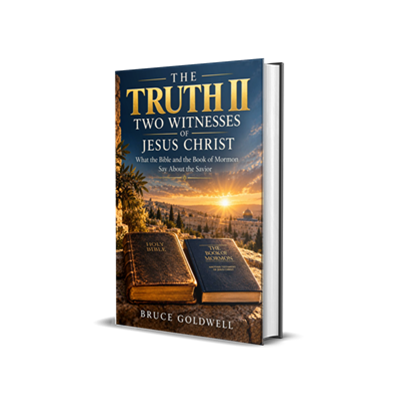
THE TRUTH II: TWO WITNESSES OF JESUS CHRIST examines the Bible and the Book of Mormon side by side.
Explore Joseph and Judah, prophecy, the birth of Christ, His teachings, Crucifixion, Resurrection, the “other sheep,” the appearance of the risen Christ in 3 Nephi, the gathering of Israel, and the claim that God preserved another ancient witness of His Son.
Don't accept another book merely because it claims to be scripture. But don't tell God He cannot speak again before examining the evidence.