Begin With What the Book Actually Claims
People often discuss the Book of Mormon without first asking what the book itself claims to be about.
Some focus immediately on Joseph Smith.
Some focus on archaeology.
Some focus on nineteenth-century America.
Some focus on Latter-day Saint doctrine.
All of those subjects may eventually matter.
But the Book of Mormon itself repeatedly directs the reader toward one central figure:
Jesus Christ.
What Does the Book of Mormon Actually Say About Jesus?
That question can be answered before deciding whether the book is ancient, inspired, or true.
Jesus Appears Before He Is Born
The Book of Mormon begins centuries before the birth of Jesus in Bethlehem.
Yet its prophets repeatedly speak of a coming Messiah.
They describe a Savior who will come into the world.
They connect Him with redemption.
They teach that humanity must look to Him for salvation.
Within the narrative, those teachings are presented as prophecy given long before the events described in the New Testament.
That immediately produces a historical fork.
If the Book of Mormon is ancient: these are pre-Christian prophecies centered remarkably on Jesus Christ.
If the Book of Mormon is nineteenth-century: these are later Christian ideas placed into an ancient setting.
The text itself gives us the claim.
History must help us evaluate its origin.
Nephi Sees the Coming of Christ
One of the earliest Book of Mormon narratives describes Nephi receiving a vision concerning the future.
He sees a virgin who will become the mother of the Son of God.
He sees the ministry of the Lamb of God.
He sees followers of Jesus.
He sees His rejection and death.
The vision places Jesus at the center of God's plan long before the Book of Mormon narrative reaches the time of Christ.
Believers see this as prophecy.
Critics see it as evidence that the text reflects Christian knowledge already available in Joseph Smith's environment.
Again, the same text supports competing explanations depending on what one concludes about the book's origin.
The Book of Mormon Calls Jesus the Son of God
The New Testament repeatedly identifies Jesus as the Son of God.
The Book of Mormon does the same.
Its prophets use titles such as:
Messiah.
Son of God.
Lamb of God.
Redeemer.
Savior.
Holy One of Israel.
Lord.
The book does not present Jesus as merely one prophet among many.
It places Him at the center of salvation.
It Teaches That Humanity Needs a Savior
The Book of Mormon presents human beings as fallen, mortal, and unable to overcome sin and death by themselves.
It teaches that the Fall of Adam and Eve introduced mortality into human experience.
It also teaches that God's plan includes redemption through Christ.
One of its most familiar statements says:
The larger argument of that chapter connects human agency, the Fall, opposition, and redemption through the Messiah.
The Book of Mormon Strongly Emphasizes the Atonement
The saving work of Jesus is one of the most repeated themes in the Book of Mormon.
Its prophets teach that Christ will suffer for sin.
They teach that mercy becomes available through Him.
They teach that He overcomes death.
They teach that reconciliation with God is possible because of His sacrifice.
The Book of Mormon often uses the word Atonement in describing that work.
This places it firmly within a Christian understanding of Jesus' mission.
King Benjamin Teaches About Christ Before His Birth
One of the most detailed pre-Christian sermons in the Book of Mormon is attributed to King Benjamin.
He tells his people that the Lord Omnipotent will come down from heaven and dwell among human beings.
He describes miracles.
He describes suffering.
He describes crucifixion.
He describes resurrection.
And he teaches salvation through the name of Christ.
For believers, this is another prophetic witness.
For critics, the detailed Christian content is one of the very features that requires explanation if the book is supposed to come from centuries before Jesus.
Abinadi Connects Isaiah With Jesus Christ
The Book of Mormon repeatedly quotes and interprets Isaiah.
One important example occurs when the prophet Abinadi teaches from Isaiah 53.
He interprets the suffering servant in relation to Christ.
Christians have long interpreted Isaiah 53 messianically, while Jewish interpretation generally does not identify the servant with Jesus.
The Book of Mormon firmly takes the Christian reading.
That makes its position clear even if readers disagree with its interpretation.
Alma Teaches About Faith in Christ
Alma is one of the major teachers in the Book of Mormon.
His sermons repeatedly connect faith, repentance, spiritual rebirth, resurrection, judgment, and salvation with Jesus Christ.
The famous comparison of faith to a seed appears in Alma 32.
That chapter is sometimes discussed simply as a lesson about faith in general.
But the surrounding Book of Mormon message places faith within a larger movement toward Christ.
Samuel Predicts Signs of Christ's Birth and Death
Near the end of the period before Christ's birth, the Book of Mormon introduces Samuel the Lamanite.
He prophesies of signs that will accompany the birth of Christ.
He also prophesies signs associated with Christ's death.
Within the narrative, those signs later occur.
Again, the claim is specific enough to matter.
Prophecy—or Narrative Written After the Fact?
The answer depends largely on what the evidence says about the origin of the Book of Mormon.
The Book of Mormon Places Jesus' Birth in the Same World as the Bible
The Book of Mormon does not invent a second Jesus.
It does not describe a different Messiah born somewhere else.
Its prophets point toward the same Jesus whose birth the New Testament places in Judea.
The Book of Mormon narrative unfolds far away, but it claims its people are watching for the birth of the same Savior.
Then Jesus Is Crucified in Jerusalem
The Book of Mormon does not place the Crucifixion in the Americas.
Jesus is crucified in the Old World.
The New Testament provides the narrative of His arrest, trial, Crucifixion, and burial.
The Book of Mormon claims that distant peoples experienced signs associated with His death.
These included darkness, destruction, and upheaval.
That makes the two records different in function.
The Bible: describes the Crucifixion where it happened.
The Book of Mormon: claims another people experienced signs connected with that same death.
Then Comes the Book's Central Event
The Book of Mormon's most important claim is not the migration of Lehi.
It is not Nephite warfare.
It is not the gold plates.
It is not even Joseph Smith.
The central event is the appearance of the resurrected Jesus Christ.
Everything leads toward 3 Nephi.
The Resurrected Christ Appears
According to 3 Nephi, a group of people gather near a temple in a place called Bountiful.
They hear a voice from heaven.
The voice introduces the Son.
Jesus descends and stands among them.
He identifies Himself directly.
The Book of Mormon leaves no ambiguity about who this figure claims to be.
This Is the Same Jesus Who Was Crucified
The narrative connects the resurrected Jesus directly with the Crucifixion.
He shows the wounds in His body.
He invites the people to come to Him.
They are invited to feel the marks of the Crucifixion.
This is crucial to the Book of Mormon's claim.
It is not merely saying:
“A spiritual teacher appeared.”
It is saying:
The crucified and risen Jesus of the New Testament appeared to another people.
One by One
The Book of Mormon emphasizes that the people approached Jesus individually.
The phrase “one by one” gives the scene unusual power.
The narrative is constructed as personal verification.
They hear Him.
They see Him.
They approach Him.
They experience His wounds for themselves.
If This Happened, What Would It Mean?
It would mean the Resurrection was witnessed beyond the world described in the New Testament.
Jesus Establishes His Gospel Among Them
The Christ of 3 Nephi does not merely appear and leave.
He teaches.
He gives authority.
He teaches baptism.
He teaches repentance.
He teaches about the Holy Ghost.
He teaches prayer.
He teaches the Sacrament.
He teaches His doctrine.
He organizes disciples to minister among the people.
This makes the Book of Mormon claim much larger than a brief post-Resurrection appearance.
It claims Christ established His Gospel among another people.
Jesus Teaches Baptism
One of the first matters addressed in 3 Nephi is baptism.
The narrative says there had been disagreement among the people about how baptism should be performed.
Jesus gives instructions.
He emphasizes unity and warns against contention.
This parallels the importance baptism holds in the New Testament while adding specific Book of Mormon teaching about the ordinance.
Jesus Teaches His Doctrine
In 3 Nephi, Jesus summarizes a pattern that includes faith, repentance, baptism, reception of the Holy Ghost, and endurance in discipleship.
This strongly resembles the Gospel pattern found elsewhere throughout the Book of Mormon.
It also overlaps significantly with New Testament preaching, especially in Acts.
The Book of Mormon therefore presents its core Gospel as coming from Jesus Himself.
Jesus Gives the Sacrament
The resurrected Christ also gives bread and wine to the people and connects them with remembrance of His body and blood.
This parallels the Last Supper tradition in the New Testament.
The Book of Mormon thus presents another community practicing a memorial ordinance centered on Christ's sacrifice.
Jesus Blesses Children
One of the most moving scenes in 3 Nephi involves children.
Jesus gathers the people around Him.
He blesses their little children.
The narrative describes an extraordinary spiritual manifestation surrounding them.
Whether one accepts the event as historical or reads it as religious literature, the scene reinforces the Book of Mormon's portrayal of Jesus as compassionate, personal, and deeply concerned with individual people.
Jesus Heals the Sick
The Book of Mormon also portrays the resurrected Christ healing.
He asks whether there are sick, disabled, or afflicted people among the crowd.
They are brought to Him.
He heals them.
Again, the description deliberately resembles the compassionate healing ministry seen in the Gospels.
Believers see continuity because it is the same Jesus.
Critics may see literary imitation of New Testament patterns.
Those competing explanations should both remain visible.
The Book of Mormon Jesus Teaches the Sermon at the Temple
Large portions of Jesus' teaching in 3 Nephi closely resemble the Sermon on the Mount in Matthew.
The similarities are substantial.
Some wording closely reflects the King James Bible.
This produces one of the important textual questions surrounding the Book of Mormon.
Believing explanation: the same Jesus teaches the same Gospel to another people, and the English translation uses familiar biblical language.
Critical explanation: the Book of Mormon author or translator drew directly upon the King James Bible.
Simply observing the similarity does not decide between those explanations.
What About “Other Sheep”?
The Book of Mormon directly connects its peoples with a statement Jesus made in the Gospel of John.
In 3 Nephi, Jesus identifies His audience as part of the “other sheep” He had mentioned in Jerusalem.
The Gospel of John itself does not provide that identification.
Many Christians understand “other sheep” as Gentiles.
The Book of Mormon gives a Restoration-specific interpretation.
That difference deserves its own investigation.
Examine: Who Were the Other Sheep? →
Jesus Speaks of Other Peoples Too
The Book of Mormon claim does not necessarily stop with the group described in 3 Nephi.
Its Jesus speaks of other sheep beyond the immediate audience.
That broadens the idea that God may have dealt with peoples outside the biblical narrative.
Whether additional records exist or ever existed is another question.
But the theological principle is significant:
Was God's Work Ever Limited to One Geography?
The Book of Mormon Teaches Universal Resurrection
The Book of Mormon teaches that because of Christ, the dead will rise.
Resurrection is not reserved for a small spiritual elite.
It is presented as a universal consequence of Christ's victory over death.
People will then stand before God for judgment.
This closely parallels major themes in the New Testament.
Jesus Is the Judge
The Book of Mormon also presents Christ in connection with final judgment.
Human beings are accountable for how they live.
Mercy is available through Christ.
But moral choices matter.
The Savior is not presented merely as someone who removes consequences without transformation.
Discipleship requires repentance and continued faithfulness.
Grace Is Central to the Book of Mormon
Some discussions mistakenly portray the Book of Mormon as teaching salvation purely by human effort.
The book repeatedly teaches dependence on Christ.
One famous verse says:
Christians and Latter-day Saints have sometimes debated the phrase “after all we can do.”
But the larger Book of Mormon message does not present human beings as saving themselves without Christ.
Grace, mercy, repentance, covenant, discipleship, and Christ's Atonement all operate together within its theology.
The Entire Record Says It Exists to Point to Christ
The Book of Mormon repeatedly explains its own purpose.
Its title page declares that one purpose is to convince people that Jesus is the Christ.
Its prophets repeatedly redirect readers toward Him.
Its final prophet, Moroni, closes the record with an invitation to come unto Christ.
Whatever one concludes about the book's origin, it is difficult to read it carefully and claim that Jesus is only a minor figure.
Jesus Christ is the center of the book.
Then Why Do Some Christians Say the Book of Mormon Is Not Christian?
Usually the disagreement is not over whether the name Jesus Christ appears in the book.
It clearly does.
The disagreement concerns larger theological questions.
Critics argue that Latter-day Saint teachings about God, authority, revelation, scripture, salvation, and the afterlife differ from historic creedal Christianity.
Latter-day Saints answer that their beliefs restore teachings and structures found in Scripture but later interpreted differently.
Those disagreements are real.
But they should not be confused with a simpler factual question:
Does the Book of Mormon Testify of Jesus Christ?
Yes.
The harder question is whether its testimony is what it claims to be.
Could Someone Write a Book About Jesus and Still Be Wrong?
Of course.
A book does not become ancient scripture simply because it teaches about Christ.
A person could write sincere Christian theology and falsely claim that it came from an ancient civilization.
So Christ-centered content alone does not prove the Book of Mormon.
At the same time, dismissing the book as though it teaches nothing about Jesus also fails to engage the actual text.
The evidence-first position should avoid both mistakes.
What Must Be Investigated?
Several distinct questions should not be collapsed into one.
Textual question: What does the Book of Mormon actually teach about Jesus?
Historical question: Where did the book come from?
Ancient-origin question: Does the evidence support or challenge its claimed antiquity?
Witness question: What should we make of the people who testified about the plates?
Theological question: How does its Gospel compare with the Bible?
Spiritual question: Can its claim to divine origin be approached through prayer?
A serious conclusion should consider more than one of these.
What If Joseph Smith Wrote It?
Suppose the Book of Mormon is entirely a nineteenth-century work.
Then the question becomes:
How was it produced?
What sources shaped it?
Why does it take the form it does?
How should the witnesses be understood?
Why does it contain such sustained focus on Jesus Christ?
None of those questions by itself proves supernatural origin.
But “Joseph Smith wrote it” is not the end of the investigation.
It is another hypothesis that should account for the evidence.
What If the Record Is Ancient?
Then the implications become enormous.
An ancient Book of Mormon would mean another civilization preserved a record centered on Israel's God and the coming Messiah.
It would mean prophets outside the biblical narrative testified of Christ before His birth.
It would mean the resurrected Jesus appeared to another people.
It would mean the biblical story of God's dealings with humanity was never intended to be the only record of those dealings.
That Is Why the Origin Question Matters So Much.
The Strongest Claim Is Still Jesus
People can spend years arguing about geography, horses, metals, language, DNA, chronology, and archaeology.
Those questions matter because the Book of Mormon makes historical claims.
But they should not cause readers to miss what the record says its purpose is.
It wants readers to face Jesus Christ.
The same question found in the New Testament eventually returns:
The Book of Mormon Gives Its Answer
Its answer is not subtle.
Jesus is the Messiah.
Jesus is the Son of God.
Jesus is the Redeemer.
Jesus atones for sin.
Jesus was crucified.
Jesus rose from the dead.
Jesus appeared to another people.
Jesus teaches His Gospel.
Jesus will judge the world.
Jesus is the only source of salvation.
The Question Is Not Whether the Book of Mormon Talks About Jesus.
It does.
The question is whether its testimony of Him is what it claims to be.
Don't Read Around Jesus
Someone can study every controversy surrounding the Book of Mormon without ever reading its central chapters about Christ.
That is not a complete investigation.
Read 1 Nephi.
Read 2 Nephi.
Read Mosiah.
Read Alma.
Read Helaman.
And especially read 3 Nephi.
Then ask:
If This Record Is False, What Best Explains It?
And if it is true, what would that mean about Jesus Christ?
The Investigation Continues With the “Other Sheep”
One of the Book of Mormon's boldest claims is that Jesus Himself connected His appearance among its people with something He had already said in Jerusalem.
The words are preserved in the Gospel of John:
What did Jesus mean?
That question takes us to the next piece of evidence.
Continue: Who Were the Other Sheep? →
Follow the Two Witnesses
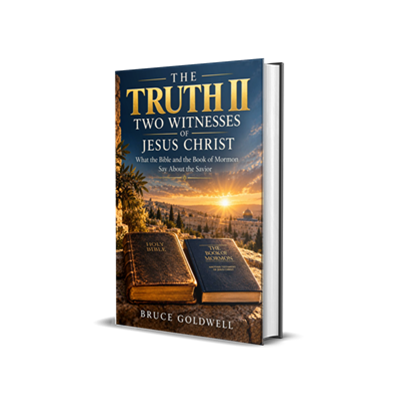
THE TRUTH II: TWO WITNESSES OF JESUS CHRIST examines what the Bible and the Book of Mormon say about the Savior.
Explore prophecy, the descendants of Joseph, the birth of Christ, His teachings, Crucifixion, Resurrection, the “other sheep,” the appearance of the risen Christ in 3 Nephi, baptism, authority, the gathering of Israel, and the claim of another ancient witness.
Don't begin by believing it. Don't begin by rejecting it. Begin by reading it.