Begin With the Words of Jesus
The question begins with a single verse.
The statement is familiar.
Its meaning is less simple than it may first appear.
Jesus says He has other sheep.
They are not of “this fold.”
He says He must bring them.
He says they will hear His voice.
And He speaks of unity under one shepherd.
Who Were They?
The Gospel of John records the statement.
But John 10:16 does not explicitly identify the group.
First Understand the Shepherd
John 10 contains Jesus' teaching about the shepherd and the sheep.
Jesus describes Himself as the good shepherd.
He knows His sheep.
His sheep know Him.
They recognize His voice.
The good shepherd is willing to give His life for the sheep.
The imagery would have been familiar within the biblical tradition.
Israel's Scriptures repeatedly use shepherd imagery for kings, leaders, God's people, and God Himself.
Jesus is therefore using language deeply connected with Israel.
Who Were the Sheep Already Around Jesus?
Jesus' earthly ministry took place primarily among the people of Israel.
The Gospel of Matthew records Him saying:
When Jesus first sent the Twelve, Matthew also records Him directing them toward “the lost sheep of the house of Israel.”
These passages establish an important connection between sheep and Israel.
That does not by itself identify the “other sheep” of John 10.
But it gives us part of the biblical context.
The Common Christian Interpretation: The Gentiles
A widely held Christian interpretation identifies the other sheep with Gentiles who would later enter the Christian community.
This interpretation fits an important New Testament development.
Jesus' earliest disciples were Jewish.
After His Resurrection, the Gospel expanded beyond Israel.
Acts describes Peter's encounter with Cornelius.
Paul became especially associated with missionary work among Gentiles.
Jew and Gentile came together within the growing Christian Church.
Paul writes about this unity in Christ.
From this perspective, John 10:16 anticipates the expansion of the Gospel beyond its original Jewish setting.
That Interpretation Has Strong Biblical Context
The Gentile interpretation should not be dismissed simply because the Book of Mormon offers another interpretation.
The New Testament clearly teaches that Gentiles were brought into the people of God.
Ephesians speaks of groups once separated becoming one in Christ.
Paul's letters repeatedly discuss Jews and Gentiles becoming part of one believing community.
John 10:16 ends with the image of unity:
That makes the Gentile interpretation understandable.
But one phrase deserves closer attention.
“They Shall Hear My Voice”
Jesus does not merely say that His disciples will eventually preach to the other sheep.
The King James wording says:
What does that mean?
It could refer to people hearing the message and call of Christ through His Gospel and His servants.
That fits the traditional Gentile interpretation.
But the Book of Mormon gives the phrase a more literal application.
It claims that another group of Israelites actually heard the voice of the resurrected Jesus Christ.
Did Jesus Mean They Would Hear About Him—or Hear Him?
The wording permits the question.
The Book of Mormon Gives an Answer
The Book of Mormon does something the Gospel of John does not do.
It explicitly identifies a group as among the “other sheep.”
According to 3 Nephi, after His Resurrection Jesus appears to people gathered in a land called Bountiful.
During His ministry among them, He refers directly to the statement He had made in Jerusalem.
He tells them:
The Book of Mormon interpretation could hardly be clearer.
It claims that the people Jesus was addressing were among the other sheep He had mentioned in Jerusalem.
That Is a Claim—Not Automatic Proof
Quoting 3 Nephi proves what the Book of Mormon claims.
It does not by itself prove that the claim is historically true.
That distinction matters.
What John establishes: Jesus said He had other sheep.
What John does not establish: John does not identify those sheep as Book of Mormon peoples.
What the Book of Mormon claims: the resurrected Jesus identified the people in 3 Nephi as among those other sheep.
The historical question: Is 3 Nephi an authentic record of something Jesus actually said?
Why Would Jesus Have Other Israelite Sheep?
The idea of scattered Israelites would not have been foreign to biblical readers.
The history of Israel includes conquest, exile, migration, dispersion, and the division of the kingdom.
The northern kingdom of Israel was conquered by Assyria centuries before the ministry of Jesus.
Judah later experienced Babylonian conquest and exile.
The prophets repeatedly speak of Israel being scattered and eventually gathered.
The Book of Mormon places its own story within that larger Israelite scattering.
Lehi's Family Is Presented as Part of Israel
According to the Book of Mormon, Lehi lived in Jerusalem near the beginning of the sixth century BC.
His family left Jerusalem before its destruction by Babylon.
The record identifies Lehi as a descendant of Joseph through Manasseh.
His descendants therefore understand themselves not as unrelated Gentiles, but as part of the house of Israel.
That detail becomes important to the Book of Mormon interpretation of John 10:16.
If Israel Was Scattered, Could Christ Have Ministered to More Than One Branch?
Jesus Says His Jerusalem Disciples Did Not Understand
The Book of Mormon expands the story further.
Its Jesus says the disciples in Jerusalem did not understand what He meant when He spoke of other sheep.
According to 3 Nephi, they assumed He was referring to Gentiles.
The Book of Mormon Jesus distinguishes between Gentiles hearing the Gospel through the ministry of others and these other sheep hearing His own voice.
This is one of the clearest places where the Book of Mormon offers an interpretation of a New Testament passage that goes beyond what the New Testament itself explains.
Whether that explanation is revelation or later interpretation depends on the larger question of the Book of Mormon's origin.
Were the Gentiles Also Sheep?
The issue does not have to be framed as though Gentiles are excluded from Christ's flock.
The New Testament clearly presents the Gospel going to Gentiles.
Paul clearly teaches their inclusion among God's covenant people.
The Book of Mormon also teaches that Gentiles can receive the Gospel and become numbered among God's people.
The narrower question is whether the specific “other sheep” of John 10:16 refers only to Gentiles.
The traditional Christian interpretation generally says yes.
The Book of Mormon says no.
Could Both Ideas Fit the Larger Picture?
There is another possibility worth considering.
The Gospel ultimately reaches Gentiles.
Scattered Israel is also a major biblical theme.
Jesus could have sheep beyond the immediate Jewish audience without the larger mission to Gentiles being excluded.
In other words, the broad biblical picture can include more than one group being brought under the one shepherd.
The specific question remains whether John 10:16 itself points to one group in particular.
Jesus Says There Are Still Other Sheep
The Book of Mormon makes an even more surprising claim.
After identifying the people in 3 Nephi as among the other sheep, Jesus speaks of still other sheep whom He must visit.
In the Book of Mormon narrative, the people at Bountiful are therefore not necessarily the only people outside Jerusalem to whom the risen Christ ministers.
The text does not give us a surviving record identifying all such groups.
That leaves another open question.
If Christ Visited Other Peoples, Where Are Their Records?
Were records made?
Were they lost?
Could they someday be discovered?
Or is the Book of Mormon claim itself mistaken?
The Bible Already Contains the Idea of Scattered Sheep
The shepherd imagery of John 10 did not begin with the Gospel of John.
The Old Testament repeatedly describes Israel using sheep and shepherd imagery.
Ezekiel 34 is especially important.
Israel's leaders are criticized as unfaithful shepherds.
God promises to seek His scattered sheep.
He promises to gather them.
The chapter eventually speaks of one shepherd associated with David.
Christians commonly understand this shepherd imagery messianically.
When Jesus later calls Himself the Good Shepherd, the connection with Israel's Scriptures is difficult to miss.
Ezekiel Also Speaks of Reuniting Israel
Just a few chapters later, Ezekiel 37 contains the prophecy of the sticks associated with Judah and Joseph.
The immediate interpretation in Ezekiel concerns the divided people of Israel becoming one.
Latter-day Saints additionally connect the passage symbolically with the Bible and Book of Mormon as records associated with Judah and Joseph.
That interpretation is not explicit in Ezekiel's explanation of the prophecy.
But it shows how the Restoration tradition connects several themes:
Scattered Israel.
Joseph and Judah.
Other sheep.
Additional scripture.
The gathering of Israel.
One shepherd.
The question is whether those connections reflect genuine fulfillment or later theological interpretation.
What About the Lost Ten Tribes?
Discussions of the “other sheep” sometimes become connected with the so-called Lost Ten Tribes of Israel.
The Assyrian conquest of the northern kingdom scattered and displaced populations, although the historical reality is more complex than the idea that ten entire tribes simply vanished without trace.
Some Israelites remained.
Some moved.
Some became integrated with other populations.
Biblical prophecy nevertheless continued to speak about the future gathering of Israel.
The Book of Mormon also anticipates a gathering.
But it does not require us to identify every unknown population with a specific modern nation or ethnic group.
Could Jesus Have Appeared Outside the Biblical World?
This question reaches beyond John 10:16.
If Jesus truly rose from the dead, what limitations would apply to where He could appear?
The New Testament describes several appearances after His Resurrection.
It does not say:
“These were the only appearances Jesus ever made anywhere.”
Absence of such a statement does not prove additional appearances.
But it means additional appearances are not automatically impossible merely because the New Testament does not record them.
If the Resurrection Happened, Is an Appearance to Another People Impossible?
Impossible?
Or simply extraordinary?
The Real Issue Is the Book of Mormon's Origin
At this point the investigation returns to the same central fork.
If Joseph Smith or another nineteenth-century source created the Book of Mormon, then 3 Nephi 15 provides a later interpretation of John 10:16.
It may be imaginative.
It may be theological.
It may even be interesting.
But it would not preserve an actual statement made by the resurrected Jesus.
If the Book of Mormon is genuinely an ancient record, however, the situation changes dramatically.
Then 3 Nephi may preserve an explanation from Jesus Himself about words previously recorded in John.
Nineteenth-century origin: the Book of Mormon interprets John.
Ancient record: the Book of Mormon may preserve additional information about what Jesus meant.
Does John 10:16 Prove the Book of Mormon?
No.
John 10:16 does not mention Nephi.
It does not mention the Americas.
It does not mention Lehi.
It does not mention the Book of Mormon.
Using the verse as though it independently proves the Book of Mormon would go beyond the biblical evidence.
What the verse does establish is that Jesus spoke of other sheep.
The Book of Mormon then makes the additional claim that it identifies at least some of them.
That is a much more precise way to state the evidence.
Does John 10:16 Disprove the Book of Mormon Interpretation?
Not by itself.
The traditional Gentile interpretation is reasonable and fits important New Testament themes.
But the verse itself does not explicitly say:
“The other sheep are the Gentiles.”
That identification comes from interpreting John within the larger New Testament story.
The Book of Mormon proposes additional information.
The real dispute therefore cannot be settled merely by pointing to the phrase “other sheep.”
It depends heavily on whether the Book of Mormon has any authority to provide additional information in the first place.
That Returns Us to Continuing Revelation
If God can no longer reveal anything beyond the Bible, then 3 Nephi's interpretation can be rejected before investigation.
If God can still speak, the possibility remains open.
That does not make the Book of Mormon true.
It simply means its claim must be tested rather than ruled out by definition.
Examine: Does God Still Speak? →
Why Would God Speak to Another People?
Perhaps this is the deeper question.
Would God care only about people living within the geographical world covered by the Bible?
The Bible itself says no.
Its vision ultimately expands to all nations.
God's concern is not confined to Jerusalem.
Jesus commands His followers to carry the Gospel throughout the world.
So the idea that God could care about another ancient people is not particularly difficult.
The extraordinary part is the claim that the risen Jesus personally visited them.
And That Claim Can Be Stated Very Simply
The Bible records Jesus saying:
The Book of Mormon records the resurrected Jesus saying:
Two passages.
One statement in Jerusalem.
One claimed explanation somewhere else.
If the second record is authentic, the connection is remarkable.
If it is not authentic, then the connection was created by someone familiar with the Gospel of John.
Which Explanation Best Fits the Evidence?
The Question Is Larger Than Geography
Arguments about whether Jesus visited the Americas can become so focused on maps that the larger theological claim gets lost.
The Book of Mormon is saying something much bigger.
It is saying that Jesus Christ knows His people wherever they are.
It is saying that God's covenant story extends beyond the portion of history preserved in the Bible.
It is saying that the risen Christ was not limited by geography.
And it is saying that God may have preserved more than one witness of His Son.
One Shepherd
The final part of John 10:16 may be the most important.
The emphasis does not ultimately remain on separate groups.
It ends with unity.
Whether the sheep are understood as Jews and Gentiles, scattered Israel, Book of Mormon peoples, or some broader combination, the shepherd remains the same.
Jesus Christ.
Different Peoples. Same Savior.
That is the claim at the heart of THE TRUTH II.
The Bible does not tell the story of every people who ever lived.
It tells an extraordinary story centered on Israel and culminating in Jesus Christ.
The Book of Mormon claims that another branch of Israel had its own record—and that its story also culminated in Jesus Christ.
If false, that claim should not survive serious investigation.
If true, it changes how we think about the reach of Christ's post-Resurrection ministry.
Then Comes an Even Larger Question
If God could speak to another people, could He also preserve another record?
If biblical revelation did not contain every word God ever spoke, could additional scripture exist?
And if another book claims to be scripture, how should we test it?
That takes us to the next question.
Continue: Why Another Book of Scripture? →
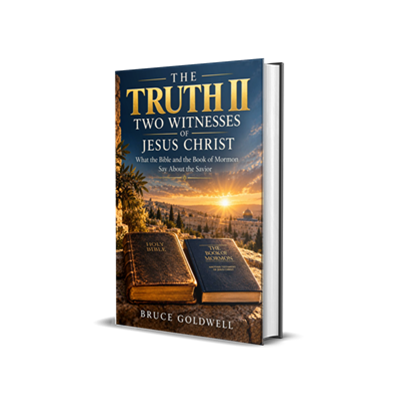
Two Witnesses. One Savior.
THE TRUTH II: TWO WITNESSES OF JESUS CHRIST examines what the Bible and the Book of Mormon say about Jesus Christ.
Follow the evidence from Joseph and Judah through prophecy, the birth of Christ, His teachings, Crucifixion, Resurrection, the “other sheep,” His appearance in 3 Nephi, and the gathering of Israel.
Don't begin by assuming the Book of Mormon is true. Don't begin by assuming it must be false. Examine the claim.