Begin With the Claim
The Bible and the Book of Mormon do not claim to be the same record.
They describe different peoples.
They emerge from different historical settings.
They contain different prophets.
Their narratives unfold in different parts of the world.
Yet the Book of Mormon claims that both records ultimately point toward the same person:
Jesus Christ.
That claim can be examined.
What Happens When the Two Records Are Placed Side by Side?
Do they describe different saviors?
Do they teach fundamentally different Gospels?
Or do they present two witnesses centered on the same Christ?
The Bible Comes First
An evidence-first examination of the Book of Mormon should not require diminishing the Bible.
The Bible provides the foundational record of Jesus' mortal life.
The Old Testament preserves the history, law, poetry, prophecy, and covenant traditions from which Christianity emerged.
The New Testament records the ministry of Jesus, His teachings, His Crucifixion, the proclamation of His Resurrection, and the growth of the early Christian Church.
Without the Bible, we would lose our primary scriptural record of Jesus' life in Judea and Galilee.
The Book of Mormon does not claim that Jesus of Nazareth was another person.
It claims to testify of the same Jesus.
What Does the Book of Mormon Claim to Be?
The Book of Mormon presents itself as a record produced by ancient peoples whose history begins with a family leaving Jerusalem around the beginning of the sixth century BC.
According to its narrative, descendants of that group eventually developed civilizations in the Americas.
Prophets among them taught about God, covenant, repentance, and the coming Messiah.
The record ultimately describes the appearance of the resurrected Jesus Christ to a gathered people after His Resurrection in Jerusalem.
Joseph Smith said he translated the record from metal plates delivered to him by an angel named Moroni.
That is the claim.
The claim is not evidence merely because it is written in a book.
But it should be understood correctly before it is evaluated.
Why Would God Provide More Than One Witness?
The idea of multiple witnesses is deeply biblical.
The law of Moses contains the principle that important matters should be established through more than one witness.
Jesus refers to the principle of multiple witnesses.
Paul uses it.
The principle is simple:
One witness speaks.
Another witness speaks.
Their testimony can then be compared.
Latter-day Saints understand the Book of Mormon as another scriptural witness of Jesus Christ.
That does not prove the record is ancient or inspired.
But it explains the purpose claimed for it.
Does Another Witness Replace the Bible?
No.
At least, that is not the claim made by the Book of Mormon itself or by Latter-day Saint teaching.
The Bible remains scripture.
The life of Jesus in Jerusalem remains central.
The Crucifixion remains in Jerusalem.
The Resurrection remains the same Resurrection.
The Book of Mormon is presented as an additional witness, not a replacement Savior and not a replacement for the biblical record of His mortal ministry.
Another Testament Does Not Mean Another Jesus.
Both Records Look Forward to a Messiah
The Hebrew Bible contains passages Christians interpret as pointing toward the Messiah.
Christian readers have historically connected passages in Isaiah, Micah, Psalms, and other books with Jesus Christ.
Jewish interpretation differs on many of those passages and does not accept Jesus as the promised Messiah.
The Book of Mormon makes its messianic claims much more explicit.
Its prophets speak directly of a future Messiah and identify Him with Jesus Christ.
Within the Book of Mormon narrative, these prophecies occur before the birth of Jesus.
That creates an obvious historical question:
Were Those Prophecies Really Written Before Jesus?
If the Book of Mormon is an ancient record, they are remarkable.
If it originated with Joseph Smith in the nineteenth century, they are later Christian compositions placed into an ancient setting.
The age and origin of the Book of Mormon therefore matter enormously.
Both Records Identify Jesus as the Son of God
The New Testament repeatedly calls Jesus the Son of God.
Peter declares:
The Book of Mormon likewise identifies the coming Messiah as the Son of God and later presents the resurrected Jesus declaring His identity to the people.
The language and theological setting are not identical in every passage.
But both records center salvation on Jesus Christ.
Both Records Teach Faith and Repentance
Jesus begins His ministry in the New Testament calling people to repent and believe.
The apostles continue that message.
The Book of Mormon repeatedly teaches faith in Jesus Christ and repentance.
Its prophets warn against sin, pride, violence, injustice, and rejection of God.
Both records present repentance not merely as feeling regret, but as turning toward God.
Both Records Teach Baptism
Baptism occupies an important place in the New Testament.
Jesus is baptized.
He commands His apostles to baptize.
Acts repeatedly describes converts being baptized.
The Book of Mormon also teaches baptism.
It describes people entering into covenant with God through baptism and later portrays the resurrected Christ giving instructions concerning baptism.
The two records therefore share baptism as a central practice of discipleship.
Both Records Teach the Holy Ghost
The New Testament presents the Holy Ghost as essential to the life of the Church.
Jesus promises the Spirit.
Pentecost dramatically demonstrates that promise.
The apostles minister the gift of the Holy Ghost.
The Book of Mormon also teaches the necessity and guidance of the Holy Ghost.
Its concluding chapters famously invite readers to ask God and seek truth through the power of the Holy Ghost.
That is a spiritual claim.
It should not replace historical investigation.
But neither should an evidence-first investigation pretend that the book itself does not ask readers to seek a spiritual answer.
Both Records Teach That Jesus Would Die
The New Testament records Jesus predicting His death.
He is arrested, brought before Roman authority, crucified, and buried.
The Book of Mormon also predicts the death of Christ before describing signs associated with that death among its own peoples.
It does not describe another crucifixion in the Americas.
There is one Jesus.
There is one Crucifixion.
The Book of Mormon narrative places that Crucifixion in the same world and general time frame described by the New Testament.
Both Records Proclaim the Resurrection
The Resurrection stands at the center of New Testament Christianity.
The apostles proclaim that Jesus, who was crucified, lives.
Paul argues that without the Resurrection Christian faith collapses.
The Book of Mormon also makes the Resurrection central.
But then it makes its most dramatic claim.
The risen Jesus appeared to another people.
The Centerpiece of the Book of Mormon
The heart of the Book of Mormon's witness of Christ is found in 3 Nephi.
According to the narrative, people gather near a temple in the land called Bountiful.
They hear a voice.
The voice of the Father introduces the Son.
Jesus Christ descends and stands among them.
He identifies Himself as the Jesus Christ whom the prophets testified would come.
He declares that He has completed the will of the Father.
Then something remarkable happens.
They Were Invited to Come Forward One by One
The Book of Mormon does not merely say that a distant crowd saw someone they believed was Jesus.
It describes the people being invited to approach Him individually.
They see and feel the wounds associated with His Crucifixion.
The narrative emphasizes personal witness.
One by one.
If This Event Happened, It Would Be One of the Most Important Events in Human History.
If it did not happen, then one of the Book of Mormon's central claims is false.
That is why the Book of Mormon cannot fairly be evaluated only as inspirational literature.
It makes historical claims.
Jesus Teaches Similar Truths on Two Continents
The resurrected Jesus in 3 Nephi teaches many principles familiar to readers of the New Testament.
He teaches about humility.
He teaches mercy.
He teaches righteousness.
He teaches prayer.
He teaches love.
He teaches reconciliation.
He teaches His Gospel.
Some passages closely parallel teachings found in the Sermon on the Mount.
Critics see these similarities as evidence of dependence on the King James Bible or nineteenth-century Christian sources.
Believers see them as exactly what should be expected if the same Jesus taught the same Gospel to another people.
The same evidence can therefore produce competing explanations.
What Did Jesus Mean by “Other Sheep”?
In the Gospel of John, Jesus says:
The Gospel of John does not identify those “other sheep” as the peoples described in the Book of Mormon.
Many Christian interpreters understand the phrase in relation to Gentiles who would later enter the Christian fold.
The Book of Mormon gives a different and more specific interpretation.
In 3 Nephi, Jesus tells the people that they are among the “other sheep” of whom He spoke in Jerusalem.
That creates a direct interpretive comparison.
Who Were the “Other Sheep”?
Gentiles?
Scattered descendants of Israel?
The Book of Mormon peoples?
Could the saying encompass more than one group?
The text should be examined rather than forcing the answer in advance.
Examine: Who Were the Other Sheep? →
What About Ezekiel's Two Sticks?
Another passage frequently associated with the Bible and Book of Mormon appears in Ezekiel 37.
Ezekiel is told to take one stick associated with Judah and another associated with Joseph, specifically Ephraim, and join them together.
The immediate context concerns the reunification of divided Israel.
The prophecy itself explains the sticks in connection with the people of Israel becoming one nation.
That context should not be ignored.
Latter-day Saints additionally see a symbolic application to two scriptural records:
Judah: the Bible.
Joseph: the Book of Mormon.
That interpretation is not stated explicitly in Ezekiel's text, and other Jewish and Christian traditions do not generally read the passage that way.
The distinction is important.
The reunification of Israel is in the text.
The identification of the sticks with two books is a Latter-day Saint interpretive application.
Why Is Joseph Important to the Book of Mormon?
The Book of Mormon presents some of its peoples as descendants of the biblical Joseph who was sold into Egypt.
Lehi's son Joseph is taught about his ancestry.
The record connects itself particularly with Joseph's descendants.
This helps explain why Latter-day Saint interpretation connects the Book of Mormon with the “stick of Joseph” in Ezekiel.
Again, that is part of the Restoration interpretation.
The question is whether the larger claim about the record's ancestry and origin is true.
Does the Book of Mormon Contradict the Bible?
Critics say yes in various areas.
Believers say apparent contradictions can often be explained through context, translation, different audiences, or later theological assumptions imposed on one or both texts.
The only useful way to investigate the question is issue by issue.
A general statement such as “the books contradict each other” proves very little unless the claimed contradiction is identified.
Likewise, saying “they agree perfectly” should not substitute for comparison.
Compare the Actual Claims
Who is Jesus?
Why did He come?
What is sin?
What is repentance?
What is baptism?
What is salvation?
What is resurrection?
What authority did Christ establish?
Does God continue to reveal truth?
That produces a much more meaningful comparison.
Does the Book of Mormon Teach Another Gospel?
The Book of Mormon repeatedly centers its message on Jesus Christ.
It teaches faith in Christ.
It teaches repentance.
It teaches baptism.
It teaches receiving the Holy Ghost.
It teaches enduring in discipleship.
It teaches Resurrection.
It teaches judgment.
It teaches salvation through Christ.
Whether every theological expression should be interpreted identically to every Christian tradition is another matter.
But the central Savior of the Book of Mormon is explicitly Jesus Christ.
Why Isn't the Book of Mormon in the Bible?
Because the Bible is a collection of ancient Jewish and Christian writings preserved and recognized within communities of faith over centuries.
The Book of Mormon entered public history in 1830 through Joseph Smith's claim to have translated an ancient record.
It was never part of the historical process by which the biblical canon developed.
The Restoration claim is not that early Christian councils accidentally forgot to place the Book of Mormon in the Bible.
The claim is that it was a separate record preserved separately and brought forth much later.
Why Would God Wait Until 1830?
That is a reasonable question.
If another witness of Christ existed, why would it remain unknown to most of the world for so long?
The Book of Mormon's own explanation is that the record was preserved for a future purpose.
Latter-day Saints connect its appearance with the latter-day gathering of Israel and the Restoration.
A skeptic may instead see the timing as evidence that the book belongs to nineteenth-century America.
Again, two explanations compete.
Ancient Record Preserved for the Latter Days—or a Nineteenth-Century Religious Text?
That is one of the central questions surrounding the Book of Mormon.
What Evidence Should Be Examined?
A serious investigation should not depend on one argument.
Several categories of evidence can be considered.
The historical claims surrounding Joseph Smith and the plates.
The testimony of people who said they saw or handled the plates.
The language and structure of the Book of Mormon.
Its relationship to the Bible.
Its claimed ancient setting.
Archaeological and geographical questions.
Cultural and historical details.
Anachronism claims.
The circumstances and process of its production.
Its theology and testimony of Jesus Christ.
The spiritual test the book itself invites readers to make.
Some evidence is historical.
Some is textual.
Some is archaeological.
Some is theological.
Some is experiential or spiritual.
They should not all be treated as though they were the same kind of evidence.
What About the Witnesses to the Plates?
The Book of Mormon was published with statements from people who said they had seen the plates or had experiences connected with them.
The Three Witnesses gave one form of testimony.
The Eight Witnesses gave another.
Their statements have been debated ever since.
Believers see the witnesses as important corroborating evidence.
Critics examine the nature of their experiences, their relationships with Joseph Smith, and later statements about what they saw.
The witnesses deserve examination in their own historical context.
Their testimony should neither be exaggerated nor ignored.
What About Archaeology?
Archaeology is often presented as though it provides a simple yes-or-no answer to the Book of Mormon.
It does not.
Questions remain about geography, population, animals, plants, metals, warfare, writing systems, chronology, and cultural details.
Critics identify features they believe are inconsistent with the ancient Americas.
Latter-day Saint scholars and other defenders propose models and evidence they believe answer some of those objections.
There is no scholarly consensus outside the Latter-day Saint faith that the Book of Mormon has been established as an ancient American historical record.
That fact should be stated plainly.
At the same time, lack of broad scholarly acceptance is not by itself a logical demonstration that every claim in the book is false.
The evidence has to be examined claim by claim.
What About DNA?
Modern genetic research has also become part of the discussion.
Early popular assumptions sometimes treated the Book of Mormon as though it claimed all Indigenous peoples of the Americas descended exclusively from Lehi's family.
The text does not require such a simple population model.
At the same time, genetics has not provided generally accepted scientific confirmation of the Book of Mormon's claimed Israelite migration.
DNA therefore belongs in the discussion, but sweeping claims on either side should be treated cautiously.
What About the King James Language?
The Book of Mormon contains language strongly resembling the King James Bible.
In some places it quotes or parallels biblical passages extensively.
Critics argue that this points toward a nineteenth-century origin and Joseph Smith's familiarity with the Bible available in his culture.
Believers argue that a translation produced for an English-speaking biblical audience could naturally use familiar scriptural language.
This is another example where the evidence is real but its interpretation is disputed.
The Book of Mormon Makes a Dangerous Claim—If It Is False
The stronger a religious claim, the more seriously it should be tested.
The Book of Mormon does not merely claim to be a collection of inspiring religious reflections.
It claims ancient origin.
It claims prophetic authorship.
It claims divine preservation.
It claims translation through divine assistance.
And most importantly, it claims to testify of Jesus Christ.
If those claims are false, readers should want to know.
If they are true, readers should also want to know.
The Importance of the Claim Works Both Ways.
A false book should not be accepted because it feels religious.
A true witness should not be rejected because it is unfamiliar.
Does the Book of Mormon Ask Readers to Replace Evidence With Feelings?
The Book of Mormon ends with an invitation to ask God whether the record is true.
That invitation is central to Latter-day Saint missionary teaching.
Some critics object that emotional or spiritual experiences cannot establish historical claims.
That objection deserves consideration.
A spiritual experience is not the same kind of evidence as an archaeological artifact, manuscript, or historical document.
But if the central claim is that God revealed the record, then the possibility of asking God is also logically connected with the claim.
The two approaches do not have to be enemies.
Study the history.
Examine the text.
Investigate the criticisms.
Consider the responses.
Read the book.
And if you believe God may answer prayer, ask Him.
What Happens When We Compare the Two Witnesses?
At the broadest level, the Bible and Book of Mormon share a remarkable set of central claims.
There is a God.
Humanity needs redemption.
Jesus is the Christ.
Jesus is the Son of God.
He came into the world.
He taught the Gospel.
He performed a saving mission.
He was crucified.
He rose from the dead.
All people will be resurrected.
Faith and repentance matter.
Baptism matters.
The Holy Ghost matters.
God calls servants.
God reveals truth.
Jesus Christ is the source of salvation.
Two Witnesses—or One Book Imitating Another?
Ultimately, that is the competing explanation.
The Latter-day Saint claim is that the similarities exist because both records testify of the same God and the same Savior.
The skeptical explanation is that the similarities exist because the Book of Mormon emerged in a Christian culture and drew heavily from the Bible and nineteenth-century religious ideas.
Both explanations account for similarity in different ways.
Which Explanation Best Accounts for the Whole Record?
Not one verse.
Not one archaeological claim.
Not one spiritual experience.
The whole body of evidence.
Don't Begin by Asking Whether You Need Another Bible
That question can frame the issue incorrectly.
The Book of Mormon does not claim to be another Bible.
It claims to be another witness.
So perhaps the better question is:
If God Had Another Witness of Jesus Christ, Would You Want to Read It?
You would not have to believe it before opening it.
You would not have to join a church.
You would not have to abandon the Bible.
You would only have to investigate.
One Savior. Two Claimed Witnesses.
The Bible takes us to Bethlehem.
It takes us through Galilee.
It takes us to Jerusalem.
It takes us to Gethsemane.
It takes us to the Cross.
It takes us to the empty tomb.
The Book of Mormon then makes an extraordinary claim:
The risen Christ appeared to another people.
If that claim is false, it should be rejected.
If that claim is true, then the world possesses another ancient testimony that:
Jesus is the Christ.
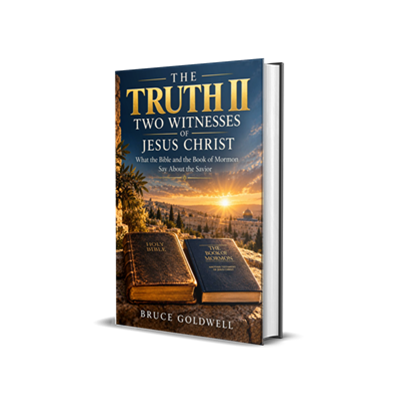
Two Witnesses of Jesus Christ
THE TRUTH II: TWO WITNESSES OF JESUS CHRIST compares what the Bible and the Book of Mormon say about the Savior.
Follow the story from ancient Israel and the descendants of Joseph to prophecies of Christ, His teachings, Crucifixion, Resurrection, the “other sheep,” the gathering of Israel, and the Book of Mormon's central claim that the risen Jesus appeared to another people.
Don't begin by believing it. Begin by examining it.