Book II of THE TRUTH Series

THE TRUTH II

Two Witnesses of Jesus Christ

What the Bible and the Book of Mormon Say About the Savior

What happens when two records, produced by different peoples and claiming to come from different parts of the ancient world, are placed beside one another?

Do they describe different Saviors? Or do they testify of the same Jesus Christ?

THE TRUTH II Two Witnesses of Jesus Christ by Bruce Goldwell

Two Records. One Question.

THE TRUTH II does not begin by asking the reader to accept the Book of Mormon as Scripture.

It begins with a simpler proposition:

Put the records beside one another.

Read what the Bible says about Jesus Christ. Then read what the Book of Mormon claims about Him.

Compare the prophecies. Compare the teachings. Compare the ordinances. Compare the Crucifixion. Compare the Resurrection. Compare the message of salvation.

Then ask whether the two records are describing the same Savior.

Two Witnesses

What if the biblical record were not the only ancient record claiming to testify that Jesus is the Christ?

Why Would God Provide More Than One Witness?

The idea of multiple witnesses is not foreign to the Bible.

Scripture repeatedly uses the principle that important matters may be established through more than one witness.

Christianity itself begins with multiple witnesses.

The New Testament does not contain one Gospel account. It contains Matthew, Mark, Luke, and John.

These accounts overlap, differ in emphasis, preserve different details, and together provide a broader testimony of Jesus Christ.

A Principle Worth Considering

The existence of one witness does not necessarily make another witness unnecessary.

Sometimes another witness strengthens, clarifies, or confirms the first.

That principle does not prove the Book of Mormon is ancient or divinely inspired.

But it does give us a reasonable question to investigate:

If God had another witness of Jesus Christ, would we be willing to examine it?
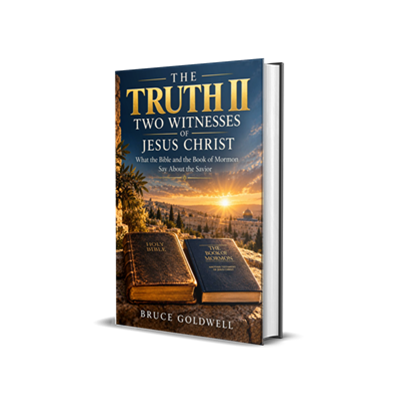
The Bible and the Book of Mormon

The Bible tells the story of God's dealings with people primarily in the ancient Near East and Mediterranean world.

The Book of Mormon makes a very different historical claim.

It presents itself as a record of ancient peoples whose ancestors left Jerusalem and whose descendants lived in another part of the world.

Its central purpose is not hidden.

The record declares that one of its purposes is to convince people that Jesus is the Christ.

The Question Is Not Merely, “Is There Another Book?”

The more important question is:

What does that book actually say about Jesus Christ?

Joseph, Judah, and the Two Records

One of the themes examined in THE TRUTH II begins with the tribes of Israel.

The Bible preserves the history of Judah and also repeatedly speaks about Joseph, Ephraim, Manasseh, and the scattering and eventual gathering of Israel.

Ezekiel 37 contains the famous imagery of two sticks — one associated with Judah and another associated with Joseph.

In its immediate biblical context, the passage concerns the reunification of divided Israel.

Latter-day Saints also understand the passage as having an additional application to two scriptural records: the Bible associated with Judah and the Book of Mormon associated with Joseph.

Text and Interpretation

Does Ezekiel explicitly say “Bible” and “Book of Mormon”?

No.

Is the two-record interpretation worth examining alongside the Book of Mormon's own claims?

That is the question.

Two Records Foretell Jesus Christ

The Bible contains prophecies Christians understand as pointing toward Jesus Christ.

The Book of Mormon likewise presents prophets who speak of Christ before His birth.

It describes His coming, His mission, His Atonement, His death, and His Resurrection.

This creates an important test.

Do the two records present fundamentally different plans of salvation?

Or do both point toward faith in Jesus Christ, repentance, baptism, the Holy Ghost, resurrection, and redemption through the Savior?

THE TRUTH II places these teachings beside one another so the reader can make that comparison.

What Did Jesus Teach?

One of the most striking comparisons occurs between the teachings of Jesus in the New Testament and the teachings attributed to the resurrected Christ in the Book of Mormon.

In the Bible, Jesus teaches His followers about faith, repentance, mercy, righteousness, prayer, love, discipleship, baptism, and the Kingdom of God.

In the Book of Mormon account, the resurrected Jesus teaches many of the same principles to another people.

Portions of the Sermon on the Mount have close parallels in the account of Christ's ministry at Bountiful.

Same Teacher. Same Gospel?

If the Book of Mormon is what it claims to be, should we expect Jesus to teach one gospel in Jerusalem and an entirely different gospel somewhere else?

The comparison allows the reader to examine whether the message remains consistent.

“Other Sheep I Have”

In the Gospel of John, Jesus makes a statement that has generated discussion for centuries:

“And other sheep I have, which are not of this fold: them also I must bring, and they shall hear my voice.” John 10:16

The Gospel of John does not identify those “other sheep” as the people described in the Book of Mormon.

Many Christians understand the statement as referring to the future inclusion of Gentiles.

The Book of Mormon makes a different and much more specific claim.

In 3 Nephi, the resurrected Jesus tells the people He visits that they are among the other sheep of whom He had spoken.

The Evidence-First Question

John gives us the saying.

The Book of Mormon gives us an interpretation of the saying.

Does the second record provide an authentic explanation, or was that explanation created in the nineteenth century?

That question cannot be settled merely by assuming the answer beforehand.

The Crucifixion — Jerusalem and Another People

The New Testament describes the Crucifixion of Jesus outside Jerusalem.

The Book of Mormon does not claim that Jesus was crucified somewhere else.

Instead, it claims that people far from Jerusalem experienced extraordinary events associated with His death.

Darkness, destruction, mourning, and upheaval are followed by an even greater claim:

The risen Christ appears among them.

The Resurrected Christ Appears to Another People

This is the centerpiece of THE TRUTH II.

The New Testament records appearances of the risen Jesus to His followers in the Old World.

The Book of Mormon claims something extraordinary:

Jesus Christ also appeared to a people in another land.

In 3 Nephi, a multitude gathers near a temple. They hear a voice from heaven. Jesus descends and identifies Himself.

He invites the people to come forward individually and examine the wounds in His body.

If This Happened, It Matters.

If 3 Nephi preserves an ancient account, it represents an extraordinary additional witness of the Resurrection of Jesus Christ.

If it does not, then we must explain how and why that account came to exist.

Either possibility deserves investigation.

One by One

One detail in the Book of Mormon account deserves particular attention.

The people do not merely see Jesus from a distance.

According to the record, they approach Him one by one.

They see. They feel. They personally encounter the wounds associated with His Crucifixion.

The scene emphasizes that the Resurrection is not presented as a metaphor or merely a spiritual idea.

The Jesus described in the record is physically risen.

Baptism, the Holy Ghost, and the Sacrament

The comparison continues beyond the Resurrection.

Both records describe baptism.

Both emphasize repentance and faith in Christ.

Both speak of the Holy Ghost.

Both describe a sacred meal involving bread and wine in remembrance of Jesus Christ.

Both describe disciples being sent to teach others.

Compare the Pattern

The question is not whether every detail in the two records is identical.

The question is whether they testify of the same Savior, the same Resurrection, and the same essential gospel.

The Gathering of Israel

The gathering of Israel is a major biblical theme.

The prophets speak repeatedly of scattering, covenant, return, restoration, and gathering.

The Book of Mormon places itself directly inside that story.

Rather than presenting Christianity as detached from Israel, it repeatedly connects Jesus Christ with God's ancient covenants.

That makes the question larger than whether another religious book appeared in the nineteenth century.

The Book of Mormon asks the reader to consider whether God is still fulfilling promises made thousands of years ago.

Why Another Book?

If the Bible already testifies of Jesus Christ, why would another book be necessary?

That question deserves a serious answer.

The Bible itself is not one witness written by one person.

It is a collection of witnesses.

Moses did not make Isaiah unnecessary. Isaiah did not make Matthew unnecessary. Matthew did not make John unnecessary. John did not make Paul unnecessary.

Additional testimony did not necessarily replace previous revelation.

It could add another witness.

What If God Had More to Say?

Would the existence of the Bible require God to remain silent forever afterward?

Another Testament — Not Another Savior

The Book of Mormon does not present another Jesus who competes with the Jesus of the New Testament.

Its central claim is that the Jesus born in Bethlehem, crucified near Jerusalem, and raised from the dead is the same Christ who appears in its pages.

That is why the question of the Book of Mormon ultimately becomes a question about Jesus Christ.

Two records.

Two peoples.

Two witnesses.

One Savior.

Jesus Christ.

Don't Begin by Believing It.

Begin by examining it.

Read the Bible. Read the Book of Mormon. Compare what they say about Jesus Christ.

Study the claims. Consider the competing explanations. Ask questions.

And if you believe God answers prayer, ask Him.

The Truth is the Truth.

Where Does the Investigation Go Next?

Book I began with the Bible and asked what Jesus and His apostles actually taught.

Book II has placed another claimed witness beside that biblical record.

But an even larger question remains.

Billions of people live within religious traditions that understand Jesus very differently.

Christians call Him Savior and Son of God. Muslims honor Him as Messiah and prophet but reject central Christian claims about His divine Sonship. Judaism does not accept Him as the promised Messiah. Others regard Him as a moral teacher, mystic, revolutionary, legend, or symbol.

So Book III asks the question directly:

Who Is Jesus Christ?

What happens when Scripture, history, competing religious claims, and the evidence for the Resurrection are placed on the same table?