Book III of THE TRUTH Series

Who Is Jesus Christ?

Examining the Evidence Across Scripture, History, and Faith

Prophet? Teacher? Messiah? Son of God? Savior?

For nearly two thousand years, people have answered the question of Jesus in dramatically different ways.

THE TRUTH III asks readers to temporarily set aside assumptions and examine the evidence.

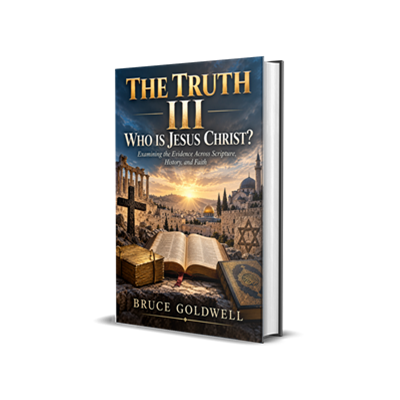
THE TRUTH III Who Is Jesus Christ by Bruce Goldwell

The Man the World Cannot Ignore

Jesus of Nazareth lived roughly two thousand years ago, yet the argument over His identity has never ended.

Christians worship Him as the Christ, the Son of God, and the risen Savior.

Muslims honor Jesus as Messiah and prophet while rejecting central Christian claims about His divine Sonship and Crucifixion.

Judaism does not accept Jesus as the promised Messiah.

Others see Him as a great moral teacher, mystic, revolutionary, religious reformer, legendary figure, or simply one influential man among many.

Those conclusions cannot all describe Jesus in precisely the same way.

So Who Was He?

And perhaps more importantly: Who is He?

Did Jesus Really Exist?

Before asking whether Jesus was the Messiah, Son of God, or Savior, there is a more basic historical question:

Was Jesus of Nazareth a real historical person?

The evidence for Jesus does not depend upon a single document.

The New Testament contains multiple sources about His life, teachings, death, and the beliefs of His earliest followers. Paul’s letters are especially important because several were written within the first generation of Christianity.

Later non-Christian writers also refer to Jesus or to the early Christian movement associated with Him.

Historical investigation cannot establish every theological claim Christians make about Jesus merely by establishing His existence.

But the investigation has to begin somewhere.

The First Question

If Jesus really lived, what can we reasonably know about Him from the earliest available evidence?

Examine the evidence for the historical Jesus →
What Are Our Earliest Sources?

When examining any ancient person, chronology matters.

A source written closer to the events may deserve different consideration from one written centuries later.

But earlier does not automatically mean true. Every source still has to be examined.

Claim → Earliest Evidence → Competing Interpretation → Question

That is one of the methods used throughout THE TRUTH III.

Instead of treating every religious claim as though it arose at the same historical moment, the book asks when the claim appears, what evidence supports it, and what competing explanations exist.

The later the claim, the more important it becomes to compare it with the earlier evidence.

Who Did Jesus Say He Was?

Jesus taught about God, repentance, righteousness, mercy, judgment, eternal life, and the Kingdom of God.

But the Gospel accounts also portray Jesus making extraordinary claims about His own role and authority.

He forgives sins. He speaks with authority. He calls people to follow Him. He describes a unique relationship with the Father. He speaks about judgment and eternal life.

The question therefore becomes larger than whether Jesus was a good teacher.

Teacher — or Something More?

What did Jesus appear to believe about Himself?

Was Jesus the Messiah?

The title “Christ” is not Jesus' last name.

It represents the Greek form of a title associated with the Hebrew idea of the Messiah — the Anointed One.

Christianity claims that Jesus fulfilled Israel's messianic hope.

Judaism generally rejects that conclusion.

This disagreement deserves more than a slogan from either side.

What did Jewish expectations of the Messiah look like before and during the time of Jesus? Which passages do Christians understand as messianic? Why do Jewish interpreters understand many of those passages differently?

A Fair Investigation

It is not enough to say, “Christians believe Jesus fulfilled prophecy.”

We should also ask why many Jews remain unconvinced.

Was Jesus Crucified?

The Crucifixion stands at the center of the Christian story.

The New Testament portrays Jesus as being executed by crucifixion under Roman authority.

The Book of Mormon also explicitly presents Jesus as crucified and risen.

The Qur'an, written centuries later, contains language that Muslims have traditionally understood as denying that Jesus was killed by crucifixion.

These claims cannot simply be blended together.

What Does the Earlier Evidence Say?

When sources disagree about an event, chronology becomes part of the investigation.

THE TRUTH III examines the Bible, the Book of Mormon, the Qur'an, historical evidence, and the competing interpretations surrounding the death of Jesus.

Did Jesus Rise From the Dead?

This may be the most important question in Christianity.

Christianity is not built merely on the claim that Jesus taught wise principles.

Its earliest proclamation centered on something far more extraordinary:

Jesus was crucified — and Jesus rose.

The Resurrection claim did not first appear centuries after Jesus.

It appears within the earliest Christian movement. Paul's letters preserve traditions about Jesus' death, burial, Resurrection, and appearances that were already being proclaimed among the first Christians.

That does not automatically prove that a miracle occurred.

But it makes one explanation difficult to sustain: that the Resurrection was simply a legend invented hundreds of years later.

What If It Really Happened?

If Jesus truly rose from the dead, the question of His identity changes completely.

Examine the Resurrection evidence →

Is Jesus God?

Christianity makes an extraordinary claim about Jesus.

He is not merely one prophet among many.

Christian Scripture gives Jesus titles, authority, honor, and a relationship with the Father that have produced centuries of theological reflection.

Yet Christians themselves have debated how best to describe the relationship between the Father, the Son, and the Holy Spirit.

Islam strongly rejects the idea that God has a divine Son. Judaism likewise rejects Christian claims concerning the divinity of Jesus.

The Question

What do the earliest Christian sources actually say about Jesus?

And how early did Christians begin treating Him as more than an ordinary human teacher?

Explore the evidence concerning Jesus and divinity →

Jesus in Islam

Jesus occupies an important place in Islam.

The Qur'an speaks of Jesus, Mary, miracles, and Jesus as Messiah and messenger of God.

Muslims honor Jesus while rejecting several central Christian conclusions about Him.

That creates both common ground and significant disagreement.

Christianity and Islam can agree that Jesus matters while disagreeing profoundly about who He is.

Rather than caricaturing either faith, THE TRUTH III asks readers to compare the claims and their sources.

Explore Jesus in Islam →

Jesus Beyond Christianity

Jesus has influenced people far beyond the boundaries of traditional Christianity.

Some admire His teachings without accepting Christian theology.

Others interpret Him through philosophical, spiritual, mystical, or ethical frameworks.

Skeptics may accept a historical Jesus while rejecting miracles.

Some question how much of the Gospel portrait can be historically recovered.

These perspectives deserve to be heard.

But they should also face the same evidence test as explicitly religious claims.

What explanation best accounts for the evidence?

What Did Jesus Establish?

If Jesus was the Messiah, what did He leave behind?

The New Testament describes more than a collection of inspirational sayings.

Jesus called apostles. He gave authority. He commanded baptism. He established a community of believers. His apostles ordained others, preached the gospel, administered ordinances, received revelation, and governed the growing Church.

This raises another historical and theological question:

What Happened to the Church Jesus Established?

Did its authority and structure continue unchanged?

Did Christianity evolve while preserving essential authority?

Or was something eventually lost?

Examine the original Church →

Reformation or Restoration?

Centuries after the New Testament period, reformers challenged corruption, doctrine, practice, and ecclesiastical authority.

The Reformation changed Christianity and helped place Scripture into the hands of ordinary people.

But reformation and restoration are not identical ideas.

Reformation seeks to correct something that already exists.

Restoration seeks to return something that has been lost.

If Christ's original authority remained on the earth, reformation may have been sufficient.

But if divine authority had been lost, reading about that authority in Scripture would not necessarily restore it.

That would require God to act.

Examine Reformation and Restoration →

Joseph Smith and the Restoration Claim

In the nineteenth century, a young man named Joseph Smith made an extraordinary claim.

He said God had acted again.

Joseph was not a university-trained theologian. His formal education was limited and intermittent. Yet by age twenty-four, the Book of Mormon had been published.

That book would eventually be read around the world.

Its origin has been debated ever since.

A Question Worth Investigating

How did a young man with limited formal education produce the Book of Mormon — a lengthy religious record filled with narratives, sermons, wars, covenants, prophecies, and testimony of Jesus Christ?

Believers and critics offer very different answers.

THE TRUTH III examines the claim rather than asking readers to accept or dismiss it because of a label.

Why Another Book?

If we already have the Bible, why would God provide another book of Scripture?

That question lies near the heart of the Restoration claim.

The Book of Mormon does not present itself as another Savior.

It presents itself as another witness of the same Savior.

Two records.

Two peoples.

Two witnesses.

One Savior.

Jesus Christ.

That claim was the central investigation of THE TRUTH II.

What If God Still Speaks?

The Bible begins with God speaking.

He speaks to prophets. He sends messengers. He gives commandments. He warns. He teaches. He reveals.

The New Testament continues the same pattern.

So THE TRUTH III eventually reaches a deceptively simple question:

When Did God Stop Speaking?

And who said He did?

Christians answer questions about continuing revelation differently.

Some believe the Bible provides everything necessary and that the foundational age of apostles and prophets ended.

Others believe God can and does continue to call prophets and reveal His will.

The existence of false prophets does not by itself prove that true prophets are impossible.

The biblical response was to test prophetic claims.

Explore the question of continuing revelation →

Don't Prove a Religion.

Don't disprove a religion.

Reveal the evidence.

Examine the earliest sources. Consider competing interpretations. Ask difficult questions.

Where the evidence is strong, say so.

Where the answer is uncertain, be willing to say:

We do not know.

The Truth is the Truth.

Where I Stand

I believe Jesus is the Christ.

I am also a member of The Church of Jesus Christ of Latter-day Saints.

I tell you that openly because readers deserve to know the perspective of the person presenting the evidence.

But my belief is not your evidence.

You should not believe something merely because I believe it.

Examine the sources. Compare the claims. Read the Bible. Read the Book of Mormon if you choose. Study the competing explanations.

And if you believe God answers prayer, ask Him.

Truth should not require us to fear questions.

“Whom Say Ye That I Am?”

Eventually the investigation becomes personal.

Historical evidence can tell us many things. Scripture can preserve testimony. archaeology can illuminate the ancient world. scholars can debate texts and dates. religions can make competing claims.

But Jesus asked His disciples a question that cannot remain forever in the third person.

“But whom say ye that I am?”

My answer is:

Jesus is the Christ.

The Son of the living God.

The Savior of the world.

The risen Lord.

I believe He lives. I believe He calls. I believe He leads. And I believe He still speaks.

Whom say ye that He is?

THE TRUTH III

WHO IS JESUS CHRIST?

Examining the Evidence Across Scripture, History, and Faith

Book III of THE TRUTH Series by Bruce Goldwell.

The Complete Investigation

Book I — THE TRUTH
What Jesus Taught, What His Apostles Revealed, and What the Bible Actually Says

Book II — THE TRUTH II: TWO WITNESSES OF JESUS CHRIST
What the Bible and the Book of Mormon Say About the Savior

Book III — THE TRUTH III: WHO IS JESUS CHRIST?
Examining the Evidence Across Scripture, History, and Faith