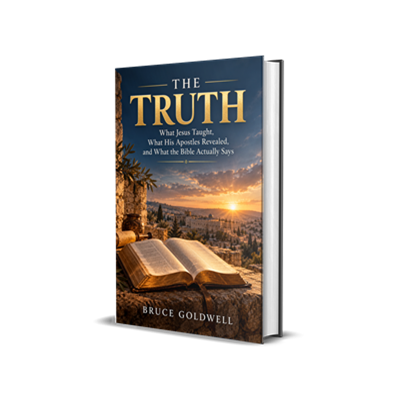
What Jesus Taught, What His Apostles Revealed, and What the Bible Actually Says
What if we temporarily set aside denominations, traditions, creeds, and assumptions and simply asked:
What does the Bible actually say?
THE TRUTH begins there.
Christianity has existed for nearly two thousand years. During that time, churches, denominations, traditions, creeds, and interpretations have multiplied.
But before there were denominations, there was Jesus Christ.
There were apostles.
There was baptism.
There was authority.
There were prophets, teachers, elders, deacons, spiritual gifts, revelation, missionary work, and ordinances.
So THE TRUTH asks a simple question:
Instead of beginning with a modern church and working backward, this book begins with Scripture and works forward.
What did Jesus establish? What did His apostles teach? What practices appear in the earliest Christian record? What happened after the apostles disappeared from history?
And perhaps most importantly:
If something was lost, could it ever be restored?
Jesus did more than deliver sermons.
He called disciples. He selected Twelve Apostles. He gave authority. He sent His servants to teach. He commanded baptism. He instituted the Lord's Supper. He promised the Holy Ghost.
After His Resurrection, the apostles continued leading the growing Church.
When Judas was gone, another apostle was selected. Paul later described apostles, prophets, evangelists, pastors, and teachers as part of the Church.
Were these simply temporary features of first-century Christianity — or were they part of the structure Jesus intended for His Church?
THE TRUTH does not ask the reader to accept an answer merely because a modern denomination teaches it.
It asks the reader to examine the biblical pattern.
Read the New Testament carefully and a recognizable pattern begins to emerge.
Among the elements found in the biblical record are:
None of those items by itself answers which modern church, if any, possesses the same authority as the Church described in the New Testament.
But together they give us something extremely useful:
A biblical standard for comparison.
One of the most important questions in THE TRUTH concerns authority.
In Scripture, people do not simply decide that they possess God's authority.
God calls. Christ commissions. Servants are sent.
Jesus called His apostles and gave them authority. The apostles ordained others. The laying on of hands appears repeatedly in the New Testament.
Owning a law book does not make someone a judge.
Reading the Bible tells us what the apostles did. But does reading about their authority automatically give that authority to the reader?
That question becomes increasingly important when we examine what happened after the original apostles were gone.
Some of the most fascinating passages in the Bible concern the period between the Crucifixion and the Resurrection.
Jesus told the thief beside Him that they would be together in Paradise.
Yet after His Resurrection, Jesus told Mary that He had not yet ascended to His Father.
Peter later wrote about Christ preaching to spirits in prison and referred to the gospel being preached to the dead.
If Jesus had not yet ascended to His Father, but had been in Paradise, what exactly did the biblical writers mean by Paradise?
These passages raise questions about death, the spirit world, judgment, resurrection, and what happens between death and the final Resurrection.
THE TRUTH examines those passages without requiring the reader to begin with a predetermined theological system.
One of the more unusual statements in the New Testament appears in Paul's first letter to the Corinthians.
While defending the reality of the Resurrection, Paul refers to people being baptized for the dead.
Christians have debated the meaning of this passage for centuries.
The important first step is not deciding which modern interpretation is correct.
The first step is acknowledging that the passage exists.
Why would baptism for the dead appear in an argument about the Resurrection?
THE TRUTH places this passage beside other New Testament teachings about baptism, the dead, Paradise, resurrection, and salvation and invites the reader to consider the evidence.
Christianity did not disappear when the original apostles died.
Believers remained. Bishops led congregations. Christians preserved writings, practiced baptism, celebrated the Eucharist, preached Christ, endured persecution, and in many cases died rather than deny their faith.
Those facts matter.
But another question also matters:
Was everything Jesus originally established still present?
Christians answer that question differently.
Catholic and Orthodox traditions maintain forms of apostolic continuity. Protestant traditions generally emphasize Scripture and the gospel rather than the necessity of an unbroken institutional structure.
The Restoration claim presents another possibility: that important truths survived, but divine authority and elements of the original organization eventually required restoration from God.
THE TRUTH examines the evidence without pretending that centuries of Christian history can be reduced to a slogan.
In Acts, Peter spoke of a future time involving the “restitution of all things.”
Christians interpret that language in different ways. Many understand it in connection with the ultimate renewal associated with Christ's return.
The Restoration tradition reads the passage more broadly, seeing in it the recovery of truths, authority, ordinances, and divine organization before the return of Christ.
The verse by itself does not settle the debate.
But it does introduce a powerful biblical idea:
If God intended a restitution of all things, what exactly needed to be restored?
Open the Bible.
Read the passages.
Compare the claims.
Ask the questions.
Decide what you believe.
The Truth is the Truth.
THE TRUTH begins with the Bible.
Book II asks what happens when another record claiming to testify of Jesus Christ is placed beside the biblical witness.
Book III expands the investigation even further — examining Jesus across Scripture, history, Christianity, Judaism, Islam, skepticism, the Resurrection, and the Restoration claim.
Book I: What does the Bible actually say?
Book II: What happens when two witnesses testify of Jesus Christ?
Book III: Who is Jesus Christ?