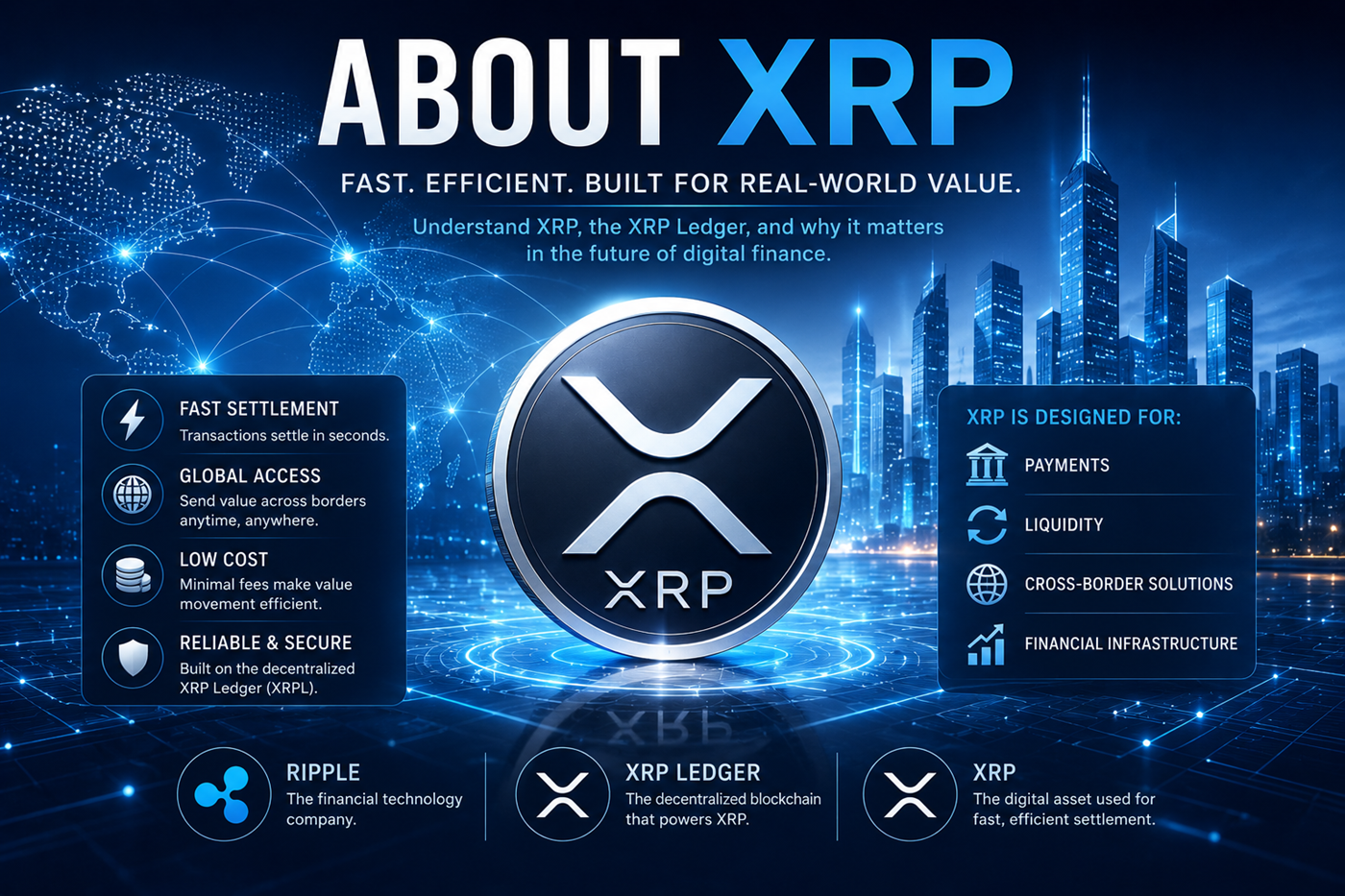
XRP is one of the most discussed digital assets in cryptocurrency because it was designed with a practical purpose: fast, low-cost movement of value. Instead of focusing only on hype or price predictions, the best way to understand XRP is to begin with its purpose, its technology, and its role in digital finance.
This page gives you a broad overview of XRP, how it connects to the XRP Ledger, how it differs from Ripple, and why many investors, researchers, and financial technology observers continue to study it.
XRP was designed to help move value quickly and efficiently across a digital ledger. It is often discussed in connection with payments, settlement, liquidity, cross-border transfers, and financial infrastructure.
Many cryptocurrencies are built around different goals. Bitcoin is commonly associated with digital scarcity. Ethereum is commonly associated with smart contracts and decentralized applications. XRP is most commonly associated with fast settlement and efficient value movement.
XRP is the native digital asset of the XRP Ledger. It can be sent, received, held, and used within the XRP ecosystem.
What Is XRP?Ripple is a financial technology company that builds payment and digital finance solutions. Ripple is not the same thing as XRP.
Ripple vs XRPThe XRP Ledger, or XRPL, is the public blockchain network where XRP transactions are recorded and settled.
XRPL ExplainedXRP transactions are signed, submitted to the ledger, validated, recorded, and settled quickly.
How XRP WorksXRP is known for fast settlement compared with many traditional payment systems.
XRP transaction costs are typically very small, supporting efficient value transfer.
The XRP Ledger can be accessed globally and operates outside traditional banking hours.
XRP is often studied as a possible bridge asset for moving value between currencies and systems.
Buying XRP does not mean owning shares of Ripple. XRP is a digital asset, not company equity.
Bitcoin and XRP have different designs, purposes, supply structures, and narratives.
XRP can rise or fall in value. Like all crypto assets, it carries risk and should be studied carefully.
Price matters to investors, but real understanding also includes technology, utility, liquidity, market structure, and risk.
Understanding XRP's purpose is the first step toward understanding its value discussion. Valuation is not just about guessing future prices. It involves studying market cap, supply, demand, liquidity, utility, regulation, adoption, and speculation.
That is why the XRP Knowledge Center connects directly with the XRP Valuation Hub. The Knowledge Center explains what XRP is. The Valuation Hub explores how people think about what XRP may be worth.
XRP is best understood as a digital asset built for fast, low-cost value movement on the XRP Ledger. Before focusing on price predictions, learn the difference between XRP, Ripple, and XRPL, then study wallets, storage, liquidity, utility, and valuation.
Follow the best learning path for building XRP understanding step by step.
Start GuideA beginner-friendly guide to XRP, Ripple, XRPL, wallets, and digital finance.
View BookLearn about liquidity, settlement efficiency, and XRP multiplier ideas.
View BookA balanced look at XRP valuation, hype, liquidity, risk, and expectations.
View Book