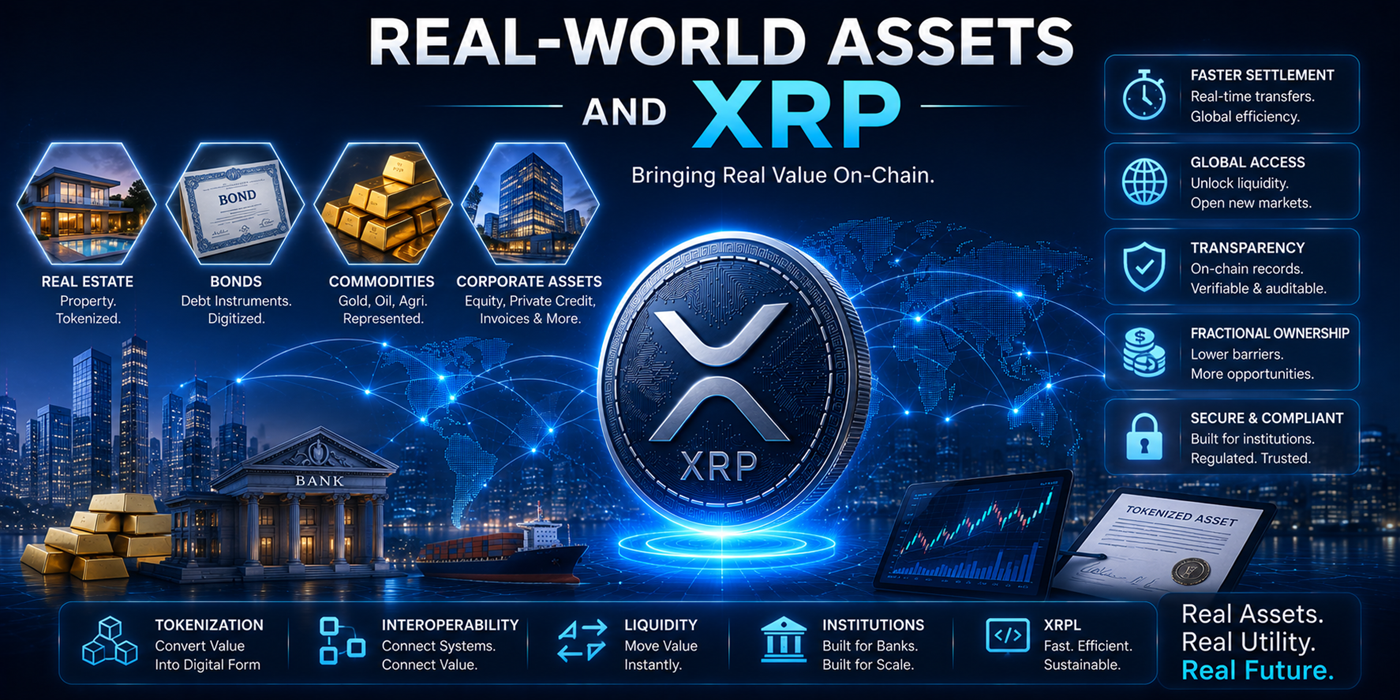
Real-world assets, often shortened to RWAs, are assets from the traditional economy that may be represented digitally on a blockchain or distributed ledger. These can include real estate, bonds, commodities, invoices, funds, private credit, and other forms of value.
XRP and the XRP Ledger enter the RWA conversation because tokenized assets still need digital infrastructure, liquidity, settlement, compliance, and reliable ways for value to move.
A real-world asset is something that has value outside the blockchain world. Tokenization creates a digital representation of that value. The token may represent ownership, a claim, a share, a receipt, a right, or another form of financial interest.
The goal is not simply to put everything on a blockchain. The deeper goal is to make assets easier to issue, verify, transfer, settle, and manage through digital infrastructure.
Property value may be represented digitally, potentially supporting fractional ownership, transfer records, or new investment structures.
Government or corporate debt instruments may be tokenized to improve issuance, settlement, reporting, and market access.
Gold, energy, agricultural products, or other physical assets may be represented by digital tokens connected to real-world reserves or claims.
Loans, invoices, receivables, or credit instruments may become part of tokenized finance when structured with proper legal and compliance frameworks.
RWAs connect the existing financial world with blockchain infrastructure, creating a bridge between old systems and digital asset networks.
Some assets are hard to trade quickly. Tokenization may improve liquidity if markets, regulation, demand, custody, and trust develop properly.
Digital rails may reduce settlement delays for certain asset types when supported by strong infrastructure and legal clarity.
Institutions are interested in RWAs because they connect blockchain technology to familiar financial assets and existing markets.
XRP is not the same thing as a real-world asset. XRP is a digital asset. RWAs are traditional assets represented digitally. The connection is infrastructure: tokenized assets require fast settlement, liquidity, exchanges, custody, compliance, and reliable value movement.
The XRP Ledger may be studied as a digital network that can support issued assets and value movement. XRP may be studied as part of the broader liquidity and settlement discussion around future financial rails.
A strong RWA project begins with clarity about the underlying asset, ownership rights, issuer, custody, legal claim, and market purpose.
Tokenization depends on trust. Someone must verify the asset, maintain records, manage custody, and ensure the token reflects a legitimate claim.
Tokenization does not automatically create buyers and sellers. Real liquidity depends on market demand, access, compliance, infrastructure, and confidence.
A tokenized asset must be supported by legal rights, contracts, custody arrangements, regulation, and investor protections.
| Topic | Traditional Asset | Tokenized Asset |
|---|---|---|
| Ownership Record | Maintained by institutions, registries, custodians, or private records. | May be represented and tracked digitally on a blockchain or ledger. |
| Transfer | May require paperwork, intermediaries, settlement periods, or manual review. | May move through digital rails with faster processing when properly structured. |
| Access | Often limited by geography, investor status, minimum size, or market structure. | May expand access through fractional units and digital platforms. |
| Risk | Includes market, legal, custody, counterparty, and liquidity risk. | Includes all traditional risks plus smart contract, platform, custody, and technology risk. |
Putting an asset on digital rails does not remove market risk, legal risk, custody risk, or bad project design.
Tokenization can improve transferability, but active buyers, sellers, platforms, and trust are still needed.
A token is only as strong as the underlying asset, legal claim, issuer, custody, and demand supporting it.
RWAs need compliant systems, identity checks, custody, reporting, settlement, and market access before they can grow at scale.
Learn the broader process of turning value into digital tokens.
Explore a major category of tokenized value used in digital finance.
Study how institutions may shape real-world asset adoption.
Understand the XRP Ledger and its role in digital asset movement.
Explores institutions, liquidity, and how digital finance may evolve.
Connects ISO 20022, XRP, and future financial infrastructure.
A future-focused look at digital money becoming real money.
A grounded guide to valuation, risk, utility, and realistic thinking.
RWAs matter because they connect blockchain technology to existing markets. XRP and XRPL belong to the larger discussion because tokenized finance still needs speed, liquidity, settlement, compliance, and trusted infrastructure.