Begin With the Historical Question
For billions of Christians, the existence of Jesus is not seriously in doubt.
But someone investigating Christianity does not have to begin by accepting Christian belief.
We can begin with history.
Was there actually a Jewish teacher named Jesus who lived in the first century, gathered followers, and was executed under Roman authority?
That question is different from asking whether Jesus performed miracles, whether He was the Messiah, or whether He rose from the dead.
Those are additional claims requiring additional investigation.
The First Question
Before asking whether Jesus was divine, we can ask whether Jesus was real.
What Kind of Evidence Should We Expect?
Jesus lived in the ancient world.
We should therefore be careful not to demand the kinds of evidence we would expect for someone living today.
There were no photographs, video recordings, birth certificates, social-media accounts, or electronic government databases.
For ancient people, historians work primarily with written sources, archaeology, inscriptions, coins, manuscripts, and the testimony preserved by later writers.
The amount of surviving evidence varies enormously depending on who the person was.
Kings, emperors, military commanders, and wealthy officials were more likely to leave extensive records than ordinary people living in distant provinces of the Roman Empire.
Jesus was not a Roman emperor.
He was a Jewish teacher from Galilee whose public ministry appears to have lasted only a few years.
The historical question therefore becomes:
What Evidence Survived?
How early is it?
How independent is it?
What does it actually tell us?
And what conclusions can reasonably be drawn from it?
Paul's Letters Are Among Our Earliest Christian Sources
When people think about evidence for Jesus, they often begin with Matthew, Mark, Luke, and John.
But some of the earliest surviving Christian writings are actually letters attributed to the Apostle Paul.
Several Pauline letters are widely regarded by scholars as authentic first-century writings composed before the Gospels reached their final written forms.
That matters because Paul is already writing about Jesus within the first generations of the Christian movement.
Paul identifies Jesus as a real person who had lived and died.
He refers to Jesus as being born, having disciples, being crucified, dying, being buried, and being raised.
Paul also refers to people associated with Jesus, including Peter and James.
In Galatians, Paul describes meeting James, whom he calls “the Lord's brother.”
Why Paul Matters
Paul does not write as though Jesus were a mythical figure from a distant age.
He describes interactions with people who belonged to the earliest Christian movement and who were connected directly with Jesus.
An Early Resurrection Tradition
One of the most important passages appears in Paul's first letter to the Corinthians.
Paul reminds his readers of a tradition he says he had previously received and passed on to them.
The tradition concerns Christ's death, burial, Resurrection, and appearances to witnesses.
Scholars have long noted that the wording appears to preserve material Paul himself received rather than invented.
The exact date when this tradition first took shape is debated, but its presence in an early Pauline letter demonstrates something important.
Belief in the death and Resurrection of Jesus was already central to Christianity very early in the movement.
That does not by itself prove the Resurrection occurred.
It does, however, make it difficult to argue that belief in a risen Jesus first appeared centuries later.
What About the Four Gospels?
The New Testament contains four narrative accounts of the life, ministry, death, and Resurrection of Jesus: Matthew, Mark, Luke, and John.
They are religious documents.
Their authors want readers to believe something about Jesus.
That does not automatically make them historically worthless.
Ancient historical sources frequently had purposes, viewpoints, political interests, or religious commitments.
The historian's job is not to discard a source because its author believed something.
The task is to examine the source critically.
Belief Does Not Automatically Equal Falsehood
A writer having a reason for telling a story does not, by itself, prove that the story is false.
The Gospels contain overlapping material, different emphases, and differences in detail.
Those differences create questions that deserve investigation, but the four accounts also share a recognizable core story.
Jesus teaches in first-century Judea and Galilee.
He gathers followers.
He becomes known as a teacher and miracle worker.
He encounters opposition.
He goes to Jerusalem.
He is crucified.
His followers subsequently proclaim that He has risen.
What Did Josephus Say About Jesus?
Flavius Josephus was a first-century Jewish historian.
His writings are important because Josephus was not a Christian Gospel writer.
One passage in his work Antiquities of the Jews refers to Jesus.
The wording of that passage has been debated because surviving manuscripts contain language many scholars believe was modified by later Christian copyists.
That means the passage should not simply be quoted as though every word unquestionably came from Josephus.
At the same time, many scholars conclude that the passage contains an authentic underlying reference to Jesus that was later altered.
There is also another passage in Josephus concerning the death of James.
Josephus identifies James in relation to:
That shorter reference is generally considered less controversial.
Why Josephus Matters
Josephus provides a non-New Testament Jewish source from the first century that refers to Jesus and to James.
What Did Tacitus Say?
Another important non-Christian reference comes from the Roman historian Tacitus.
Writing in the early second century, Tacitus discusses the persecution of Christians under the emperor Nero.
He explains that the name Christian came from Christus, who had suffered the death penalty during the reign of Tiberius at the hands of Pontius Pilate.
Tacitus was not writing to promote Christianity.
His comments about Christians are hostile.
That makes the reference especially interesting.
What Tacitus Supports
A movement known as Christianity existed in the first century.
The movement took its name from Christ.
Its founder had been executed during the period associated with Pontius Pilate.
Pliny and the Early Christians
Another Roman writer, Pliny the Younger, wrote to Emperor Trajan in the early second century asking how Christians should be handled.
Pliny's letter is not a biography of Jesus.
But it provides independent evidence that Christianity had spread far enough by that time to become an administrative concern for Roman officials.
He describes Christians gathering and singing hymns to Christ.
This tells us something about how early Christians regarded Jesus, even though it does not provide details about Jesus' earthly life.
Other Ancient References
Other ancient writers are sometimes brought into the discussion, including Suetonius and later Jewish sources.
These references vary greatly in their usefulness.
Some are ambiguous.
Some are late.
Some may reflect what Christians themselves were already saying.
An evidence-first investigation should not pretend that every possible reference carries equal weight.
Strong evidence does not become stronger by adding weak evidence to the pile.
Use the Best Evidence First
The goal is not to collect the largest possible number of references.
The goal is to determine what the strongest sources reasonably establish.
Why Don't We Have a Roman File on Jesus?
A common objection asks why we do not possess an official Roman record created during Jesus' lifetime documenting His ministry or Crucifixion.
It is a reasonable question.
But the absence of such a surviving document is not especially surprising.
The Roman Empire was enormous.
Jesus spent most of His life in a relatively small region on the edge of that empire.
From Rome's perspective at the time, the execution of a Jewish religious figure in Judea would not necessarily have appeared to be an event of worldwide importance.
Even if administrative records once existed, surviving records from antiquity represent only a fraction of everything that was originally written.
The fact that a document did not survive is not the same as evidence that the event never occurred.
Does Archaeology Prove Jesus Existed?
Archaeology has helped illuminate the world described in the New Testament.
It can tell us about first-century settlements, Jewish religious practices, Roman government, crucifixion, burial customs, architecture, roads, coins, inscriptions, and many of the places associated with the Gospel narratives.
Archaeological discoveries have also confirmed the historical existence of some people mentioned in the New Testament world, including Pontius Pilate.
But archaeology has not produced an artifact that can simply be labeled “proof that Jesus existed.”
That distinction matters.
What Archaeology Can Do
Archaeology can test the historical setting in which the Gospel story is placed.
It cannot, by itself, prove every event described in the Gospels.
Could Jesus Have Been Entirely Mythical?
Some modern writers have argued that Jesus never existed at all and that Christianity developed around a mythical or symbolic figure.
This position is often called Jesus mythicism.
The theory attracts attention because Christianity certainly developed theological interpretations of Jesus.
But saying that stories about a person acquired theological meaning is not the same as demonstrating that the person never existed.
The historical evidence creates several problems for the idea of a completely invented Jesus.
Paul writes relatively early and refers to people connected with Jesus.
Multiple Gospel traditions place Jesus in a specific first-century Jewish environment.
Josephus refers to Jesus in connection with James.
Tacitus connects Christus with execution under Pontius Pilate.
And a movement centered on Jesus appears remarkably early.
Which Explanation Requires Fewer Assumptions?
That a Jewish teacher named Jesus actually lived and became the center of the Christian movement?
Or that the movement invented Him entirely and nevertheless placed Him among identifiable people, locations, rulers, relatives, and followers within recent memory?
What Do Historians Generally Conclude?
Historical scholarship contains enormous disagreement about Jesus.
Scholars disagree about how individual Gospel passages should be interpreted.
They disagree about miracles.
They disagree about what sayings can confidently be attributed to Jesus.
They disagree about theology.
They disagree, most importantly, about what happened after the Crucifixion.
But the view that Jesus of Nazareth existed as a historical person is widely accepted among scholars who study the period, including many who do not accept Christian theological claims.
That distinction is important.
A historian does not have to believe Jesus was the Son of God in order to conclude that Jesus existed.
A Reasonable Historical Starting Point
Jesus of Nazareth was a first-century Jewish teacher.
He gathered followers.
He became the center of a religious movement.
He was crucified during the period of Roman rule associated with Pontius Pilate.
His followers soon proclaimed that He had risen from the dead.
History Can Take Us Only So Far
Establishing that Jesus existed does not establish every claim Christianity makes about Him.
That would be moving too quickly.
History can give us a foundation.
Then the investigation has to continue.
Did Jesus really say the things attributed to Him?
Did He perform miracles?
Was He the Messiah?
Was He the Son of God?
Was He crucified?
And above all:
Did He rise from the dead?
The Investigation Changes at the Empty Tomb
If Jesus lived and died, He joins countless other figures from ancient history.
But Christianity makes a claim that changes the entire investigation.
His followers said He did not remain dead.
They said they saw Him alive.
They proclaimed His Resurrection publicly.
And the movement they began changed history.
The Next Question
If Jesus really existed and really was crucified, what happened next?
Continue: Did Jesus Rise From the Dead? →
Follow the Evidence
The purpose of this investigation is not to begin with the conclusion.
It is to ask the questions in order.
Claim: Jesus existed.
Evidence: Early Christian writings, multiple Gospel traditions, references to people associated with Jesus, and later non-Christian historical sources.
Competing interpretation: Jesus was entirely mythical or constructed by the early Christian movement.
Question: Which explanation best accounts for the surviving evidence?
The historical evidence gives us good reason to begin with Jesus as a real person.
But that is only the beginning.
Jesus Existed. But Who Was He?
A Jewish teacher?
A prophet?
The Messiah?
The Son of God?
The Savior of the world?
Those are much larger questions.
And they are exactly where the investigation goes next.
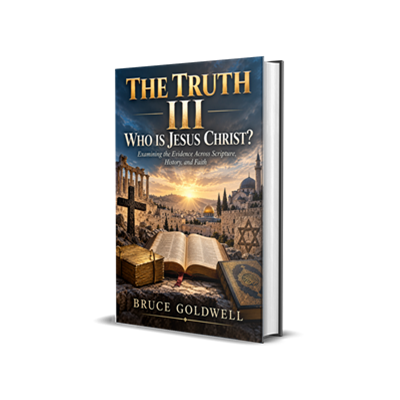
Continue the Investigation
THE TRUTH III: WHO IS JESUS CHRIST? examines the evidence across Scripture, history, and faith.
The investigation goes beyond whether Jesus existed to examine His identity, the Messiah prophecies, the Crucifixion, the Resurrection, Jesus in Judaism and Islam, the claims of Christianity, and the question of whether God still speaks.
The goal is not to tell you what you must believe.
Put the evidence on the table. Ask the questions. Decide what you believe.