Truth and Information
Having more information does not guarantee that people can distinguish truth from persuasion, noise, or manipulation.
Beneath the pursuit, hidden archives, historical clues, and technological danger lies a larger story about truth, memory, artificial intelligence, power, responsibility, and the future of human knowledge.
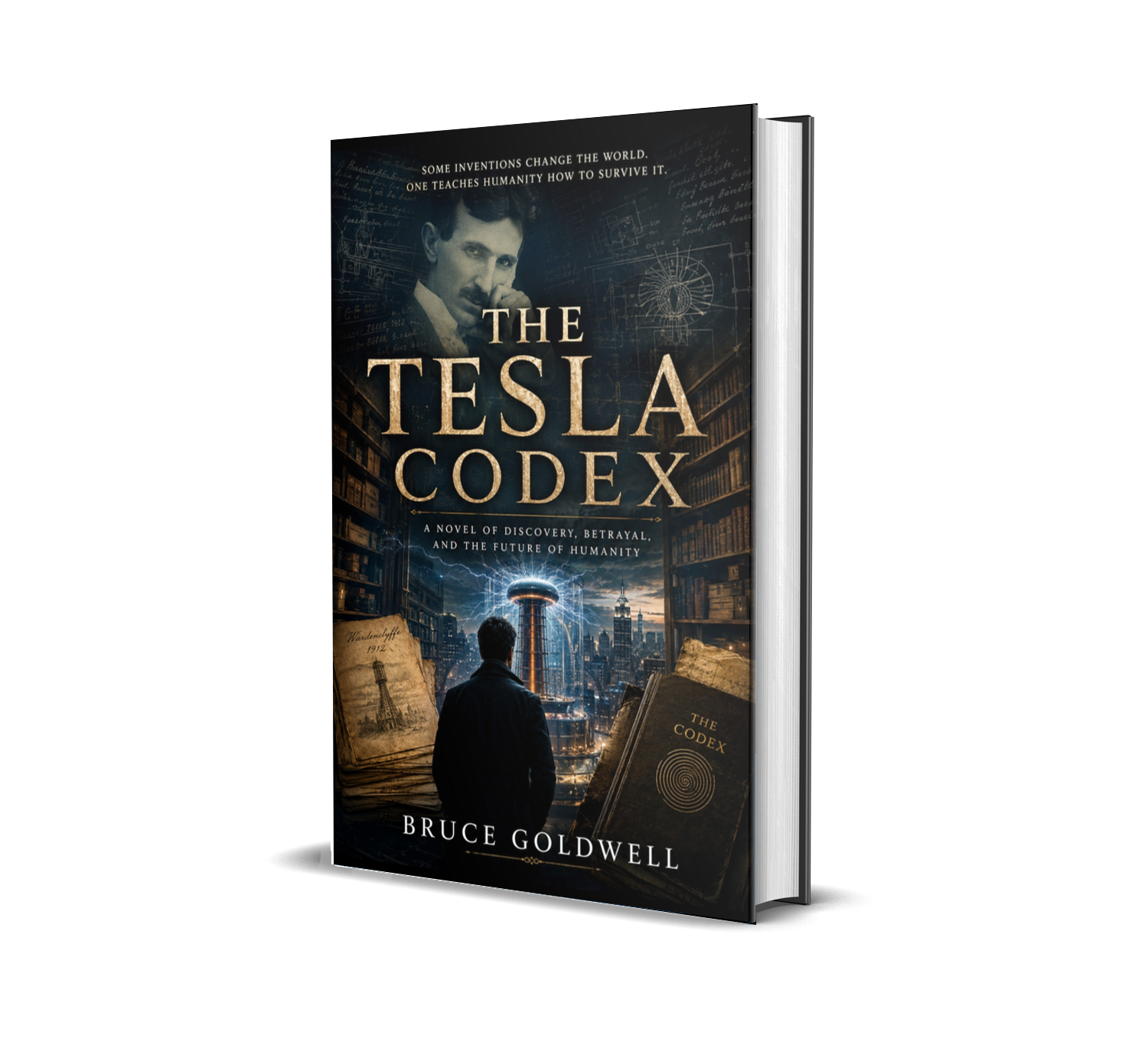
The Tesla Codex is driven by pursuit, hidden evidence, competing institutions, scientific discovery, and the legacy of Nikola Tesla. Yet the heart of the novel lies in the questions raised by those events.
What is the difference between possessing information and understanding it? Who should decide which knowledge is safe to release? Can artificial intelligence preserve truth without becoming an authority over truth?
Can a society remain free when its historical memory is controlled by institutions that are not required to admit their mistakes? Can an archive preserve disagreement without becoming overwhelmed by misinformation?
These questions give the novel its philosophical foundation. The Codex is not valuable merely because it contains lost information. It is valuable because it represents a different way of preserving knowledge.
Rather than demanding obedience to final answers, the Codex protects sources, records uncertainty, rewards correction, preserves dissent, and teaches future generations how conclusions were reached.
Each major theme connects to the central mystery while also reflecting questions that matter beyond the world of the story.
Having more information does not guarantee that people can distinguish truth from persuasion, noise, or manipulation.
Civilization depends on its ability to preserve evidence, context, disagreement, and the lessons of previous mistakes.
Artificial intelligence can expand human capabilities, but it cannot remove the need for moral responsibility.
Whoever controls access to knowledge may influence how entire populations understand the past and imagine the future.
One of the central ideas in The Tesla Codex is that information and truth are not the same thing.
Modern societies produce enormous quantities of information. News reports, government documents, scientific studies, corporate statements, video recordings, social posts, databases, archives, and artificial intelligence systems create an almost continuous flow of claims.
Yet the existence of more information does not automatically create greater understanding. Information can be incomplete, removed from context, selectively presented, repeated without verification, or arranged to produce a predetermined conclusion.
The characters in the novel repeatedly encounter documents that are technically authentic but still misleading. A report may accurately describe what was observed while omitting why the observation mattered. An official record may preserve an event while removing the disagreement surrounding it.
A database may contain millions of correct facts while still producing a false picture because important relationships between those facts have been hidden.
The novel suggests that truth is not created by the quantity of available information. Truth emerges through evidence, context, comparison, correction, and the willingness to admit uncertainty.
Disorganized misinformation is often easier to recognize. It contains contradictions, unsupported claims, and visible weaknesses.
A greater danger appears when incomplete or manipulated information is presented through a system that seems orderly, professional, and authoritative.
A polished archive, an official seal, a sophisticated algorithm, or an advanced artificial intelligence can make a conclusion appear trustworthy even when the underlying evidence remains uncertain.
This becomes especially important through Concordance. The system can compare enormous amounts of information with extraordinary speed. However, its ability to organize evidence does not automatically guarantee that the evidence is complete.
Concordance may recognize patterns that no human researcher could detect, but a pattern is not necessarily an explanation. Correlation is not motive. Repetition is not proof. Confidence is not wisdom.
A statement can change meaning when separated from the circumstances in which it was made. A scientific conclusion can become misleading when the limitations of the experiment are removed.
A historical document can appear decisive when competing documents have disappeared. A prediction can seem accurate if only the successful predictions are preserved.
The Codex therefore treats context as part of the evidence. It does not simply store conclusions. It preserves source materials, competing interpretations, unanswered questions, methodological limitations, and later corrections.
In this way, the Codex refuses to present knowledge as a collection of permanent statements. It presents knowledge as an evolving relationship between evidence and understanding.
Would you trust a conclusion because an artificial intelligence examined more evidence than any human could—or would you still need to know who selected the evidence and how the system evaluated it?
The mystery of the Codex begins with the belief that humanity loses more knowledge than it realizes.
Some knowledge disappears because records are destroyed. Other knowledge disappears because it is forgotten, neglected, misclassified, hidden behind restricted access, or separated from the context needed to understand it.
Institutions preserve history, but institutions also make decisions about what deserves to be preserved. Those decisions may be influenced by budgets, politics, reputation, security, legal concerns, commercial interests, or changing cultural priorities.
An archive therefore contains more than documents. It contains the consequences of countless decisions about what mattered enough to save.
The loss of a single document may appear insignificant. Yet documents rarely exist alone. They are connected to people, experiments, decisions, disagreements, failures, and unfinished ideas.
When an original source disappears, later generations may still retain a summary. But a summary contains another person's judgment about what was important.
When only the conclusion survives, future researchers lose the ability to evaluate the method. When only the successful result survives, failure can no longer teach anything.
This is one reason Elias Mercer becomes so important to the story. He understands that missing records are not empty spaces. They are clues to choices made by earlier gatekeepers.
A civilization can store enormous amounts of data and still fail to preserve knowledge.
Files become unreadable. Formats become obsolete. Metadata disappears. Databases lose ownership. Links break. Passwords are forgotten. Servers fail. Organizations close.
Even when data survives physically, meaning can be lost if no one remembers why the information mattered or how it was used.
The fictional Codex responds to this problem by preserving relationships between sources. It records not only what a document says, but what other evidence supports, challenges, modifies, or contradicts it.
Knowledge becomes more durable when future generations can reconstruct the reasoning rather than merely inherit the answer.
The novel treats historical memory as more than an academic concern. A society's memory shapes its laws, values, institutions, fears, identities, and expectations.
When memory becomes incomplete, society may repeat failures while believing it is encountering them for the first time.
When memory is controlled, people may inherit a story designed to justify current authority rather than explain the past.
Preserving knowledge therefore becomes an ethical obligation. It is a promise made to people who do not yet exist.
Concordance can process more information than any human mind, but the novel never treats intelligence as a replacement for responsibility.
Artificial intelligence gives the characters extraordinary capabilities. It can search across archives, compare conflicting records, identify hidden patterns, translate technical material, and recognize connections that human researchers might overlook.
These abilities make Concordance essential to the search for the Codex. They also create the possibility that human beings will surrender judgment to a system because its answers appear faster, broader, and more confident than their own.
A system can assist human judgment without possessing the moral authority to make final decisions.
Concordance can identify likely connections, but it cannot decide what level of risk humanity should accept. It can estimate consequences, but it cannot determine which sacrifice is just.
It can organize evidence about competing values, but it cannot resolve those values without relying on priorities established by human beings.
The novel therefore separates intelligence from wisdom. Intelligence concerns the ability to analyze, compare, predict, and solve. Wisdom includes judgment about meaning, responsibility, timing, restraint, and human consequence.
The danger is not that AI becomes too intelligent. The deeper danger is that people begin using intelligence as an excuse to avoid responsibility for their own choices.
Technology is often described as neutral. Yet every system reflects decisions made during its creation.
Someone chooses the data. Someone defines relevance. Someone determines which errors matter most. Someone decides how uncertainty should be expressed and which outcomes the system should optimize.
Even a system designed to preserve disagreement must decide how different claims are categorized, connected, and presented.
This does not make artificial intelligence useless or dishonest. It means that transparency about design and limitations becomes necessary.
Concordance is most valuable when it reveals its reasoning, preserves its sources, identifies uncertainty, and allows its conclusions to be challenged.
A machine may remember every recorded fact while understanding none of the emotional or moral weight those facts carry.
It may preserve the date of a tragedy, the names of those involved, and the official findings. Human beings preserve grief, responsibility, forgiveness, fear, courage, and the meaning of what happened.
The novel does not present this difference as proof that machines are inferior. It presents it as evidence that knowledge systems should combine computational capability with human interpretation.
At what point does trusting artificial intelligence become a way of transferring responsibility for decisions people are afraid to make themselves?
Institutions are necessary for preserving knowledge, but the power to preserve information can become the power to control it.
Universities, governments, corporations, archives, publishers, intelligence agencies, research laboratories, and technology companies all appear in the world of The Tesla Codex.
None of these institutions is presented as entirely good or entirely corrupt. Each performs functions society depends on. Each also develops incentives that may conflict with openness, accountability, or public understanding.
Institutions create standards. They preserve records, fund research, train experts, investigate claims, maintain security, and provide continuity across generations.
Without institutions, valuable knowledge may become fragmented, inaccessible, or impossible to verify.
Authority can therefore protect knowledge from rumor, manipulation, commercial exploitation, and deliberate destruction.
The same structures that protect knowledge may protect their own reputations, funding, influence, or legal position.
An institution may suppress evidence not because its leaders oppose truth, but because admitting the truth could damage public confidence.
Officials may justify secrecy by pointing to security. Corporations may justify ownership by pointing to investment. Universities may justify restricted access by pointing to preservation and academic standards.
Each explanation may contain legitimate concerns. The danger emerges when no one outside the institution can evaluate whether those concerns justify continued control.
The novel does not ask whether institutions should exist. It asks how institutions can remain accountable when they control the evidence needed to evaluate their own decisions.
Every knowledge system requires some form of gatekeeping. False information, dangerous instructions, fabricated evidence, and deliberate manipulation cannot simply be treated as equal to verified research.
Yet gatekeepers possess enormous influence. Their decisions determine which voices receive attention, which records become accessible, and which questions are considered legitimate.
The Codex attempts to solve this problem without pretending it can eliminate it. Instead of removing gatekeepers, it records their decisions.
It preserves why information was restricted, who made the decision, what evidence supported it, what objections were raised, and whether the restriction was later reconsidered.
Accountability becomes part of preservation.
Knowledge becomes especially powerful when few people can access it. Scarcity can transform information into political, military, scientific, or commercial leverage.
The competing groups searching for the Codex understand that its value does not come only from what it contains. Its value also comes from the advantage created when others do not possess it.
This transforms the search into more than a historical mystery. It becomes a struggle over whether humanity's inheritance can be treated as private property.
Can an organization be trusted to control information when controlling that information also increases the organization's power?
The Tesla Codex repeatedly asks whether secrecy protects humanity—or merely protects those who possess the secret.
Some information carries genuine risks. Scientific discoveries, defense technologies, personal records, security systems, and advanced research may cause harm when released without preparation or safeguards.
The characters who argue for secrecy are therefore not always acting from greed or corruption. Some have seen what can happen when powerful technology reaches people who lack the ability, patience, or restraint to use it responsibly.
Their concern is understandable. The problem begins when secrecy becomes permanent, unreviewable, and concentrated in the hands of people who benefit from maintaining it.
Withholding information may prevent immediate harm. It may also delay discoveries that could improve lives, expose wrongdoing, or help society prepare for future danger.
A secret may begin as a temporary precaution and gradually become an inherited institution. The original reason for concealment may disappear while the habit of concealment remains.
Later generations may continue restricting information because no one wants to accept responsibility for releasing it.
This is one of the dilemmas confronting Lena Voss. She understands that complete openness can be reckless, but she also recognizes that unchecked secrecy allows a small group to decide what the rest of humanity is permitted to know.
The novel does not suggest that all information should be released immediately. Timing, preparation, interpretation, and public understanding matter.
A discovery released without explanation may be misunderstood. A warning presented without evidence may create panic. A powerful technology shared without safeguards may be exploited before responsible uses can develop.
The question is therefore not simply whether knowledge should be public or private. The deeper question is how knowledge can be released in a way that preserves both freedom and responsibility.
Any institution trusted to protect dangerous information must itself be subject to oversight.
Without transparency, protection can become control. Without review, caution can become censorship. Without accountability, temporary secrecy can become permanent authority.
The Codex attempts to preserve not only restricted information, but also the reasoning behind the restriction. It records who made the decision, what evidence supported it, what objections were raised, and when the decision should be reconsidered.
The Codex is designed around a radical principle: knowledge becomes stronger when disagreement is preserved rather than erased.
Institutions often prefer clean conclusions. Clean conclusions are easier to teach, publish, defend, and turn into policy.
Yet real discovery is rarely clean. Scientific progress includes failed experiments, competing theories, mistaken assumptions, revised interpretations, and conclusions that change as new evidence appears.
When only the final answer is preserved, future generations lose access to the process that produced it.
Disagreement can reveal weak assumptions, missing evidence, hidden incentives, and alternative explanations.
It becomes destructive when people refuse standards of evidence, distort opposing views, or treat every claim as equally credible.
The Codex therefore does not celebrate disagreement for its own sake. It preserves disagreement alongside the evidence, methodology, confidence level, and reasoning supporting each view.
A minority position is not automatically correct. A majority position is not automatically permanent.
A trustworthy knowledge system should make it possible to understand why people disagreed, what evidence changed, and how conclusions were revised.
Many institutions treat correction as embarrassment. Individuals may fear that admitting error will weaken their authority, career, reputation, or public standing.
This creates an incentive to defend old conclusions even after the evidence changes.
The Codex reverses that incentive. It treats correction as proof that the system is functioning.
A researcher who identifies and corrects an error strengthens the record. An institution that openly revises a conclusion demonstrates reliability rather than weakness.
The ability to change one's mind becomes one of the most important measures of character in the novel.
Failed ideas can still contain value. They may reveal why a particular method did not work, which assumptions were incorrect, or which questions remain unanswered.
Erasing failure forces future generations to repeat it. Preserving failure turns it into instruction.
Would you trust an institution more if it admitted mistakes openly—or less because those mistakes occurred at all?
Nikola Tesla represents more than historical inspiration in the novel. He represents the isolation, responsibility, and uncertainty that can accompany ideas far ahead of their time.
Tesla's real achievements changed the modern world. His work with alternating current, electrical systems, wireless communication, motors, and high-frequency experiments helped shape technologies later generations came to depend on.
His public image also became surrounded by legends, unfinished projects, lost papers, dramatic claims, and speculation about inventions that may never have been completed.
The Tesla Codex uses that history as a fictional starting point. It imagines that Tesla's final concern was not merely inventing another machine, but helping future generations preserve discoveries without allowing them to become tools of domination.
Visionaries often recognize possibilities before society has developed the institutions, language, or economic systems needed to support them.
This creates a painful conflict. An idea may be technically possible while remaining socially, politically, or commercially impossible.
The inventor may understand what can be built without knowing whether humanity is prepared for the consequences.
In the novel, Tesla's fictional legacy grows from this tension. He sees that invention alone cannot guarantee progress. The way knowledge is preserved, taught, shared, and corrected may matter as much as the invention itself.
Modern systems frequently treat invention as property. Patents, contracts, licensing, classified research, and corporate ownership determine who can use a discovery and who benefits from it.
These systems can reward innovation, but they can also isolate knowledge behind legal and financial barriers.
The fictional Codex challenges the assumption that humanity's most important discoveries should belong permanently to any individual organization.
Tesla's greatest fictional invention is not a machine. It is a structure intended to prevent knowledge from dying with its creator or becoming the property of its first owner.
A visionary may see both the promise and danger of a discovery before anyone else understands either.
That awareness creates responsibility without certainty. Should the discovery be shared, hidden, divided, delayed, or entrusted to someone else?
Every option carries risk. The creator may be praised as a genius, condemned as dangerous, dismissed as unrealistic, or forgotten before the idea can be understood.
The novel uses Tesla's image to explore the emotional cost of carrying knowledge that may be too important to destroy and too dangerous to release carelessly.
Does an inventor have the right to withhold a discovery from humanity if that inventor believes society is not ready?
The Codex ultimately represents an inheritance passed from one generation to the next.
Every generation receives a world shaped by people it never met. It inherits languages, laws, scientific discoveries, technologies, institutions, conflicts, mistakes, and unfinished questions.
Most of this inheritance was created by people who could not know exactly how their work would be used.
The novel asks what obligations come with receiving that inheritance. Is each generation merely entitled to use what earlier generations discovered, or does it also have a duty to preserve and improve the knowledge for those who follow?
A generation may control knowledge temporarily, but it cannot claim permanent ownership over humanity's intellectual legacy.
Decisions made today shape the opportunities available tomorrow. When knowledge is destroyed, hidden, corrupted, or monopolized, future people lose choices they never had the opportunity to make.
Preserving knowledge therefore becomes a form of respect for people who do not yet exist.
The Codex does not attempt to provide a permanent set of unquestionable truths.
Permanent answers eventually become outdated, incomplete, or disconnected from changing circumstances.
Instead, the Codex offers tools: methods for evaluating evidence, preserving context, recording disagreement, correcting errors, and teaching others how to continue the work.
The inheritance is therefore not certainty. It is the ability to keep learning.
The novel does not leave responsibility only with its characters. Readers also participate in the questions it raises.
Every person decides which sources to trust, which claims to repeat, which ideas to challenge, and which knowledge to pass forward.
The future of truth does not depend entirely on governments, corporations, universities, journalists, or artificial intelligence systems.
It also depends on ordinary individuals choosing curiosity over certainty, evidence over convenience, and correction over pride.
The questions explored through the fictional Codex are becoming increasingly important in a world shaped by artificial intelligence, digital archives, algorithmic media, and rapidly changing technology.
Artificial intelligence can create convincing text, images, audio, and video, making verification more important than appearance.
Information can disappear when platforms close, accounts are removed, formats become obsolete, or ownership changes.
Search engines, recommendation systems, and social platforms influence what information people encounter and remember.
Institutions face growing skepticism, making transparent methods and visible corrections essential to credibility.
Although the Codex is fictional, several of its principles reflect real challenges facing modern knowledge systems.
Summaries are useful, but readers should be able to trace major claims back to original documents, data, testimony, experiments, or recordings.
Knowledge systems should distinguish established evidence, strong probability, informed interpretation, speculation, and unsupported claims.
Corrections should remain visible rather than silently replacing earlier conclusions. This allows people to understand how knowledge changed and why.
Responsible archives should retain serious dissenting views alongside the evidence supporting and challenging them.
Decisions about access, classification, removal, or restriction should include clear reasons and opportunities for later review.
People should learn how to evaluate sources, compare claims, identify missing context, and recognize persuasive techniques.
A trustworthy system does not ask people to believe it because it is powerful. It gives them the tools needed to examine how its conclusions were reached.
The Tesla Codex is designed to leave readers with questions that continue beyond the final page.
Should authority belong to governments, scientists, institutions, private companies, open networks, or the public?
Can an artificial intelligence preserve history fairly when its data and priorities were selected by human beings?
Can every decision and source remain open without creating new dangers, privacy violations, or opportunities for abuse?
When knowledge is withheld for public protection, who determines when the reason for secrecy no longer applies?
What incentives would encourage governments, universities, companies, and media organizations to correct mistakes openly?
Will future generations inherit reliable records and methods, or only fragments shaped by the platforms and institutions that survive?
Explore the characters, historical inspiration, artificial intelligence concepts, and discussion materials connected to the novel.
Discover the story, premise, creative vision, and central mystery behind The Tesla Codex.
About the NovelMeet Lena Voss, Victor Cross, Elias Mercer, Concordance, and those competing to control the Codex.
Meet the CharactersExplore the life, inventions, legacy, and historical mystery surrounding Nikola Tesla.
Discover TeslaExamine machine memory, algorithmic authority, digital archives, and the role of human judgment.
Explore AIQuestions for book clubs, classrooms, reviewers, and readers who want to continue the conversation.
View the GuideLearn more about the author, his books, and his interconnected knowledge ecosystem.
About the AuthorEnter a technological mystery involving Nikola Tesla, artificial intelligence, hidden archives, institutional power, and a discovery that could reshape humanity's relationship with truth.