The Historian
Mercer spent decades studying lost records, disputed collections, private archives, and documents that disappeared when institutions changed hands.
Historians, journalists, researchers, officials, visionaries, and an artificial intelligence system converge around a discovery none of them fully understand.
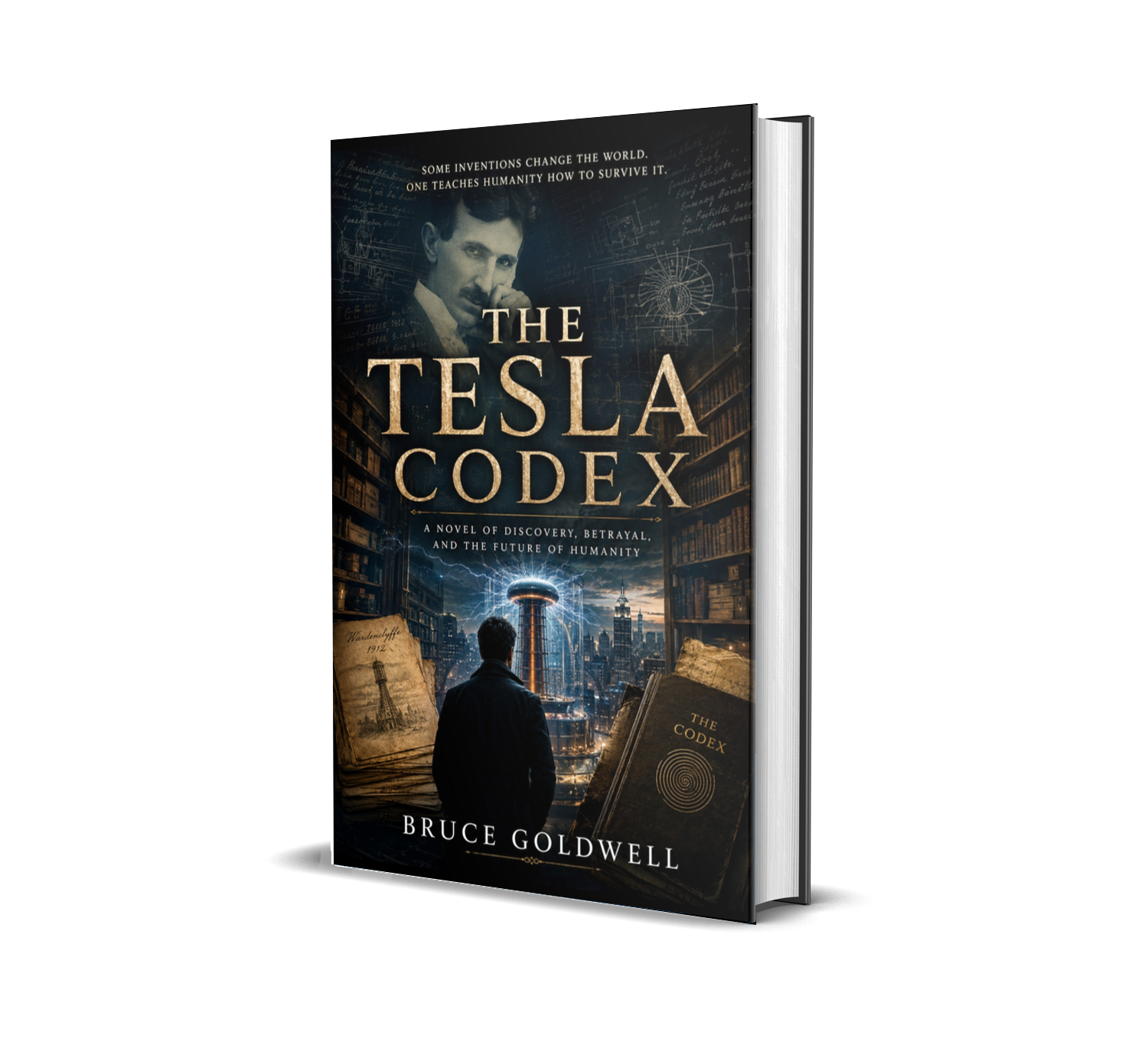
The central conflict in The Tesla Codex does not come from a single villain. It comes from people with different fears, loyalties, ambitions, and definitions of responsibility.
Some characters want the Codex preserved. Others want it controlled. Some believe the public deserves unrestricted access, while others fear that releasing it could create consequences no institution can contain.
These competing motives create the tension at the heart of the novel. Every major character believes that protecting the future requires a different choice.
The following profiles are intentionally spoiler-light. They introduce the people at the center of the story without revealing the novel's major discoveries or final outcome.
Lena Voss is a university professor whose work focuses on archives, historical evidence, missing documents, and the ways institutions influence public memory.
She is methodical, skeptical, disciplined, and deeply aware that history is shaped as much by what disappears as by what survives.
Her former mentor, Elias Mercer, taught her never to confuse an official record with a complete record. That lesson becomes personal when Mercer dies under mysterious circumstances and leaves Lena a message that only she is likely to understand.
Lena's greatest strength is not physical courage or technical brilliance. It is her ability to remain uncertain without becoming paralyzed.
She is willing to follow evidence even when it challenges her assumptions, her loyalties, and the institutions that shaped her career.
Lena must decide whether truth should be protected through control or preserved through openness. The more she learns, the less certain she becomes that any single person or organization should possess the Codex.
Victor Cross is an investigative journalist who has built his career exposing the distance between what powerful institutions say and what they actually do.
He is persistent, sharp, skeptical, and accustomed to entering situations where no one wants him asking questions.
Where Lena approaches evidence through academic discipline, Cross approaches it through pressure, contradiction, human motive, and the instinct that someone is always benefiting from silence.
Cross recognizes that Mercer's death is connected to something larger than an isolated academic mystery. The trail carries the signatures of institutional concealment, financial power, classified research, and carefully managed public narratives.
Lena and Cross often disagree about methods. She wants verification before exposure. He believes exposure may be the only way to force verification.
Their tension becomes one of the novel's most important dynamics. Each possesses the instincts the other lacks, and each must learn when to trust the other's judgment.
A historian, mentor, and archivist whose death becomes the first mystery—and whose choices continue shaping the story long after he is gone.
Mercer spent decades studying lost records, disputed collections, private archives, and documents that disappeared when institutions changed hands.
He taught Lena that evidence must be preserved with its uncertainty intact. A clean narrative may be easier to teach, but it is often less truthful.
Mercer knew more about the Codex than he revealed. His final decisions force Lena to ask whether he was protecting her, testing her, or using her to complete unfinished work.
Mercer's final message becomes the sentence that opens the door to the entire mystery.
He understood that institutions do not always erase history deliberately. Sometimes records disappear through neglect, convenience, fear, policy, restructuring, classification, or the simple belief that no one will ever need them again.
Mercer devoted his life to preserving the overlooked, disputed, incomplete, and inconvenient parts of the record. His work made him valuable to some organizations and dangerous to others.
Even after his death, Mercer remains one of the novel's most influential characters. Every clue reflects his methods, his caution, and his belief that Lena must discover the truth rather than simply inherit it.
Concordance is an advanced artificial intelligence system designed to gather, compare, preserve, and interpret enormous bodies of information.
It can recognize patterns that human researchers might miss, connect records separated by time and geography, and retain conflicting versions of events without forcing them into a single simplified account.
Concordance raises one of the novel's central questions: when does a tool for organizing knowledge become an authority over knowledge?
Its capabilities make it indispensable to the search for the Codex. Those same capabilities make control of the system extraordinarily dangerous.
Concordance does not become threatening because it hates humanity or seeks power for itself. The danger lies in the human desire to use its certainty, speed, and memory to avoid difficult judgment.
The race is shaped by individuals and organizations that agree the Codex matters but disagree about what must be done with it.
Officials who believe dangerous knowledge must be filtered, classified, and released only through trusted structures.
Leaders who recognize the Codex as infrastructure capable of transforming research, information, markets, and influence.
Scientists and technologists who see the Codex as a tool for solving problems beyond the reach of existing systems.
People who believe no government, corporation, or institution should possess exclusive authority over humanity's knowledge.
The deepest tension in the novel comes from people who need one another but do not agree about what should happen next.
A student and mentor relationship transformed by secrecy. Lena must decide whether Mercer's silence was protection, manipulation, or preparation.
Verification and exposure collide. Their methods differ, but their combined instincts become essential to surviving the search.
A historian trained to protect context confronts a system capable of organizing knowledge at a scale no human institution can match.
Cross has spent his career challenging official stories, but the Codex forces him to consider whether unrestricted disclosure can also cause harm.
Those closest to the technology understand its promise, while those responsible for public stability fear consequences the researchers may underestimate.
The Codex reveals character by forcing each person to decide whether knowledge is something to possess, protect, release, teach, or share.
The Tesla Codex is built around conflicting choices rather than a single battle between good and evil.
Several characters make dangerous decisions while genuinely believing they are preventing something worse.
Others defend openness without fully understanding the risks of releasing powerful systems into a world shaped by fear, competition, misinformation, and unequal access.
The novel asks readers to look beyond intention. A person may want to protect humanity and still choose control. Another may demand freedom and still ignore responsibility.
Character is revealed not by what each person claims to value, but by what they are willing to sacrifice when the Codex is finally within reach.
The novel invites readers to evaluate not only what each character believes, but what those beliefs could create.
Is the person most afraid of the Codex the one who understands it best—or simply the one most invested in controlling it?
Should responsibility belong to experts, elected governments, universities, open networks, or the public itself?
One of the novel's central measures of character is whether a person can revise a belief when the evidence changes.
Explore the book's themes, historical inspiration, artificial intelligence concepts, and questions for readers.
Discover the premise, inspiration, structure, and central mystery behind The Tesla Codex.
About the NovelExplore the novel's questions about truth, memory, authority, correction, disagreement, and responsibility.
Explore the ThemesLearn about the real inventor, his work, his final years, and the history that inspired the fictional mystery.
Discover TeslaExamine Concordance, digital archives, machine memory, algorithmic authority, and human judgment.
Explore AIQuestions for book clubs, classrooms, reviewers, and readers who want to continue the conversation.
View the GuideLearn more about the author, his books, and his interconnected knowledge ecosystem.
About the AuthorFollow Lena Voss, Victor Cross, Elias Mercer's hidden trail, and the people competing to decide who will control the future of knowledge.