Machine Memory
An AI may preserve enormous amounts of information while lacking human experience, emotion, conscience, and historical understanding.
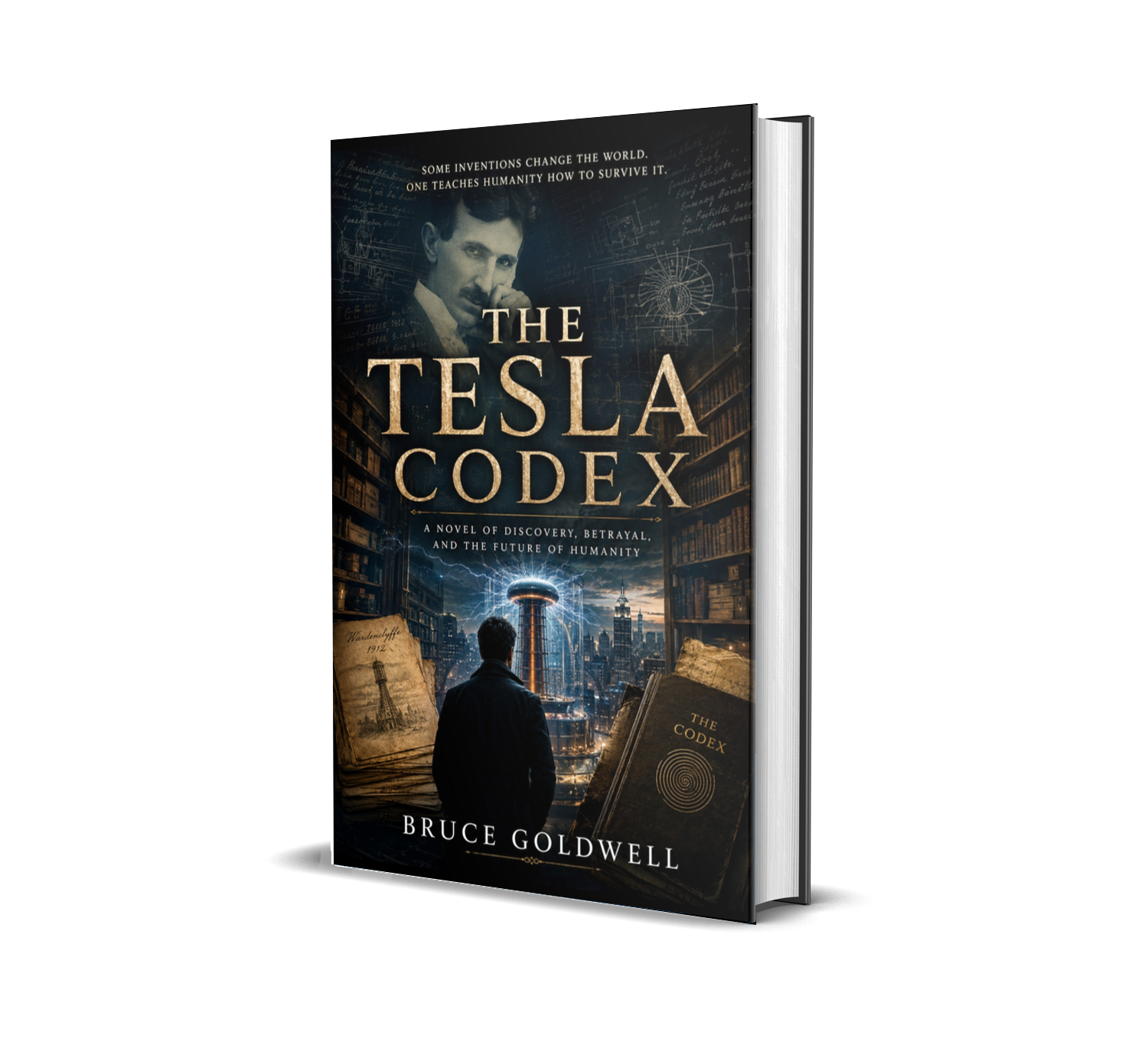
The Tesla Codex imagines an AI capable of searching humanity's accumulated knowledge—but unable to remove the need for human judgment, courage, responsibility, and restraint.
Artificial intelligence gives humanity the ability to search, compare, summarize, translate, generate, and organize information at extraordinary speed.
Those abilities can support research, education, medicine, creativity, communication, scientific discovery, accessibility, and preservation.
They can also increase the speed at which errors, manipulation, misleading conclusions, fabricated evidence, and persuasive falsehoods spread.
The central AI system in The Tesla Codex is called Concordance. It is not portrayed as an all-knowing machine, a robotic villain, or a digital replacement for humanity.
Concordance is an archive intelligence. It can discover relationships across enormous collections of records, identify contradictions, preserve competing interpretations, and show how conclusions developed over time.
Yet it remains dependent on human choices. People determine which records enter the archive, which restrictions apply, which values matter, and what should happen after the system produces an answer.
Concordance becomes a way to examine the opportunities and dangers created when machine intelligence enters the systems humanity uses to define truth.
An AI may preserve enormous amounts of information while lacking human experience, emotion, conscience, and historical understanding.
AI can help compare sources and expose contradictions, but its conclusions remain dependent on evidence, methods, and human review.
People may trust an answer because it came from an advanced system rather than because they understand how it was reached.
Every AI system reflects decisions about data, relevance, priorities, acceptable error, and the outcomes it is designed to produce.
Intelligence can identify possibilities and predict outcomes, but humans remain responsible for deciding what should be done.
Digital archives may become humanity's most important inheritance—or systems that quietly rewrite the past.
Concordance was designed to do more than search documents. It was designed to preserve the relationships between them.
A conventional search system returns information that appears relevant to a request. Concordance attempts to reconstruct the intellectual history surrounding that information.
It can identify which records support a conclusion, which records challenge it, which sources rely on one another, which evidence arrived later, and which claims changed over time.
It preserves corrections rather than silently replacing them. It records uncertainty rather than hiding it behind a confident summary. It connects archived material to the decisions that caused information to be classified, restricted, ignored, promoted, or removed.
Concordance is powerful, but it is not an oracle. It cannot transform missing evidence into certainty.
If important records were destroyed before entering the archive, Concordance cannot recover them merely by processing the surviving material.
It can identify suspicious gaps, unusual patterns, and conflicts, but recognizing that something is missing is not the same as knowing exactly what disappeared.
Concordance does not decide what humanity should believe. It gives people a better view of the evidence and the process through which conclusions emerged.
Its purpose is not to eliminate disagreement. Its purpose is to make disagreement visible, traceable, and accountable.
A machine may preserve every available record of an event without understanding what that event meant to the people who experienced it.
Digital systems can store dates, names, locations, measurements, transcripts, photographs, video, testimony, and official reports.
Human memory contains additional layers. It includes grief, fear, hope, guilt, courage, regret, forgiveness, loyalty, and the emotional consequences of what occurred.
This difference does not make machine memory useless. Machine memory can preserve details humans forget and compare evidence across distances and generations.
The danger appears when society begins treating complete data as complete understanding.
An archived statement can appear clear while losing the circumstances in which it was made.
A quotation may survive after the debate surrounding it has disappeared. A photograph may remain after the photographer's intention is forgotten. A scientific result may be preserved after its limitations are removed.
AI can amplify this problem by generating immediate summaries. A summary is useful, but every summary is also a decision about what to include, what to omit, and what to emphasize.
The future of knowledge will depend not only on whether information is stored, but on whether sources, context, uncertainty, disagreement, and correction remain attached to it.
Digital information can appear permanent while remaining surprisingly fragile.
Websites disappear. Accounts are removed. Companies close. Links break. File formats become obsolete. Databases are sold. Access permissions change. Search rankings bury older material.
A future archive must therefore do more than collect files. It must preserve relationships, ownership history, authenticity, changes, and the conditions required to understand the records.
AI can assist with verification, but truth cannot be reduced to the output of a single system.
Artificial intelligence can compare documents, detect repeated claims, identify inconsistencies, examine metadata, translate sources, summarize arguments, and reveal relationships that a human researcher might overlook.
These abilities can make AI a powerful investigative partner. They do not guarantee that the AI has access to complete, authentic, or fairly selected evidence.
AI systems often present answers in clear and fluent language. That fluency can create an impression of certainty even when the underlying evidence is incomplete.
A confident answer may be correct, partly correct, outdated, based on weak sources, or entirely fabricated.
Responsible use therefore requires checking important claims against reliable evidence rather than treating polished language as proof.
People may accept an AI conclusion because the system appears advanced, neutral, fast, and knowledgeable.
The appearance of authority can become especially dangerous when users cannot inspect the sources, assumptions, or steps behind the answer.
Finding many sources that repeat the same claim does not necessarily verify it. Those sources may all trace back to the same original mistake.
Strong verification asks whether sources are independent, whether original evidence exists, whether dates and context align, and whether competing explanations were considered.
Concordance is built around this principle. It does not merely count agreement. It attempts to map where claims originated and how they spread.
The novel does not treat AI and humanity as competitors for the same role. Each contributes different capabilities.
| Area | Artificial Intelligence | Human Judgment |
|---|---|---|
| Information Processing | Can compare large amounts of data rapidly and identify patterns across many records. | Can decide which patterns are meaningful within a lived, cultural, moral, or historical context. |
| Memory | Can preserve and retrieve enormous quantities of recorded information. | Connects memory with identity, emotion, meaning, responsibility, and consequence. |
| Prediction | Can estimate likely outcomes based on available data and detected relationships. | Can decide which risks are acceptable and which values should guide action. |
| Consistency | Can apply rules repeatedly without fatigue when the rules and inputs remain clear. | Can recognize when a rule is unjust, outdated, harmful, or inappropriate for a unique situation. |
| Creativity | Can generate combinations, patterns, drafts, simulations, and possibilities from learned material. | Can connect creativity to personal experience, intention, purpose, risk, sacrifice, and cultural meaning. |
| Responsibility | Can recommend actions but does not independently carry human legal or moral accountability. | Remains responsible for deciding, approving, rejecting, or acting on recommendations. |
Artificial intelligence may operate through mathematics and computation, but the system surrounding it is shaped by people.
Someone decides which data is collected. Someone determines which material is excluded. Someone defines the task, chooses the desired outcome, measures success, sets restrictions, and decides which errors are most important to avoid.
These choices do not automatically make an AI system dishonest. They mean that claims of perfect neutrality should be examined carefully.
A system trained on incomplete historical records may repeat the limitations of those records.
A system optimized for engagement may favor dramatic, emotional, or controversial material because that content attracts attention.
A system optimized for efficiency may recommend actions that reduce cost while overlooking dignity, fairness, or long-term social consequences.
Optimization always requires a goal. The choice of that goal expresses a value.
Should a system maximize accuracy, speed, profit, safety, access, privacy, fairness, stability, or public trust?
These priorities may conflict. Increasing one may reduce another. No mathematical system can eliminate the human responsibility involved in deciding which tradeoffs are acceptable.
The future of knowledge will be influenced not only by what information exists, but by which information algorithms choose to place in front of people.
Search engines rank results. Social platforms recommend posts. Streaming systems select entertainment. News feeds prioritize stories. Online stores decide which books and products appear first.
These systems help people navigate overwhelming amounts of information. They also influence public attention.
Information that receives high visibility may appear more important or credible simply because people encounter it often.
Information that is ranked lower may effectively disappear, even though it remains technically available.
This creates a new kind of gatekeeping. Instead of physically destroying a record, a system can bury it beneath millions of more highly ranked results.
Personalized systems show different users different information based on interests, behavior, location, history, and predicted preferences.
Personalization can make information more useful. It can also divide people into separate informational environments.
Two people may search for the same subject and receive different paths through the evidence. Over time, each may believe that their version represents the complete public record.
A society cannot maintain a shared reality when no one can see how information was selected, ranked, removed, or personalized.
Artificial intelligence can generate convincing material faster than human institutions can investigate every claim.
Text, images, audio, video, documents, and simulated evidence can be created or altered in ways that appear authentic.
This does not mean that all digital content becomes useless. It means that appearance alone becomes a weaker form of proof.
For much of modern history, photographs and recordings carried persuasive authority. They appeared to provide direct evidence that something occurred.
As synthetic media becomes easier to create, people will need additional methods for establishing origin, ownership, editing history, and authenticity.
The challenge works in both directions. Fabricated evidence may convince people that a false event occurred. Genuine evidence may be dismissed as artificial when it becomes inconvenient.
Creating a false claim may take minutes. Investigating it may take days, weeks, or longer.
By the time a careful correction appears, the original claim may have reached millions of people.
This speed imbalance rewards emotional certainty and punishes careful verification.
Important digital evidence may increasingly require a visible chain of custody showing where it originated, who handled it, what changes were made, and how authenticity was evaluated.
The Codex represents a model for preserving knowledge without pretending that knowledge can ever become complete or final.
A trustworthy archive would retain original sources, metadata, revision history, competing interpretations, corrections, restrictions, ownership changes, and evidence of uncertainty.
It would show not only what the current conclusion is, but how that conclusion developed.
Major claims should remain connected to the documents, observations, testimony, measurements, or recordings on which they depend.
When an error is found, the correction should not silently replace the earlier version. The archive should preserve what changed and why.
The system should distinguish between established evidence, strong probability, interpretation, speculation, and claims that remain unsupported.
Serious competing interpretations should remain visible alongside the evidence supporting and challenging them.
When information is restricted, the archive should record who made the decision, the stated reason, the evidence supporting it, and when the restriction should be reviewed.
The novel suggests that trustworthy AI requires more than intelligence. It requires systems designed for transparency, review, correction, and human responsibility.
The goal is not to create a machine that people must obey. The goal is to create tools that help people see evidence, uncertainty, disagreement, and consequence more clearly.
A machine can recommend a decision. It cannot remove the moral burden carried by the people who accept that recommendation.
Human beings may be tempted to transfer responsibility to AI, especially when decisions are difficult, unpopular, risky, or emotionally painful.
Officials may say the algorithm made the choice. Companies may say the system followed its rules. Individuals may say they trusted the recommendation.
Yet a person or institution still chose to create, deploy, approve, or depend on the system.
AI may estimate risk, but humans determine which risks are acceptable.
AI may predict behavior, but humans decide whether prediction should affect freedom, employment, education, medical care, opportunity, or access.
AI may recommend secrecy, but humans decide whether the public interest justifies withholding information.
AI may identify a dangerous possibility, but humans decide how much uncertainty is required before acting.
A system may produce a recommendation supported by overwhelming statistical evidence. A human being may still recognize that the recommendation is unjust in a particular case.
Dissent is not always correct, but a system that prevents disagreement becomes dangerous regardless of its intelligence.
Concordance is designed to preserve the right to challenge its conclusions. That ability is not a weakness in the system. It is one of its most important protections.
Artificial intelligence does not create one inevitable future. Different choices could produce very different outcomes.
AI helps people research, learn, communicate, create, solve problems, and make better-informed decisions while humans remain responsible for outcomes.
A small number of institutions control the systems that organize information, define acceptable conclusions, and determine which knowledge receives visibility.
Personalized systems divide society into separate realities, each supported by different evidence, priorities, and algorithmic interpretations.
Generated content becomes so common that people struggle to distinguish original evidence, authentic testimony, and machine-created material.
AI systems reveal sources, uncertainty, design decisions, corrections, and the reasoning behind important conclusions.
Humanity builds archives that preserve evidence, context, disagreement, correction, accountability, and the right to question machine conclusions.
The future portrayed in The Tesla Codex begins with practical principles that can guide real-world systems.
Keep original sources, metadata, revision histories, and supporting records connected to important conclusions.
Clearly distinguish direct evidence, probability, interpretation, speculation, and unknowns.
Treat revision as evidence of a functioning knowledge system rather than something that should be hidden.
Keep meaningful human oversight wherever automated decisions affect rights, opportunities, safety, or public knowledge.
No AI system should become so authoritative that its assumptions, evidence, and conclusions cannot be challenged.
The Tesla Codex invites readers to consider how artificial intelligence may change authority, evidence, memory, and human responsibility.
Or will every system always reflect the data, priorities, restrictions, and values chosen by its creators?
When would a confident answer be insufficient without visible sources, assumptions, and uncertainty?
Is responsibility held by the programmer, the organization, the operator, the user, or everyone involved?
What happens when personalized systems show different people different evidence about the same event?
Who should decide, what oversight should exist, and when should restrictions be reconsidered?
Are there decisions that should always require direct human judgment, conscience, and accountability?
The novel avoids the simple choice between fearing artificial intelligence and treating it as the solution to every human problem.
Concordance is capable of extraordinary analysis. It helps Lena Voss and Victor Cross locate connections that human researchers might never discover.
Yet every answer produces another question. Who entered the information? Who selected the sources? Who created the restrictions? What records were removed before Concordance gained access?
The deeper conflict is therefore not between people and machines. It is between different ways of using intelligence.
One path uses AI to centralize power, hide decisions, control access, and make authority appear objective.
The other path uses AI to expose relationships, preserve uncertainty, record correction, and give people better tools for evaluating evidence.
The future does not depend only on how intelligent machines become. It depends on whether humanity builds those machines to strengthen curiosity and accountability—or to replace them.
Explore the novel, characters, historical inspiration, philosophical themes, and reading resources.
Discover the premise, story foundation, mystery, and creative vision behind The Tesla Codex.
About the NovelMeet Lena Voss, Victor Cross, Elias Mercer, Concordance, and the organizations competing for the Codex.
Meet the CharactersExamine truth, knowledge preservation, institutional power, secrecy, correction, and humanity's inheritance.
Explore the ThemesExplore Tesla's real life, inventions, ambitions, unfinished projects, and enduring cultural legacy.
Discover TeslaQuestions for individual readers, book clubs, classrooms, reviewers, and discussion groups.
View the GuideLearn more about the author, his books, creative projects, and interconnected knowledge ecosystem.
About the AuthorEnter a technological mystery involving Nikola Tesla, artificial intelligence, hidden archives, institutional power, and a discovery capable of changing humanity's relationship with truth.