Some books end with an answer. The Tesla Codex is designed to continue as a conversation.
Questions for Readers and Book Clubs

The Tesla Codex Reading Guide

Explore the mystery, characters, historical inspiration, artificial intelligence, institutional power, and questions about humanity's responsibility to preserve knowledge.
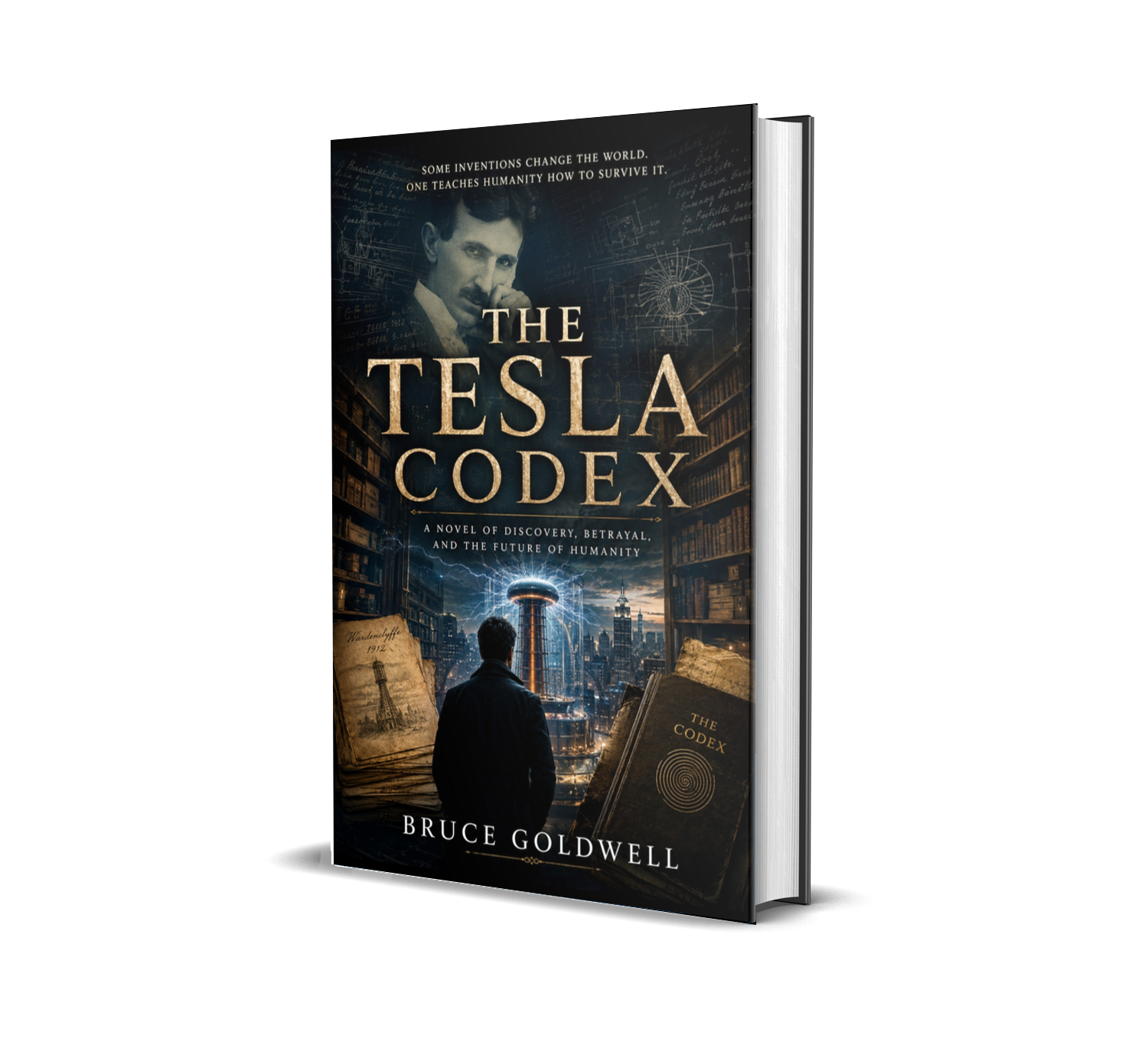
The Tesla Codex by Bruce Goldwell book cover
A Guide for Deeper Reading

The Mystery Is Only the Beginning

This reading guide is designed for individual readers, book clubs, classrooms, reviewers, libraries, and discussion groups exploring The Tesla Codex.

The novel follows Professor Lena Voss, investigative journalist Victor Cross, historian Elias Mercer, and the artificial intelligence known as Concordance as they pursue an archive connected to Nikola Tesla's legacy.

Beneath the suspense lies a larger examination of truth, information, secrecy, institutional memory, artificial intelligence, technological responsibility, and the ownership of humanity's intellectual inheritance.

The questions below are intended to help readers examine both the story and the ideas beneath it. Most sections are written to avoid revealing specific plot resolutions.

Spoiler Notice

The opening sections can be used before or during reading. The sections labeled After Finishing the Novel may encourage discussion of the ending and should be saved until every participant has completed the book.

Flexible Discussion Format

How to Use This Reading Guide

Choose the sections that best fit your group rather than trying to cover every question in a single meeting.

Individual Readers

Use the questions as journal prompts, chapter reflections, review notes, or a way to examine how your interpretation changes throughout the story.

Book Clubs

Select eight to twelve questions and invite each member to choose one additional question that mattered personally.

Classrooms

Combine literary analysis with research on Nikola Tesla, artificial intelligence, archives, ethics, and source verification.

Reviewers

Use the theme, character, pacing, and historical questions to organize a detailed review without summarizing the entire plot.

Libraries

Build a public program around technological fiction, Nikola Tesla, digital literacy, AI ethics, and the preservation of community history.

Writers

Examine how the novel combines historical inspiration, speculative technology, suspense, character conflict, and philosophical questions.

Optional Group Schedule

A Four-Meeting Reading Plan

Because the novel is substantial, groups may benefit from discussing it across several meetings.

Meeting One

The Discovery

Discuss first impressions, the central mystery, early character motivations, Tesla's presence, and the meaning of an archive.

Meeting Two

The Pursuit

Examine trust, institutional secrecy, Victor's investigation, Lena's choices, and the increasing role of Concordance.

Meeting Three

The Conflict

Discuss control of knowledge, ethical tradeoffs, character loyalties, historical evidence, and the consequences of access.

Meeting Four

The Inheritance

After everyone finishes, discuss the ending, the Codex's purpose, unresolved questions, and the future implied by the novel.

Before Opening the Book

Questions to Consider Before Reading

These prompts establish expectations and reveal assumptions readers may carry into the story.

  1. What comes to mind when you hear the name Nikola Tesla? Which parts of that image come from documented history, and which may come from popular legend?
  2. What is the difference between information, knowledge, understanding, and wisdom?
  3. Should some discoveries be restricted if they could be used to cause serious harm?
  4. Who should have the authority to decide whether information is too dangerous to release?
  5. Would you trust an artificial intelligence to evaluate historical evidence? What would you need to know about the system first?
  6. What responsibilities do archives, libraries, governments, universities, and corporations have to future generations?
  7. Can an institution preserve history objectively when its own reputation may be affected by the records?
  8. Have you ever changed your view after learning that information you trusted was incomplete or taken out of context?
Opening Discussion

First Impressions of the Novel

Use these questions after the group has read enough to understand the central premise and principal characters.

  1. What first drew you into the story: the Tesla connection, the mystery, the characters, the artificial intelligence, or the questions about hidden knowledge?
  2. How did the novel's opening establish its atmosphere? Did it feel more like a historical mystery, technological thriller, conspiracy story, or philosophical novel?
  3. Which character earned your trust first? What action, statement, or decision created that trust?
  4. Which character or organization made you most suspicious during the early chapters?
  5. What did you initially expect the Codex to contain? How did those expectations shape your reading?
  6. How effectively does the novel balance explanation, investigation, action, and character development?
  7. Which early clue seemed most important at the time? Did its importance change later?
  8. Did the historical connection to Tesla make the fictional mystery feel more believable? Why or why not?
  9. What questions did the novel make you want to research independently?
  10. At what point did you feel the mystery became larger than the search for a lost invention?
Character Analysis

The People Carrying the Mystery

Each principal character represents a different relationship with knowledge, authority, risk, memory, and truth.

Professor Lena Voss

Knowledge and Responsibility

  • What motivates Lena beyond intellectual curiosity?
  • How does her training influence the way she evaluates evidence and danger?
  • When does caution protect her, and when does it limit her?
  • Which of Lena's decisions reveals the most about her values?
  • Does her sense of responsibility grow, change, or become more complicated during the novel?
Victor Cross

Investigation and Public Truth

  • How does Victor's journalistic background shape his understanding of secrecy and evidence?
  • Is his instinct to expose information always justified?
  • When does Victor act from principle, and when does he act from personal need or ambition?
  • How does his relationship with Lena affect his judgment?
  • Does Victor believe the public has a right to know everything? Does that belief change?
Professor Elias Mercer

The Keeper of Institutional Memory

  • What does Mercer understand about archives that the other characters initially overlook?
  • How does his relationship with the past influence his choices?
  • What does the quotation “The archive remembers what institutions forget” mean within the story?
  • Is Mercer primarily a scholar, protector, witness, strategist, or something else?
  • What does his character suggest about the burden of preserving uncomfortable knowledge?
Victor Cross

Power, Belief, and Opposition

  • What does Victor believe would happen if the Codex became freely available?
  • Are any of his concerns legitimate even when his methods are objectionable?
  • Does he see himself as protecting humanity, controlling it, or both?
  • How does the novel avoid presenting opposition as simple evil?
  • Which of Victor's arguments would be most persuasive outside the context of the story?
Concordance

Intelligence Without Final Authority

  • In what ways does Concordance function as a character rather than merely a tool?
  • What are Concordance's greatest capabilities?
  • What limitations prevent it from becoming all-knowing?
  • Does Concordance appear neutral? Should readers trust that appearance?
  • What responsibilities remain human even after Concordance provides an analysis?

Editing note: The fourth character panel above should use the name of the principal opposing character or institutional leader from your final manuscript. Replace the repeated “Victor Cross” label and related questions if that role belongs to another character in the published novel.

Trust Under Pressure

Character Relationships and Shifting Loyalties

The mystery places every relationship under pressure because knowledge creates both connection and danger.

  1. How does the relationship between Lena and Victor develop through shared risk and competing instincts?
  2. Which character is most willing to trust others? Does that trust become a strength or vulnerability?
  3. How does secrecy affect relationships even when secrecy is intended to protect someone?
  4. Which betrayal, concealment, or withheld truth has the greatest emotional effect?
  5. Can two characters share the same goal while disagreeing completely about the ethical path toward it?
  6. How does the possession of information alter the balance of power between characters?
  7. Which relationship becomes more important than you expected?
  8. Does anyone in the novel earn forgiveness? What makes forgiveness possible or impossible?
Mystery and Structure

Discussing the Search for the Codex

The Codex functions as an object of pursuit, a historical puzzle, a technological system, and a symbol of humanity's inheritance.

  1. How does the meaning of the word “Codex” change throughout the story?
  2. Did you initially imagine the Codex as a physical object, a set of documents, a machine, a code, or something else?
  3. Which clue or discovery most changed your understanding of the central mystery?
  4. How does the novel use archives, records, missing documents, and historical gaps to create suspense?
  5. Did the investigation feel driven more by deduction, historical research, technology, intuition, or human testimony?
  6. What role does coincidence play in the story? Does it feel plausible within the fictional world?
  7. How does the novel distinguish between evidence of absence and absence of evidence?
  8. At what point does finding the Codex become less important than deciding what to do with it?
  9. Does the novel provide enough explanation for readers to follow its technical ideas without slowing the suspense?
  10. What would have changed if the Codex had contained a single powerful machine rather than a knowledge system?
Thematic Discussion

Truth, Knowledge, Secrecy, and Power

These questions move beyond plot and examine the ideas that give the novel its philosophical foundation.

  1. How does the novel distinguish information from truth?
  2. Can accurate information still create a false conclusion? Which situations in the novel illustrate this?
  3. What is lost when institutions preserve conclusions but not the evidence, disagreement, or process behind them?
  4. Does the novel present secrecy as necessary, dangerous, or both?
  5. When does protection become control?
  6. What responsibilities do gatekeepers have when they restrict access to knowledge?
  7. Why does the Codex preserve corrections rather than silently replacing old conclusions?
  8. Is disagreement a weakness in a knowledge system, or evidence that the system remains open to improvement?
  9. What does the novel suggest about institutions that must investigate their own past decisions?
  10. Can knowledge belong permanently to one person, corporation, government, or institution?
  11. What does humanity owe to future generations that cannot yet participate in today's decisions?
  12. Which theme felt most relevant to the world outside the novel?
Artificial Intelligence

Concordance, Machine Memory, and Human Judgment

The novel treats AI as a powerful assistant whose capabilities do not eliminate human responsibility.

  1. Is Concordance best understood as a tool, archive, collaborator, character, institution, or intelligence?
  2. What can Concordance do better than the human characters?
  3. What can the human characters understand that Concordance cannot?
  4. Does processing more information necessarily produce a more truthful conclusion?
  5. How does the novel explore the difference between pattern recognition and explanation?
  6. What information would you need before trusting an AI system to evaluate historical evidence?
  7. Who should be responsible when people act on an AI recommendation that causes harm?
  8. Is an AI system neutral if humans selected its data, objectives, restrictions, and definitions of success?
  9. Why is the ability to challenge Concordance important?
  10. Does the novel leave you more hopeful, cautious, or uncertain about the future of artificial intelligence?
History Behind the Fiction

Nikola Tesla and the Burden of Vision

The novel draws from Tesla's documented achievements, unfinished ambitions, public image, and the mythology that developed after his death.

  1. What did you know about Nikola Tesla before reading the novel?
  2. Did the story encourage you to separate Tesla's documented inventions from later legends?
  3. Why is Tesla an effective historical figure for a novel about lost knowledge and institutional control?
  4. How does Tesla's experience with invention, financing, competition, and unfinished projects support the novel's themes?
  5. Does society tend to romanticize inventors after their deaths? What may be lost through that process?
  6. What is the difference between an invention and a system capable of making that invention widely useful?
  7. How does Wardenclyffe symbolize the distance between vision and implementation?
  8. Does the novel use Tesla respectfully while still creating an imaginative fictional mystery?
  9. Why might stories about suppressed inventions remain attractive even when evidence is incomplete?
  10. What historical figure other than Tesla could support a similar story about knowledge, power, and memory?
Ethical Dilemmas

What Would You Decide?

Invite participants to defend a position, then ask them to argue the opposing view.

  1. You discover a technology that could improve millions of lives but could also be adapted into a weapon. Do you publish it, restrict it, divide it, or destroy it?
  2. An AI identifies evidence that a respected institution concealed a serious mistake decades earlier. Should every record be released immediately?
  3. A private company funds the preservation of a global archive. Does that investment give the company ownership or control?
  4. A government restricts information for national security. How long should the restriction last, and who should review it?
  5. An archive contains personal information about people who are no longer alive but whose descendants could be harmed. Should history or privacy take priority?
  6. An AI produces a recommendation that is statistically strong but feels morally wrong in one individual case. Which should prevail?
  7. An institution can protect public trust only by withholding evidence of an earlier failure. Is preserving trust ever a sufficient justification?
  8. A researcher believes society is not ready for a discovery. Does the researcher have a right to decide for everyone else?
  9. A false theory played an important role in scientific progress. Should the archive preserve it prominently or reduce its visibility to prevent confusion?
  10. If complete openness creates danger and complete secrecy creates control, what principles should guide the middle path?
Craft and Storytelling

Literary Analysis Questions

These prompts focus on structure, symbolism, point of view, pacing, atmosphere, and the relationship between ideas and story.

  1. How does the title The Tesla Codex shape reader expectations before the story begins?
  2. What does the Codex symbolize beyond its function in the plot?
  3. How does the novel use archives, locked rooms, laboratories, records, or technology to create atmosphere?
  4. Which scenes carry the greatest sense of discovery? Which create the greatest sense of danger?
  5. How does the pacing change when the novel moves between investigation, action, history, and philosophical discussion?
  6. Does the novel reveal information at the right time? Which revelation most changed your interpretation?
  7. How does the use of a real historical figure affect the fictional world's credibility?
  8. What role does the recurring quotation about the archive play in unifying the novel?
  9. How do character conflicts embody the novel's larger philosophical conflicts?
  10. Is the ending primarily a resolution, warning, beginning, or invitation?
Classroom and Group Activities

Extend the Reading Beyond Discussion

These activities can be adapted for high school, college, library, adult education, or book-club settings.

Fact Versus Fiction Research

Choose one Tesla-related element from the novel and create a two-column presentation.

  • Documented history
  • Fictional adaptation
  • Sources used
  • Why the author may have changed or expanded the history

Build a Codex Entry

Select a debated historical or scientific claim and create an archive entry containing:

  • Original sources
  • Supporting evidence
  • Contradictory evidence
  • Known uncertainty
  • Corrections and revisions

AI Verification Exercise

Ask an AI system a historical question about Tesla, then verify the response using museum, archive, patent, or academic sources.

  • Which claims were correct?
  • Which lacked sources?
  • Which were oversimplified?
  • Did the AI express uncertainty?

Secrecy Debate

Divide participants into groups representing:

  • Public-access advocates
  • National-security officials
  • Scientists and engineers
  • Private owners or investors
  • Future generations

Character Decision Map

Select a major character decision and diagram:

  • Information available at the time
  • Personal motivations
  • Possible alternatives
  • Risks and consequences
  • Whether the decision was justified

Archive the Present

Design a preservation plan for an important current event. Decide what future readers would need to understand it.

  • Official records
  • First-person testimony
  • News coverage
  • Data and images
  • Minority or dissenting perspectives

Design Concordance

Create rules for an archive intelligence that must:

  • Identify evidence
  • Display uncertainty
  • Preserve disagreement
  • Protect privacy
  • Remain open to correction

Write the Missing Document

Create a fictional archive item that could exist within the novel without changing its ending.

  • Research note
  • Letter
  • Classified memo
  • Concordance report
  • Historical testimony
Reflection and Writing

Essay and Journal Prompts

Use these prompts for classroom assignments, personal reflection, reviews, or extended book-club discussion.

  1. Explain the meaning of the statement: “The archive remembers what institutions forget.”
  2. Analyze the difference between intelligence and wisdom as presented through Concordance and the human characters.
  3. Discuss whether the Codex should be considered technology, philosophy, archive, institution, or inheritance.
  4. Evaluate one character's decision to reveal, conceal, protect, or control information.
  5. Compare Nikola Tesla's historical legacy with the fictional role assigned to him in the novel.
  6. Explain how the novel uses missing records and incomplete information as both a plot device and a philosophical idea.
  7. Argue for or against the statement: “Some knowledge is too dangerous to make public.”
  8. Describe what a trustworthy artificial intelligence should be required to reveal about its answers.
  9. Discuss whether correction strengthens or weakens public trust in an institution.
  10. Imagine the world twenty years after the novel. How has the existence of the Codex changed education, government, science, or public knowledge?
After Finishing the Novel

Final Discussion Questions

This section is intended for readers who have completed the book and are prepared to discuss the ending.

Ending Discussion

The questions below do not state specific plot details, but answers will probably reveal important events and resolutions from the final chapters.

  1. Did the final purpose of the Codex match what you expected?
  2. Which earlier clue became most meaningful after the ending?
  3. Were the final decisions made by Lena and Victor ethically justified?
  4. Did any opposing character make an argument you found difficult to dismiss?
  5. What does the ending suggest about whether knowledge can ever be fully protected from power?
  6. Does Concordance end the story with more authority, less authority, or a different kind of role?
  7. Which character changed most significantly?
  8. What does the ending leave deliberately unresolved?
  9. Is the final outcome hopeful, cautious, tragic, or balanced?
  10. Who ultimately owns the Codex?
  11. What responsibility now belongs to the people who know the truth?
  12. What do you believe happens immediately after the final page?
Group Review

Rate the Reading Experience

Ask each participant to rate these elements from one to five, then compare the reasons behind the ratings.

Mystery 1–5
Characters 1–5
Pacing 1–5
Historical Interest 1–5
AI Ideas 1–5
Suspense 1–5
Themes 1–5
Worldbuilding 1–5
Ending 1–5
Discussion Value 1–5
For Discussion Leaders

A Simple Book-Club Meeting Format

Suggested 75-Minute Discussion

  1. Opening reaction — 10 minutes: Ask each person to describe the novel in one sentence and name one memorable moment.
  2. Characters — 15 minutes: Discuss Lena, Victor, Mercer, Concordance, and the principal opposing force.
  3. Mystery and structure — 15 minutes: Examine clues, revelations, pacing, and the changing meaning of the Codex.
  4. Major themes — 20 minutes: Select three questions involving secrecy, AI, truth, archives, or institutional power.
  5. The ending — 10 minutes: Discuss the final decision and what may happen next.
  6. Closing reflection — 5 minutes: Ask each participant what idea from the novel they expect to remember.

The strongest discussions may not produce agreement. Encourage participants to explain the evidence and values behind their position rather than trying to reach one final interpretation.

For Reviewers and Bloggers

Questions for Writing a Thoughtful Review

These prompts can help reviewers evaluate the book without reducing the review to a plot summary.

  1. What type of reader is most likely to enjoy the novel?
  2. How well does the book combine history, technology, suspense, and philosophical discussion?
  3. Are the central characters emotionally engaging as well as intellectually interesting?
  4. Does the historical material support the story without overwhelming it?
  5. Are the AI concepts understandable to readers without technical expertise?
  6. Which theme gives the novel its greatest relevance?
  7. Does the book satisfy readers seeking a mystery while offering enough depth for discussion?
  8. Which comparable authors, novels, films, or genres might help readers understand its style?
  9. What is the strongest aspect of the book?
  10. What idea remained with you after finishing?
Continue Learning

Topics for Further Exploration

The novel can serve as a starting point for research, discussion, and independent learning.

Nikola Tesla

Research Tesla's AC patents, induction motor, Tesla coil, wireless experiments, Wardenclyffe Tower, and later proposals.

Artificial Intelligence

Explore language models, AI verification, algorithmic bias, explainability, synthetic media, and human oversight.

Archives

Study digital preservation, metadata, provenance, classification, institutional memory, and historical access.

Verification

Learn how to compare sources, trace original claims, evaluate evidence, identify context, and correct misinformation.

Ethics of Technology

Examine dual-use research, restricted knowledge, public access, scientific responsibility, and institutional accountability.

Memory and History

Explore how communities, governments, institutions, and digital systems decide what the future will remember.

Continue Exploring

Go Deeper Into The Tesla Codex

Explore the novel, characters, themes, historical inspiration, artificial intelligence concepts, and author information.

The Novel

About the Book

Discover the premise, story foundation, mystery, and creative vision behind The Tesla Codex.

About the Novel
People

Characters

Meet Lena Voss, Victor Cross, Elias Mercer, Concordance, and the forces competing for the archive.

Meet the Characters
Ideas

Themes

Examine truth, knowledge preservation, institutional power, secrecy, correction, and humanity's inheritance.

Explore the Themes
History

Nikola Tesla

Explore Tesla's real life, inventions, ambitions, unfinished projects, and cultural legacy.

Discover Tesla
Technology

AI and the Future

Explore machine memory, verification, algorithmic authority, digital archives, and human responsibility.

Explore AI
Author

Bruce Goldwell

Learn more about the author, his books, creative projects, and interconnected knowledge ecosystem.

About the Author
Begin the Investigation

Read The Tesla Codex

Enter a technological mystery involving Nikola Tesla, artificial intelligence, hidden archives, institutional power, and a discovery capable of changing humanity's relationship with truth.