Polyphase Power
Multiple alternating currents offset in phase could produce a smoothly rotating magnetic field and efficiently transmit electrical energy.
Before he became a symbol of hidden inventions and forgotten genius, Nikola Tesla was an electrical engineer whose work helped create the modern alternating-current power system.
Nikola Tesla was an inventor, electrical engineer, experimenter, public lecturer, and visionary whose ideas helped transform electricity from a laboratory phenomenon into a system capable of powering cities.
His documented accomplishments were extraordinary. His work contributed to alternating-current motors, polyphase electrical systems, high-frequency experimentation, radio control, wireless communication, and new ways of thinking about energy.
His life also contained dramatic reversals. Tesla experienced scientific recognition, public fame, commercial opportunity, failed partnerships, unfinished projects, financial hardship, and increasing isolation.
That combination of achievement and unfinished ambition helped create the Tesla legend. Over time, verified inventions became mixed with disputed claims, imagined technologies, conspiracy theories, and stories about discoveries supposedly hidden after his death.
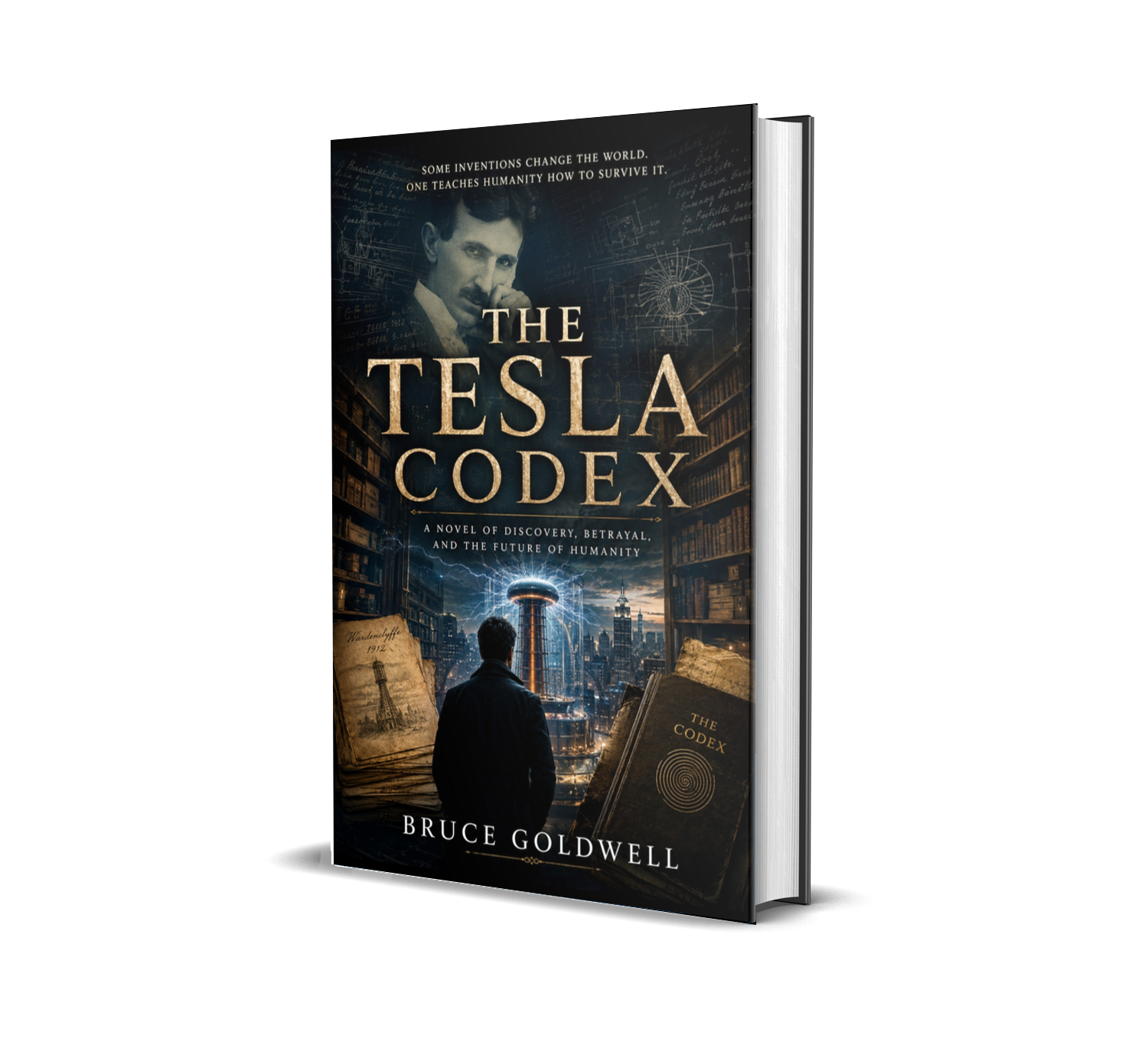
The Tesla Codex begins in the space between documented history and imaginative possibility. The novel does not claim that a real Codex existed. It asks what Tesla might have created if his final concern had been the preservation of knowledge rather than the construction of one last machine.
The novel uses real people, inventions, locations, and historical questions as the foundation for a fictional mystery.
Nikola Tesla was a real inventor whose alternating-current motors and polyphase system contributed to the development of modern electrical power.
He conducted high-voltage and wireless experiments, developed the Tesla coil, demonstrated radio-controlled technology, and built Wardenclyffe Tower on Long Island.
Tesla died in New York City in 1943. Government officials examined his papers because of wartime security concerns.
The Codex, Professor Lena Voss, Victor Cross, Elias Mercer, Concordance, and the organizations pursuing the archive are fictional.
The novel's hidden records, coded clues, institutional conspiracy, and knowledge-preservation system were created for the story.
The book does not present its fictional discoveries as historical evidence or claim that Tesla secretly created the Codex.
Nikola Tesla was born on July 10, 1856, in Smiljan, a village then located within the Austrian Empire and now part of Croatia.
Tesla was born into a Serbian family. His father, Milutin Tesla, was an Eastern Orthodox priest and writer. His mother, Đuka Mandić, had no formal technical education but designed practical household tools and possessed a remarkable memory.
Tesla later credited his mother with influencing his inventive abilities. He described a childhood filled with intense mental images, mechanical curiosity, and an unusual ability to visualize devices in detail before constructing them.
He studied mathematics, physics, and engineering but did not complete a university degree. His education nevertheless gave him a foundation in the emerging science of electricity and rotating machinery.
One of Tesla's most important ideas involved producing rotation through changing magnetic fields rather than through the mechanical switching used in many early motors.
Tesla later described conceiving the principle while walking with a friend in Budapest. Whether every remembered detail occurred exactly as he later told it, the rotating magnetic field became the foundation of his induction-motor work.
The concept allowed an alternating-current motor to operate without the commutator and brushes required by many direct-current designs. It became an important part of a practical polyphase electrical system.
Tesla worked in Budapest and Paris for organizations associated with the emerging electrical industry. He gained experience with generators, lighting systems, and electrical equipment while continuing to develop his own ideas.
In 1884, at approximately twenty-eight years old, Tesla traveled to the United States. He arrived in New York during a period of rapid industrial growth and intense competition over the future of electric power.
Tesla did not arrive with a finished blueprint for the modern world. He arrived with technical experience, unusual confidence, a powerful mental model of alternating-current machinery, and a determination to find support for his ideas.
Soon after arriving in New York, Tesla worked for Thomas Edison's organization, which was building direct-current electrical systems.
Edison and Tesla have often been portrayed as opposite kinds of inventor. Edison became associated with organized laboratories, commercial development, persistent experimentation, and direct current. Tesla became associated with mathematical visualization, dramatic demonstrations, alternating current, and ambitious future technologies.
Their relationship was brief. Tesla left Edison's company and attempted to build an independent career.
Popular retellings often reduce the story to a personal rivalry. The reality was larger. The electrical industry included numerous inventors, engineers, investors, patent holders, manufacturers, and competing business systems.
Direct current moves electrical charge primarily in one direction. Edison's early distribution systems supplied low-voltage direct current to customers located relatively close to generating stations.
Alternating current periodically reverses direction. Using transformers, AC voltage could be increased for efficient long-distance transmission and then reduced for local use.
Tesla's motor and polyphase concepts helped make alternating current useful not only for lighting but also for industrial machinery.
Tesla's most consequential period began when investors helped him establish the Tesla Electric Company in 1887.
In his New York laboratory, Tesla developed and patented motors, generators, and system components based on alternating current and rotating magnetic fields.
In 1888, Tesla presented his work to the American Institute of Electrical Engineers. His system attracted the attention of industrialist and inventor George Westinghouse.
Westinghouse recognized that Tesla's patents could strengthen an alternating-current system capable of competing with direct-current networks.
Westinghouse acquired rights to important Tesla patents and brought Tesla into the development of practical AC machinery. Engineers working within the Westinghouse organization refined and adapted the technology for commercial use.
Tesla's achievements were therefore both individual and collaborative. His concepts were crucial, but the construction of a widespread power system also required industrial engineering, manufacturing, financing, standardization, and installation.
Competition between AC and DC became known as the War of the Currents. Supporters of direct current emphasized the potential dangers of high-voltage AC. Supporters of alternating current emphasized its ability to transmit power efficiently across greater distances.
The debate included legitimate engineering questions, aggressive publicity, commercial competition, demonstrations, and attempts to influence public opinion.
Alternating-current systems eventually became dominant for large-scale electrical distribution, although direct current remained useful and is still important in batteries, electronics, data systems, transportation, and specialized transmission.
Multiple alternating currents offset in phase could produce a smoothly rotating magnetic field and efficiently transmit electrical energy.
Tesla's motor designs used electromagnetic induction and rotating magnetic fields to produce mechanical motion.
The licensing and development of Tesla's patents helped establish a commercially competitive alternating-current system.
Two major projects helped demonstrate that alternating current could power more than laboratory experiments and isolated electrical systems.
Westinghouse supplied alternating-current power for the World's Columbian Exposition in Chicago. The illuminated fairgrounds provided millions of visitors with a dramatic demonstration of electric lighting on a massive scale.
Tesla also presented electrical demonstrations that helped strengthen his image as both a serious inventor and a scientific showman. High-frequency currents, glowing lamps, electrical discharges, and carefully controlled spectacle captured public attention.
The development of hydroelectric generation at Niagara Falls became another important milestone. Alternating-current equipment enabled energy generated at the falls to be transmitted to Buffalo, New York.
The project involved many engineers, companies, investors, and technical decisions. Tesla's polyphase patents formed an important part of the system associated with the project.
Niagara Falls became a symbol of the new electrical age: natural force converted into power and transmitted beyond the place where it was generated.
Tesla's importance rests not on the claim that he single-handedly invented modern electricity, but on the documented influence of his motors, patents, demonstrations, and system concepts during a decisive period of electrical development.
After his success with alternating-current systems, Tesla increasingly focused on high-frequency electricity, wireless effects, lighting, communication, and energy transmission.
The Tesla coil, developed during the early 1890s, is a resonant transformer circuit capable of producing high-voltage, high-frequency alternating current.
Tesla coils became associated with dramatic electrical arcs, wireless lighting demonstrations, scientific research, radio-frequency experimentation, education, and entertainment.
Tesla investigated the behavior of electrical oscillations and resonance. He experimented with lamps that could glow without conventional wired connections and imagined environments in which energy and information might be transmitted wirelessly.
Tesla understood the power of spectacle. Photographs and public lectures often placed him amid enormous electrical discharges, glowing tubes, and unfamiliar machinery.
These demonstrations helped audiences imagine technologies that did not yet exist. They also contributed to the later mythology surrounding Tesla.
A dramatic demonstration could make a future possibility feel immediate—even when years of engineering, financing, testing, and infrastructure would still be required.
Tesla was one of several inventors whose work contributed to the development of radio and wireless technology.
The history of radio cannot be reduced to a single invention created by one person. It emerged through experiments and patents involving multiple researchers, including Tesla, Guglielmo Marconi, Heinrich Hertz, Oliver Lodge, and others.
Tesla developed tuned electrical circuits and pursued wireless signaling. He received patents connected to radio technology and publicly described systems for transmitting signals.
In 1898, Tesla demonstrated a radio-controlled boat at Madison Square Garden in New York.
Tesla called the device a teleautomaton. Members of the audience watched as he controlled the small vessel remotely without a visible wire connecting it to the operator.
Some observers suspected trickery. Tesla understood the device as an early demonstration of remotely controlled machines and imagined future applications extending far beyond a model boat.
The demonstration anticipated important developments in robotics, unmanned vehicles, remote weapons, automation, and machine control.
Tesla's teleautomaton is especially relevant to the novel because it illustrates a recurring question: when a machine can act at a distance, where does the machine end and human responsibility begin?
Tesla traveled to Colorado Springs in 1899 to conduct high-voltage and wireless experiments on a scale difficult to achieve in New York.
The location offered space, access to electrical power, and an environment where enormous discharges could be produced with less risk to nearby buildings and residents.
Tesla constructed a large experimental station equipped with an immense coil and a mast extending above the laboratory.
He studied resonance, electrical behavior in the earth and atmosphere, wireless signaling, and the possibility of transmitting electrical effects over distance.
Tesla's Colorado Springs work produced striking photographs and observations, but later claims about its meaning have often moved beyond what was conclusively demonstrated.
Some experiments showed that electrical energy could create measurable effects without conventional point-to-point wiring. That does not establish that unlimited useful power was transmitted freely across the globe.
Tesla's ideas combined real electrical principles, bold engineering proposals, incomplete demonstrations, and predictions about future systems.
That mixture makes his work fascinating. It also requires careful separation between documented experiment, theoretical proposal, public promotion, and later legend.
Wardenclyffe became the most powerful symbol of Tesla's ambition and the uncertainty surrounding his later career.
With financial backing from banker J. P. Morgan, Tesla began building a wireless station on Long Island, New York, in the early twentieth century.
Architect Stanford White designed the laboratory building. A wooden tower rose above the site, crowned by a large metal structure.
Tesla initially presented the project as part of a global wireless communication system. His ambitions expanded to include broader transmission of information and, according to his public statements, electrical power.
The project faced technical, financial, and competitive problems. Costs increased. Morgan declined to continue providing the level of support Tesla required.
Meanwhile, Marconi and other wireless developers achieved practical communication milestones using systems that appeared less expensive and easier to commercialize.
Wardenclyffe never became the functioning global system Tesla envisioned. The tower was eventually demolished in 1917, although the laboratory building survived.
Wardenclyffe is often described as a technology suppressed before it could provide free energy to humanity. The documented history supports a more complicated explanation involving insufficient financing, uncertain technical feasibility, changing objectives, commercial competition, and Tesla's difficulty converting a visionary concept into a completed system.
Its failure does not make the project meaningless. Wardenclyffe represents the distance between a powerful idea and the infrastructure needed to make it real.
Tesla continued proposing and developing technologies throughout his career, although not every idea reached commercial use.
A resonant transformer circuit used for producing high-frequency, high-voltage alternating current.
Tesla's radio-controlled boat demonstrated remote command of a machine without a physical control connection.
Tesla experimented with fluorescent effects, gas-discharge lamps, and wireless illumination.
A bladeless turbine design used smooth disks and boundary-layer effects rather than conventional turbine blades.
A fluidic device designed to resist flow more strongly in one direction than the other without using moving mechanical parts.
Tesla pursued systems for transmitting signals and electrical effects without conventional wires.
Tesla remained a recognized public figure, but his later life was marked by declining financial security and fewer completed commercial projects.
He continued issuing announcements, developing proposals, speaking with journalists, and describing future inventions. Some ideas reflected serious engineering concepts. Others were never demonstrated in a form that allowed independent evaluation.
Tesla lived in several New York hotels and became known for routines, personal eccentricities, exacting habits, and his affection for pigeons.
Admirers continued to celebrate him, but public attention often focused increasingly on his personality and dramatic claims rather than his earlier achievements.
During the 1930s, Tesla described a proposed defensive system involving a concentrated beam of charged particles. Newspapers often called it a death ray, although Tesla preferred to present it as a weapon capable of preventing invasion and therefore preserving peace.
No completed operational device matching Tesla's public claims has been established. The proposal nevertheless contributed greatly to later stories about secret weapons and missing plans.
Nikola Tesla died alone in his room at the New Yorker Hotel on January 7, 1943. He was eighty-six years old.
Because the United States was at war and Tesla had publicly discussed advanced weapons, government authorities arranged for his papers to be examined.
Electrical engineer John G. Trump reviewed materials for the government and reported that they did not contain a new, operational weapon of the kind suggested by Tesla's public claims.
The examination of Tesla's papers was real. Later stories about completed superweapons, unlimited energy systems, and deliberately suppressed inventions go beyond what surviving evidence has established.
Tesla's genuine accomplishments are remarkable enough without attributing every modern technology or unexplained invention to him.
Electricity was studied for centuries before Tesla. His major contribution was advancing practical alternating- current motors and polyphase power systems during a critical period of electrical development.
Tesla's patents and concepts were important, but modern electrical infrastructure emerged through the work of many engineers, scientists, manufacturers, investors, utilities, and public institutions.
Wardenclyffe was never completed as a functioning global energy-distribution system. Tesla pursued wireless communication and broader power-transmission ambitions, but the full system was not demonstrated.
Authorities examined Tesla's papers after his death because of wartime security concerns. Surviving records do not establish that officials found a completed, operational superweapon.
Tesla experienced periods of fame, professional recognition, media attention, public lectures, awards, and commercial success. His later financial hardship does not mean his work was completely unknown or ignored.
Tesla's documented story reveals a gifted but imperfect human being navigating invention, business, publicity, collaboration, competition, ambition, and failure. That story is more useful than a legend in which every claim must be accepted as fact.
A concise timeline of important moments in Tesla's life, inventions, public career, and legacy.
Nikola Tesla is born on July 10 in Smiljan, then part of the Austrian Empire.
Tesla studies physics, mathematics, and engineering but does not complete a university degree.
He works in the developing electrical industry and advances his concept for a motor driven by a rotating magnetic field.
Tesla immigrates to the United States and briefly works for Thomas Edison's organization.
With financial backing, Tesla opens a laboratory and develops alternating-current motors and system components.
Tesla presents his AC motor and polyphase system to electrical engineers. George Westinghouse licenses important patents.
Tesla patents and demonstrates resonant high-frequency electrical apparatus later known as the Tesla coil.
Alternating current powers the World's Columbian Exposition, while Tesla performs public electrical demonstrations.
Hydroelectric generation and alternating-current transmission help deliver power from Niagara Falls to Buffalo.
Tesla publicly demonstrates a radio-controlled boat at Madison Square Garden.
Tesla conducts high-voltage, resonance, and wireless experiments at a large laboratory in Colorado.
Tesla begins building his Long Island wireless station with financial support from J. P. Morgan.
The unfinished tower is dismantled after the project fails to achieve Tesla's intended global system.
Tesla discusses particle-beam defense proposals often described by newspapers as a death ray.
Nikola Tesla dies at the New Yorker Hotel on January 7. His papers are examined because of wartime security concerns.
Tesla's legacy survives through electrical engineering, popular culture, scientific education, historical debate, and the enduring appeal of ambitious ideas.
His induction motors and polyphase concepts contributed to the development of systems that power homes, factories, cities, and infrastructure.
His radio-control demonstration anticipated a world of remote machines. His experiments with resonance and high-frequency electricity influenced research and public imagination.
Tesla also matters because his life reveals that invention is not the same as implementation.
An inventor may conceive a transformative idea but still require partners, money, manufacturing, public trust, legal protection, reliable engineering, and a practical path to adoption.
Scientists celebrate Tesla's documented electrical work. Entrepreneurs admire his vision. Artists are drawn to his dramatic personality. Futurists connect him to wireless systems, automation, robotics, and energy innovation.
Others use Tesla as a symbol of discoveries suppressed by powerful institutions. Some of those stories reflect legitimate questions about ownership and influence. Others turn speculation into certainty without sufficient evidence.
Tesla's greatest lesson may be neither unquestioning admiration nor cynical dismissal.
His life encourages curiosity while also demonstrating the need for verification. It shows the value of vision while revealing the difficulty of turning vision into a reliable public system.
It reminds readers that history should preserve both achievement and failure, inspiration and limitation, documented evidence and unanswered questions.
The novel draws inspiration from Tesla's documented achievements, ambitious projects, disputed legacy, missing context, and continuing cultural influence.
Tesla lived during a transformation in which electricity changed from scientific curiosity to essential infrastructure. The characters in the novel face another transformation as artificial intelligence changes humanity's relationship with information and knowledge.
Both eras raise similar questions. Who controls a foundational technology? Who receives access? Which discoveries become public? Which remain proprietary or classified? What happens when the inventor's vision exceeds the institutions surrounding it?
The fictional Codex is not a free-energy machine, death ray, antigravity device, or proof of a hidden historical conspiracy.
It is a knowledge-preservation framework built around sources, uncertainty, correction, disagreement, context, and human responsibility.
In the novel, Tesla's final breakthrough is not a device that gives humanity unlimited power. It is a system designed to prevent knowledge from being destroyed, monopolized, stripped of context, or transformed into unquestionable authority.
Tesla stands at the intersection of documented science and cultural mythology. His name can represent engineering achievement, misunderstood vision, failed commercialization, hidden knowledge, technological hope, and public fascination.
That makes him an ideal historical presence for a mystery about archives, institutions, artificial intelligence, truth, and the future of humanity.
Readers interested in separating Tesla's documented history from later legend can begin with museum collections, patent records, archives, and carefully sourced biographies.
Discover the novel, its characters, philosophical themes, artificial intelligence questions, and reading resources.
Explore the story, mystery, creative foundation, and spoiler-light premise of The Tesla Codex.
About the NovelMeet Lena Voss, Victor Cross, Elias Mercer, Concordance, and the forces searching for the hidden archive.
Meet the CharactersExamine truth, knowledge preservation, institutional power, secrecy, artificial intelligence, and human responsibility.
Explore the ThemesExplore machine memory, algorithmic authority, verification, digital archives, and the limits of automation.
Explore AIQuestions for readers, book clubs, classrooms, reviewers, and anyone interested in continuing the conversation.
View the GuideLearn about the author, his books, creative projects, and interconnected knowledge ecosystem.
About the AuthorFollow Professor Lena Voss and investigative journalist Victor Cross into a technological mystery involving Tesla's legacy, hidden archives, artificial intelligence, institutional power, and a discovery capable of changing humanity's relationship with knowledge.