The Locked Office
Renowned historian Elias Mercer is found dead inside his locked university office under circumstances that leave more questions than answers.
A technological mystery thriller about Nikola Tesla, artificial intelligence, hidden knowledge, institutional power, and one question every civilization must eventually answer: how do we know what is true?
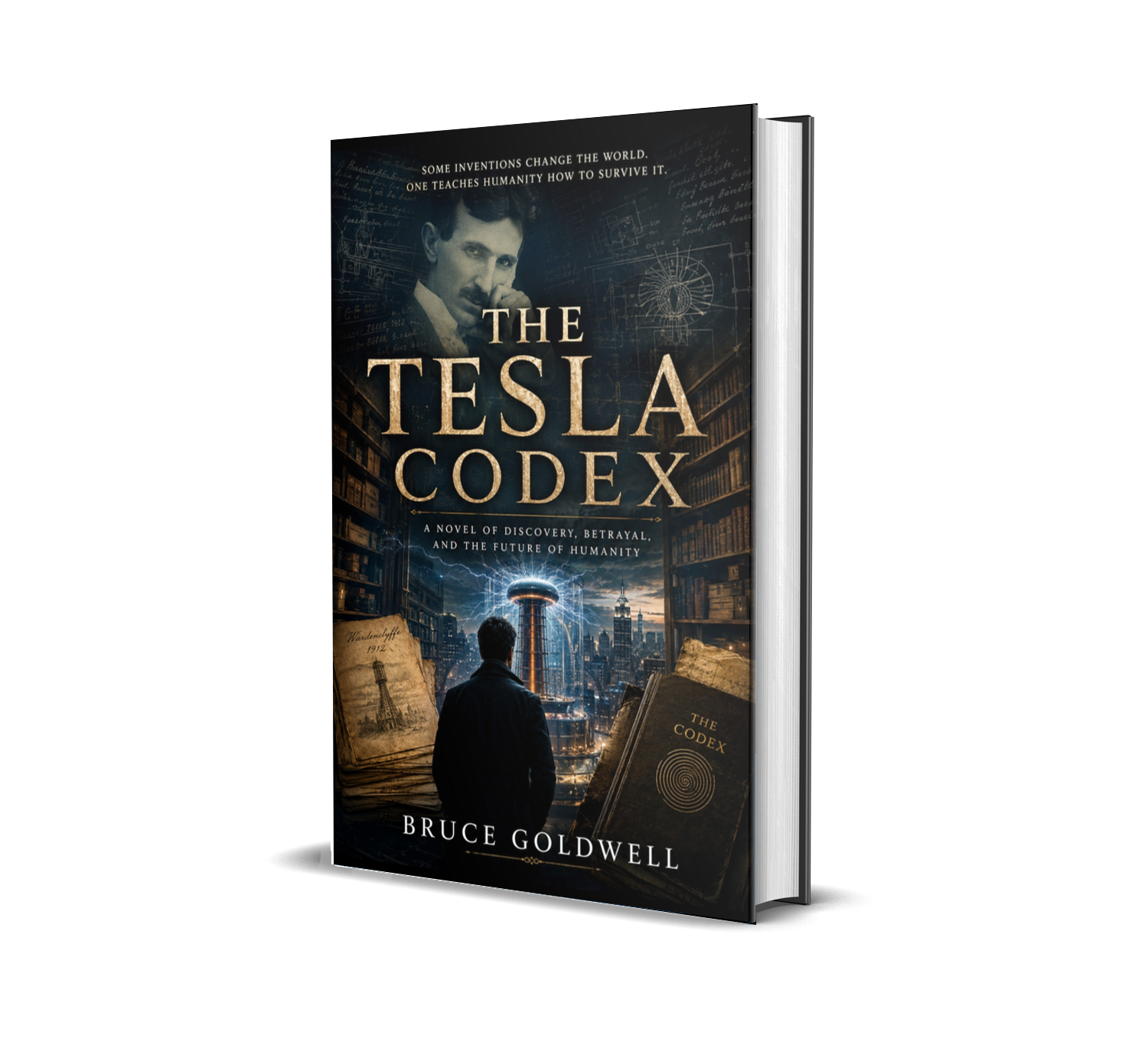
The Tesla Codex begins with a familiar legend: Nikola Tesla may have left behind discoveries the world was not ready to receive.
But instead of building the story around a lost weapon, unlimited energy device, or secret machine, the novel asks a different question.
What if Tesla's greatest final creation was a method for preserving knowledge, protecting disagreement, rewarding correction, and helping future generations separate truth from manipulation?
From that idea grew a mystery involving locked archives, forgotten repositories, private research networks, government institutions, corporations, historians, journalists, and an artificial intelligence system capable of remembering more than any human being.
The result is a thriller driven not only by danger and discovery, but by the growing realization that knowledge can be both humanity's greatest inheritance and one of its most dangerous forms of power.
The novel begins with an impossible event that forces Professor Lena Voss to question everything she believes about history, evidence, and the people she once trusted.
Renowned historian Elias Mercer is found dead inside his locked university office under circumstances that leave more questions than answers.
After his death, Lena receives a message Mercer arranged to send only if something went wrong: “The archive remembers what institutions forget.”
Mercer's message points toward a vanished archival case containing clues connected to Nikola Tesla's final years and a secret known only as the Codex.
Professor Lena Voss has spent her professional life studying archives, historical records, missing documents, and the ways institutions shape public memory. Elias Mercer was more than her mentor. He taught her to question the difference between what history records and what it leaves behind.
Following Mercer's death, Lena discovers that he had been investigating a hidden trail connected to Nikola Tesla. The evidence leads through university collections, private archives, classified research, forgotten storage facilities, and digital systems designed to preserve information beyond the reach of ordinary institutions.
Investigative journalist Victor Cross joins Lena as the search expands. Together, they uncover competing groups seeking the same discovery. Some believe the Codex should be controlled. Others want it destroyed. Still others insist that releasing it without restriction could destabilize society.
An advanced artificial intelligence known as Concordance becomes central to the investigation. Its ability to gather, compare, and preserve information makes it an extraordinary tool. It also creates a deeper danger: whoever controls the system may influence what future generations accept as truth.
Lena eventually realizes that the Codex was never intended to provide final answers. Tesla designed it as scaffolding: a structure future generations could build upon, correct, challenge, and improve.
The novel deliberately moves beyond several familiar Tesla-story expectations.
The mystery does not end with a destructive device capable of changing the balance of global power.
The Codex is not a blueprint for unlimited electricity, anti-gravity, or a miraculous technology withheld from humanity.
Artificial intelligence is important to the novel, but the story does not depend on machines replacing or conquering humanity.
No single organization controls every event. The conflict emerges from people and institutions with different motives, fears, responsibilities, and definitions of protection.
Within the novel, the Codex becomes a framework for how civilization might protect information without freezing it into unquestionable doctrine.
Conclusions lose meaning when the original evidence, context, and chain of reasoning disappear.
A healthy knowledge system should treat correction as progress rather than embarrassment or defeat.
People should learn how conclusions are reached, not simply be told which conclusions to accept.
Competing ideas should remain visible so that future generations can examine assumptions and recognize errors.
The Tesla Codex combines the pace of a mystery thriller with the questions of philosophical science fiction.
The story includes hidden evidence, secret repositories, coded messages, historical documents, competing organizations, surveillance, pursuit, betrayal, discovery, and a global race to reach the Codex.
At the same time, the novel asks readers to consider how knowledge is verified, how institutions gain authority, how technology influences memory, and whether humanity can create systems capable of admitting error.
Readers who enjoy historical mysteries, technological thrillers, artificial intelligence fiction, conspiracy suspense, and thoughtful speculative stories will find several familiar elements within the novel.
Yet the final destination is intentionally different. The greatest discovery is not an object someone can own. It is a responsibility everyone must share.
The external search for the Codex is matched by a deeper investigation into the nature of truth and responsibility.
Archives are not neutral. Decisions about preservation, classification, access, and interpretation shape collective memory.
Evidence alone may not persuade people when the institutions presenting it are no longer trusted.
A system may store every document while still losing the context, uncertainty, and human judgment that gave those documents meaning.
Information can be dangerous, but withholding it can also concentrate power and prevent accountability.
Artificial intelligence may assist human reasoning, but efficiency and memory do not automatically create wisdom or moral legitimacy.
The novel suggests that better questions, transparent methods, and teachable systems may be more valuable than permanent answers.
Nikola Tesla was a real inventor whose work helped shape the modern electrical world. His achievements, public image, unfinished projects, financial struggles, and unusual ideas have made him one of history's most fascinating scientific figures.
The Tesla Codex uses elements of Tesla's documented history as a foundation for fiction. The hidden Codex, the characters, the secret archival trail, Concordance, and the central conspiracy belong to the world of the novel.
The story does not claim that Tesla created the fictional system described in the book. Instead, it imagines the kind of intellectual legacy a visionary might leave if he believed humanity needed better ways to protect knowledge from control, distortion, and loss.
Explore Tesla HistoryThe conclusion of The Tesla Codex reflects the central belief that civilization is strengthened not by final certainty, but by preserving the ability to keep learning.
The Codex is not presented as a finished system. It is meant to remain open to challenge, interpretation, and improvement.
Knowledge survives when people learn not only information, but how to examine, question, and teach it to others.
Every generation inherits unfinished work. Its responsibility is not merely to preserve the past, but to leave better tools for those who follow.
Explore the characters, historical background, artificial intelligence concepts, themes, and discussion questions connected to the novel.
Meet Lena Voss, Victor Cross, Elias Mercer, and the individuals competing to control the future of the Codex.
Meet the CharactersExamine the novel's ideas about truth, memory, authority, correction, disagreement, trust, and responsibility.
Explore the ThemesLearn about the real inventor, his achievements, his later years, and the historical inspiration behind the novel.
Discover TeslaExplore the questions raised by Concordance, digital archives, machine memory, algorithmic authority, and human judgment.
Explore AIQuestions for book clubs, classrooms, reviewers, and readers who want to continue the conversation after finishing the novel.
View the GuideLearn more about the author, his books, and the interconnected knowledge ecosystem behind his work.
About the AuthorFollow Professor Lena Voss through hidden archives, forgotten evidence, advanced artificial intelligence, and a mystery that could change how humanity preserves truth.