More than 500 published books—and every book begins with one idea worth preserving.
Author, Publisher, Researcher, and World Builder

Bruce Goldwell

The author of more than 500 books, Bruce Goldwell has built an interconnected body of fiction, educational resources, knowledge centers, personal-development books, technology guides, music, courses, and creative concepts designed to help ideas continue growing long after a single book is finished.

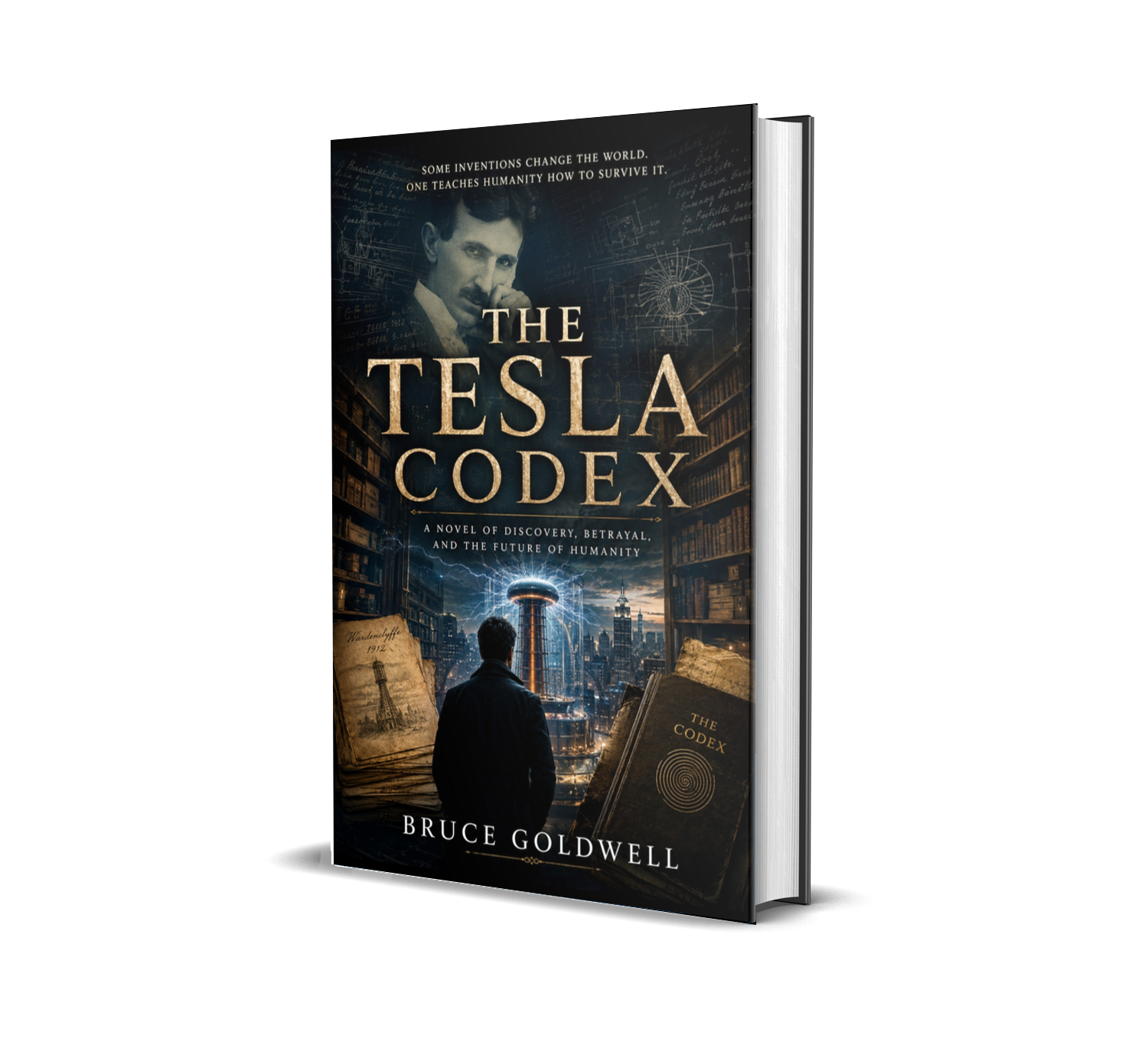
The Tesla Codex by Bruce Goldwell
Meet the Author

A Life Built Around Ideas

Bruce Goldwell is an independent author whose work crosses fiction, technology, personal development, education, artificial intelligence, history, finance, music, and imaginative world building.

His publishing journey did not begin with a traditional literary career or a carefully planned path through the publishing industry. It grew from a lifetime of varied experiences, setbacks, reinvention, curiosity, and a persistent belief that useful ideas should be shared.

Before becoming a full-time author, Bruce served in the United States Army, worked in construction, operated an architectural drafting business, taught computer programming, worked with federal computer systems, and experienced years of severe personal and financial hardship.

Those experiences gave him an unusual perspective on technology, self-reliance, resilience, human potential, and the importance of preserving knowledge in forms ordinary readers can use.

Since publishing his first book in 2007, Bruce has continued expanding his work into a growing network of books, websites, knowledge centers, courses, creative brands, stories, and educational projects.

500+ Published books across fiction and nonfiction
2007 Year his first book was published
U.S. Army Veteran with service in Vietnam and Germany
One Ecosystem Books, knowledge centers, courses, music, and ideas
Biography

From West Palm Beach to a Life of Reinvention

Bruce Goldwell's story is not a straight line from childhood ambition to literary success. It is a story of rebuilding, learning, changing direction, and repeatedly beginning again.

Born Bruce Barbre and raised in West Palm Beach, Florida, Bruce showed an early willingness to compete and perform. As a child, he became a skating champion, an experience that introduced him to discipline, practice, and the importance of continuing after mistakes.

His formal education followed a less conventional path. He later earned his GED while serving in the United States Army. Military service became one of the defining chapters of his early life.

Bruce served in the Army twice for a total of approximately six years. His service included a year in Vietnam in 1970, where he worked as a driver for a colonel, followed by several years in Germany during the mid-1970s. He received the Bronze Star.

The military taught him adaptability, responsibility, observation, and the need to remain functional under pressure. Those lessons would later appear indirectly throughout his books, especially in stories involving leadership, survival, service, courage, and personal transformation.

Building Skills Across Several Careers

After military service, Bruce worked in a number of practical and technical fields. He spent years as a carpenter and subcontractor, learning how plans become physical structures through measurement, patience, sequencing, and attention to detail.

He later worked as an architectural draftsman and operated his own drafting business. Drafting strengthened his ability to visualize a completed structure before construction began—a skill that would eventually influence how he outlined books, developed fictional worlds, and designed interconnected websites.

Bruce also became involved in computing during an era when personal and institutional computer systems were still developing. He worked as a computer programmer, taught programming at the high-school level, and later worked as a computer operator for the federal government.

That experience gave him a long-term interest in how technology changes work, education, communication, and access to information. Decades later, that foundation helped him recognize artificial intelligence not simply as a new software trend, but as another major transition in how people create and use knowledge.

Hardship and the Long Road Back

In 1989, a serious back injury changed the direction of Bruce's life. The years that followed included financial instability, physical limitations, and an extended period of homelessness.

During the late 1990s, he lived in the Venice and Santa Monica areas of California. His homelessness lasted for years and became one of the most difficult periods of his life.

The experience reshaped the way he thought about dignity, opportunity, persistence, fear, faith, and the assumptions people make about those who have lost conventional stability.

By 2000, Bruce had relocated to Utah and began rebuilding. He continued studying personal development, belief, motivation, and the relationship between thought and action.

A person can lose money, possessions, status, and certainty without losing the ability to imagine a new beginning.
Bruce Goldwell

The release of The Secret in 2006 became an important turning point. Its message connected with ideas Bruce had already been exploring about belief, expectation, gratitude, visualization, and personal responsibility.

Rather than treating inspiration as an ending, he used it as a reason to act. In 2007, he published his first book and began the long process of building a body of work that would eventually include hundreds of titles.
An Unconventional Career

Every Earlier Life Became Part of the Author

Bruce's books draw from a combination of practical experience, technical curiosity, personal hardship, imagination, and a belief that knowledge becomes more valuable when it can be used.

Military Service

Leadership, Duty, and Survival

Army service exposed Bruce to responsibility, hierarchy, uncertainty, discipline, and the consequences of decisions. These ideas later became important in his military, leadership, adventure, and science-fiction writing.

Construction

Building One Step at a Time

Carpentry taught him that even a complex structure is created through a sequence of smaller actions. The same principle now guides his approach to writing books and developing large knowledge ecosystems.

Architectural Drafting

Seeing the Structure Before It Exists

Drafting strengthened his ability to think visually, plan interconnected components, and imagine a finished structure before every detail had been created.

Computer Programming

Systems, Logic, and Technology

Programming introduced Bruce to structured problem solving, information systems, automation, and the relationship between human instructions and machine output.

Teaching

Making Complex Ideas Understandable

Teaching programming helped him learn that information is most useful when it is organized clearly enough for another person to understand and apply.

Publishing

Turning Experience Into Resources

Independent publishing allowed Bruce to combine all of these earlier skills into books, guides, stories, courses, websites, and creative projects without waiting for a traditional institution to approve each idea.

Milestones

The Road to Becoming an Author

Each chapter of Bruce's life contributed knowledge, perspective, or discipline that later became part of his creative work.

  1. Early

    Childhood in West Palm Beach

    Bruce grew up in Florida and became a skating champion as a child, gaining an early understanding of practice, performance, and persistence.

  2. 1970

    Service in Vietnam

    While serving in the United States Army, Bruce spent a year in Vietnam and worked as a driver for a colonel.

  3. 1970s

    Army Service in Germany

    Bruce later served for several years in Germany during his second period of Army service.

  4. Career

    Construction and Drafting

    He worked as a carpenter, subcontractor, architectural draftsman, and business owner, developing practical and visual problem-solving skills.

  5. Tech

    Programming, Teaching, and Federal Computing

    Bruce worked as a programmer, taught computer programming, and operated federal computer systems during the earlier development of modern digital technology.

  6. 1989

    Life-Changing Back Injury

    A serious back injury disrupted his working life and began a prolonged period of instability and hardship.

  7. 1990s

    Years of Homelessness

    Bruce experienced an extended period of homelessness, including years in the Venice and Santa Monica areas of California.

  8. 2000

    Rebuilding in Utah

    A move to Utah became part of a new chapter focused on rebuilding stability and redefining his future.

  9. 2006

    A New Personal-Development Direction

    The ideas popularized through The Secret reinforced Bruce's interest in belief, visualization, gratitude, expectation, and purposeful action.

  10. 2007

    First Book Published

    Bruce entered independent publishing and began building what would eventually become a catalog of more than 500 books.

  11. Today

    An Interconnected Creative Ecosystem

    His work now includes fiction, nonfiction, knowledge centers, educational programs, music, websites, courses, licensing concepts, and AI-supported research projects.

Writing Philosophy

A Book Is the Beginning of an Idea

Bruce does not view a book as an isolated product. He sees it as the center of a larger structure that may include websites, learning paths, related books, videos, music, communities, courses, tools, and future creative possibilities.

01

Make Knowledge Accessible

Complex subjects should be organized so that ordinary readers can understand the central ideas without needing years of technical training.

02

Build From Lived Experience

Personal hardship, work experience, military service, mistakes, and reinvention can become useful knowledge when shared honestly and constructively.

03

Connect Books to Larger Worlds

A story or nonfiction book can become the foundation for a larger network of related pages, resources, characters, lessons, and discoveries.

04

Use Technology as an Assistant

Digital tools and artificial intelligence can support research, organization, editing, design, and discovery while human judgment remains responsible for the final work.

05

Keep Creating

Progress often comes from consistency rather than waiting for perfect circumstances. Each completed project creates knowledge that can improve the next one.

06

Leave Something Useful Behind

Books and knowledge centers can preserve lessons, ideas, imagination, research, and encouragement for readers the author may never personally meet.

I thought I was writing books. Over time, I realized I was building an interconnected world of books, brands, ideas, education, and discovery.
Bruce Goldwell
Behind the Novel

Why Bruce Wrote The Tesla Codex

The novel grew from Bruce's long-standing interest in inventors, emerging technology, hidden records, artificial intelligence, institutional authority, and the ways history can be remembered, distorted, or lost.

Nikola Tesla has become one of history's most fascinating inventors—not only because of what he achieved, but because of the distance between the documented man and the mythology that grew around him.

Tesla's real accomplishments were extraordinary. His work helped establish alternating-current power systems, advanced motor technology, expanded high-frequency electrical research, and demonstrated new possibilities in radio control and wireless communication.

At the same time, Tesla became associated with stories about secret inventions, suppressed technology, lost papers, unlimited energy, and discoveries supposedly hidden from the public.

Bruce recognized that this combination of history and legend could support a suspenseful novel. Yet he did not want to repeat the familiar idea that a lost Tesla machine would suddenly provide free energy or unlimited power.

Instead, he asked a different question:

What if Tesla's greatest lost contribution was not a machine—but a method for preserving knowledge, tracing evidence, recording disagreement, and preventing powerful institutions from quietly rewriting the past?

That question became the foundation of The Tesla Codex.

The resulting story combines historical mystery, fictional technology, artificial intelligence, institutional conflict, and a philosophical debate about whether humanity is prepared to inherit everything it discovers.

Experience Behind the Ideas

Technology, Systems, and the Human Cost of Decisions

Although The Tesla Codex is fiction, many of its deeper concerns connect with experiences Bruce has carried throughout his life.

His work with computers taught him that every system reflects human instructions, limitations, assumptions, and priorities. A machine may produce an answer quickly, but speed does not remove the need to examine the information entering the system.

His experience in architectural drafting taught him to think about structures as relationships between components. A building remains standing only when its pieces support one another. Knowledge systems work in a similar way. Conclusions depend on evidence, sources, context, interpretation, and the ability to correct weaknesses.

His military background provided a direct understanding of hierarchy, restricted information, operational security, duty, and the reality that decisions made by institutions can affect people far from the room where those decisions occur.

His years of homelessness taught him how easily a person's experience can disappear from official narratives. Institutions may preserve statistics while losing the human meaning behind them.

His publishing career taught him that gatekeepers influence which ideas receive attention, which voices become visible, and which work remains difficult to discover.

Together, these experiences helped shape a novel in which the greatest danger is not simply a weapon, machine, or secret. The deeper danger is a system that controls what people are allowed to know while hiding the process through which that control was created.

Technology can organize information. Only people can decide whether that information will be used to enlighten, protect, manipulate, or control.
Bruce Goldwell
Beyond One Book

The Bruce Goldwell Interconnected Knowledge Ecosystem

Bruce's books are increasingly connected to dedicated websites, subject hubs, learning resources, related books, tools, and discovery paths that help readers continue exploring.

For many years, Bruce approached publishing primarily as the process of completing one book and then beginning another.

Over time, he recognized that hundreds of books had created something larger: a network of recurring subjects, fictional worlds, practical lessons, educational resources, personal experiences, and connected ideas.

That realization led to the development of an interconnected knowledge ecosystem.

In this model, a book becomes a starting point. A reader may continue into a knowledge center, related article, historical background page, educational guide, course, video, music project, companion book, or another creative world.

Search engines and artificial intelligence systems can also use these connections to understand how Bruce's work fits together. Rather than leaving each book isolated on a retail page, the ecosystem provides context, relationships, explanations, and pathways for deeper discovery.

Bruce Goldwell Knowledge Base

A central author resource covering Bruce's life, books, bibliography, creative projects, educational programs, interviews, research, and publishing history.

Explore the Author Knowledge Base

Interconnected Ecosystem

A dedicated section explaining how books, knowledge centers, websites, courses, music, fictional worlds, and licensing concepts connect.

Explore the Ecosystem

AI Knowledge Center

A growing educational hub covering artificial intelligence, prompting, AI tools, responsible use, verification, research, creativity, publishing, and application development.

Visit the AI Knowledge Center

XRP Knowledge Center

An extensive educational resource explaining XRP, the XRP Ledger, digital finance, utility, valuation, institutional adoption, wallets, history, and related books.

Visit the XRP Knowledge Center

Law of Attraction Center

A knowledge hub exploring belief, visualization, gratitude, identity, conscious creation, personal change, action, manifestation practices, and related books.

Visit the Law of Attraction Center

Licensing and Creative Concepts

A portfolio of fictional worlds, entertainment concepts, educational brands, restaurant ideas, immersive destinations, and properties available for future collaboration.

Explore Licensing Opportunities

The purpose of the ecosystem is not simply to promote more books. It is to preserve ideas, create relationships between subjects, help readers continue learning, and allow each project to support the growth of the others.

A Growing Publishing Catalog

Books Across Fiction, Technology, Personal Growth, and Finance

Bruce Goldwell's publishing catalog includes more than 500 books spanning imaginative fiction, artificial intelligence, personal development, digital finance, health, education, leadership, creativity, and practical learning.

The variety within Bruce's catalog reflects a lifelong habit of following questions wherever they lead.

Some books begin with a personal experience. Others begin with a change in technology, a historical mystery, a new financial system, a creative world, a lesson learned through hardship, or a subject readers may find difficult to understand.

Rather than limiting himself to one publishing category, Bruce has created an expanding body of work that allows fiction, nonfiction, educational resources, and practical guides to support one another.

A reader may discover Bruce through an adventure novel, continue into a personal-development book, explore one of his knowledge centers, and later use an educational guide or online resource.

Fiction

The Tesla Codex

A technological mystery involving Nikola Tesla, artificial intelligence, hidden archives, institutional power, and the future of humanity's relationship with truth.

Fantasy

Dragon Keepers

A multi-book fantasy series built around dragons, chosen protectors, courage, friendship, destiny, and the struggle between darkness and hope.

Science Fiction

Starfighters

A science-fiction adventure series exploring planetary defense, teamwork, leadership, advanced technology, and humanity's place in a larger universe.

History and Citizenship

Foundations of Freedom

A series created to help readers understand American principles, constitutional ideas, civic responsibility, national history, and the continuing meaning of freedom.

Personal Development

Law of Attraction Books

Books focused on belief, gratitude, visualization, identity, prosperity, conscious creation, resilience, and purposeful action.

Digital Finance

XRP and Crypto Books

Beginner guides, market analysis, utility discussions, institutional adoption studies, valuation frameworks, and practical resources for understanding digital assets.

Artificial Intelligence

AI Guides and Training

Accessible books explaining AI tools, prompting, verification, productivity, research, publishing, creative workflows, responsible use, and emerging opportunities.

Health and Wellness

Frequency and Wellness Books

Exploratory books examining sound, vibration, wellness practices, personal preparation, mindset, and emerging ideas within alternative-health communities.

Bruce's catalog is not defined by one genre. It is defined by a desire to explore possibilities, organize information, encourage readers, and turn ideas into resources that can continue growing.

Imaginative Worlds

Fiction as a Laboratory for Possibility

Bruce uses fiction to explore courage, leadership, technology, identity, responsibility, destiny, hope, and the consequences of human choices.

Fiction allows questions to become experiences.

Instead of merely explaining an idea, a story can place readers inside a decision, allow them to feel the cost of failure, and reveal how different personalities respond to the same crisis.

Bruce's fictional projects range from fantasy adventures and science-fiction conflicts to historical mysteries and conceptual entertainment worlds.

Although the settings vary, many of the stories return to similar questions: What makes someone worthy of trust? How does a person become a leader? What should be protected? When should a rule be challenged? What happens when power grows faster than wisdom?

D

Dragon Keepers

A fantasy universe where young heroes, ancient creatures, responsibility, loyalty, and destiny intersect.

S

Starfighters

A science-fiction world built around planetary defense, teamwork, courage, advanced training, and leadership under pressure.

T

The Tesla Codex

A mystery combining real history, fictional archives, artificial intelligence, institutional conflict, and a discovery tied to humanity's future.

C

CelestiSphere

A conceptual immersive destination combining entertainment, education, futuristic design, spectacle, and storytelling.

R

StarReach Tower

A visionary entertainment and architectural concept designed around space, observation, imagination, and human aspiration.

X

Xtasy Land Cruises

A land-based resort concept recreating the luxury, activities, dining, and atmosphere of a cruise ship without sailing.

Belief, Identity, and Action

Personal-Development Books Built From Experience

Bruce's personal-development work is shaped by the belief that thought matters most when it changes identity, choices, persistence, and action.

Bruce's interest in personal development did not begin as an abstract study. It grew from the need to rebuild his own life.

Years of injury, instability, homelessness, and uncertainty forced him to examine the relationship between inner belief and outer action.

He became interested in gratitude, visualization, affirmations, expectation, faith, self-concept, and the Law of Attraction. Yet his books repeatedly emphasize that intention becomes more effective when paired with action.

Visualization can help a person see a different future. Belief can make that future feel possible. Identity can influence behavior. But progress still requires decisions, habits, persistence, learning, and movement.

This practical approach appears throughout his personal-growth catalog and in the Law of Attraction Knowledge Center.

Belief opens the door, but action is what carries you through it.
Bruce Goldwell

Recurring Ideas in the Personal-Development Books

  • Identity influences the actions a person is willing to take.
  • Gratitude shifts attention toward possibility and available resources.
  • Visualization helps the mind rehearse a new future.
  • Repeated thought can strengthen belief, expectation, and emotional direction.
  • Faith becomes stronger when supported by consistent behavior.
  • Small actions can create a ripple that changes relationships, opportunities, and future decisions.
  • Past hardship does not have to become a permanent identity.
  • A person can begin rebuilding before every condition feels perfect.
Artificial Intelligence

Helping Readers Understand and Use AI

Bruce approaches artificial intelligence as a powerful creative, educational, research, and productivity tool that still requires verification, judgment, responsibility, and human direction.

Bruce's early experience with programming and computer systems gave him a foundation for recognizing the importance of the current AI transition.

He has watched computers evolve from specialized systems used by trained operators into everyday tools capable of assisting with writing, research, design, analysis, communication, planning, coding, and creative production.

His AI books and knowledge-center pages are designed for readers who may feel overwhelmed by the speed of change.

Rather than presenting AI as magic, he emphasizes that these systems work through data, models, probabilities, instructions, and patterns. They can produce useful answers, but they can also produce errors, outdated information, fabricated details, and overconfident conclusions.

Responsible AI use therefore requires both opportunity and caution.

AI can help a person create faster, research more broadly, organize complex projects, and discover connections—but the human user remains responsible for verification, judgment, ethics, and the final decision.

The AI Knowledge Guide

A practical introduction to understanding, using, verifying, and building with modern artificial intelligence.

Explore AI Books

AI Knowledge Center

A structured learning hub with beginner explanations, tool guides, creator resources, responsible-use pages, verification guidance, and practical applications.

Visit the AI Knowledge Center

AI for Authors

Resources covering book research, outlining, writing, editing, descriptions, keywords, marketing, and the creation of interconnected publishing systems.

Explore AI for Authors
Digital Finance

Making XRP and Blockchain Concepts Easier to Understand

Bruce's digital-finance books and online resources are intended to help readers move beyond headlines, hype, and simple price predictions.

Digital assets can be difficult for beginners because the subject combines technology, finance, regulation, speculation, payments, custody, networks, and rapidly changing terminology.

Bruce's XRP books and knowledge-center pages organize these ideas into learning paths that begin with basic questions and gradually move into utility, infrastructure, adoption, liquidity, tokenization, stablecoins, market behavior, and valuation.

His work also examines the difference between a digital asset's market price and the larger network that may support its use.

Rather than relying on one valuation method, Bruce encourages readers to consider multiple factors, including utility, liquidity, transaction demand, circulating supply, infrastructure, regulation, institutional adoption, speculation, and risk.

Understanding an asset requires more than asking how high the price might go. It requires understanding what the network does, who may use it, what risks remain, and how value could move through the system.
Bruce Goldwell
Beginner Education

XRP and Digital Finance Basics

Clear introductions to XRP, the XRP Ledger, wallets, exchanges, custody, transactions, common mistakes, and digital-finance terminology.

Utility

Payments and Settlement

Exploration of cross-border payments, liquidity, settlement, tokenization, stablecoins, institutional infrastructure, and real-world financial use.

Valuation

Beyond Market Capitalization

Pages and books examining velocity, liquidity, infrastructure, multiplier effects, tokenized assets, transaction demand, and scenario-based valuation.

Research

A Living Knowledge Center

The XRP Knowledge Center connects foundational education, technical explanations, book resources, research pages, valuation frameworks, and learning paths.

Education and Training

Turning Books Into Learning Experiences

Bruce has expanded selected subjects into courses, academies, learning paths, workbooks, certificates, and interactive educational systems.

Starfighters Academy

A futuristic educational system using the structure of a space academy to teach leadership, artificial intelligence, reality engineering, entrepreneurship, and creator skills.

Explore Starfighters Academy

AI Command

A guided learning division introducing artificial intelligence, responsible use, prompting, verification, and practical applications.

Explore AI Command

Command Leadership

A structured program focused on communication, decision-making, steadiness, strategy, teamwork, responsibility, and leadership.

Explore Leadership Training

Creator Command

Training designed to help creators build identity, content, audience, monetization systems, AI workflows, and long-term creative assets.

Explore Creator Command

Entrepreneur Command

A practical entrepreneurship division covering ideas, customers, offers, systems, execution, resilience, and business-building principles.

Explore Entrepreneur Command

Success Academy

Personal-development courses, affirmations, meditations, workbooks, challenges, and lessons designed to support belief, identity, action, and personal transformation.

Explore Success Academy
Research and Creation

How Bruce Develops Books and Knowledge Centers

Bruce's process combines curiosity, outside research, artificial intelligence, human judgment, iterative planning, writing, visual design, publishing, and website development.

Most projects begin with a question, a pattern, a change in the world, or an idea that seems capable of becoming something larger.

Bruce gathers information from multiple sources, compares explanations, identifies recurring themes, and looks for gaps that readers may need help understanding.

He may use research platforms to collect current information, artificial intelligence systems to explore additional angles, and ChatGPT as a primary partner for organization, planning, drafting, editing, coding, and creative development.

This process remains iterative. A book outline may produce a new chapter. A chapter may suggest a companion book. A finished book may reveal the need for a knowledge center. A knowledge-center page may expose a missing topic that becomes another page, course, tool, or future publication.

01

Identify the Core Question

The project begins by defining what readers need to understand, experience, solve, imagine, or reconsider.

02

Gather and Compare Research

Multiple sources and viewpoints are collected so the subject is not built around one unsupported claim or narrow perspective.

03

Build the Structure

The material is organized into chapters, sections, learning paths, timelines, themes, or connected pages.

04

Draft and Refine

The writing is expanded, reorganized, edited, corrected, and improved until the ideas form a complete reader experience.

05

Create the Visual Identity

Covers, hero images, diagrams, thumbnails, and promotional visuals are developed to communicate the project's tone.

06

Connect the Project

The finished work is linked to related books, knowledge hubs, resources, educational programs, and future projects.

Human-Directed AI

Artificial Intelligence as a Creative Partner

Bruce uses AI to extend his ability to research, organize, create, verify, publish, and build—but not to remove his own responsibility for the work.

Bruce's creative process often begins with research collected from several systems and sources.

He uses research-oriented AI tools to explore current subjects, compare information, and identify additional questions. He may use other systems to challenge an idea, offer alternate interpretations, or identify missing information.

ChatGPT serves as his primary creative and development assistant. Together, Bruce and the AI may create book plans, chapter structures, website architecture, HTML pages, descriptions, keywords, promotional copy, image concepts, educational modules, and connected knowledge systems.

Bruce provides the original direction, gathered information, personal experience, publishing goals, desired tone, and final judgment.

AI assists with speed, organization, expansion, iteration, and technical production.

The result is a collaborative workflow in which human vision directs machine capability.

AI does not decide what Bruce believes, which projects matter, what experiences shaped him, or what final message a book should carry. Those decisions remain human.

Author Mission

Preserve Ideas, Encourage Readers, and Build Possibility

Bruce's mission is to turn ideas, experiences, research, and imagination into resources that may help readers see new possibilities.

Some readers may discover courage through a fantasy story. Others may learn how artificial intelligence works, understand a digital-finance concept, reconsider an old belief, begin writing a book, or recognize that a difficult past does not have to determine the future.

Bruce does not expect every project to reach every reader. His catalog is intentionally broad because different people enter learning through different doors.

A reader interested in Tesla may discover artificial intelligence. A reader interested in AI may discover publishing. A reader interested in publishing may discover personal growth. A reader interested in personal growth may discover a fictional world that restores imagination and hope.

The interconnected ecosystem makes those pathways visible.

One book can become a ripple. A connected body of ideas can become an ecosystem that continues reaching people long after the first page was written.
Bruce Goldwell
Service Beyond Publishing

Remembering Veterans and People Rebuilding Their Lives

Bruce's military service and experience with homelessness continue to influence the causes and communities he cares about.

As a Vietnam veteran, Bruce understands that service can continue affecting a person's life long after military duty ends.

His own years without stable housing also gave him a personal understanding of how difficult it can be to rebuild once someone loses health, income, housing, confidence, or access to ordinary support systems.

These experiences have influenced his support for veteran-focused charitable work and his belief that dignity should not depend on current financial circumstances.

They also inform the recurring themes of second chances, resilience, service, courage, and renewal found throughout his books.

Readers, Authors, and Creators

Building Connections Around Books

Bruce believes publishing becomes stronger when authors, readers, reviewers, researchers, and creators help one another discover meaningful work.

Readers

Continue Beyond the Final Page

Knowledge centers, reading guides, related books, timelines, background pages, and topic hubs help readers continue exploring after finishing a book.

Authors

Share Knowledge and Support

Bruce has created author resources, networking communities, review guidance, publishing tools, and educational content designed to help independent writers.

Creators

Turn Ideas Into Assets

His creator-focused work encourages people to build websites, videos, books, courses, brands, knowledge systems, and long-term intellectual property.

Educators

Use Stories to Begin Learning

Reading guides, historical background, discussion questions, workbooks, and academy programs allow stories and books to support structured learning.

An Invitation

Enter the Story—Then Follow the Idea

Bruce invites readers to approach The Tesla Codex as both a mystery and a doorway into larger questions.

The novel can be read for suspense, investigation, historical intrigue, technological speculation, and character conflict.

It can also begin a deeper conversation about artificial intelligence, digital archives, public memory, source verification, scientific responsibility, secrecy, authority, and the future of knowledge.

Readers who want to continue can explore the history behind Nikola Tesla, the characters, the themes, the AI concepts, and the discussion guide available throughout this microsite.

The book is the beginning of the journey—not the end.

Continue Exploring

Discover More About The Tesla Codex

Explore the story, characters, themes, history, artificial intelligence, and discussion resources connected to the novel.

The Novel

About the Book

Discover the premise, central mystery, fictional technology, and creative vision behind The Tesla Codex.

About the Novel
People

Characters

Meet Professor Lena Voss, Victor Cross, Professor Elias Mercer, Concordance, and the forces competing for the archive.

Meet the Characters
Ideas

Themes

Examine truth, knowledge preservation, secrecy, correction, institutional power, and humanity's inheritance.

Explore the Themes
History

Nikola Tesla

Explore Tesla's life, inventions, ambitions, unfinished projects, documented achievements, and cultural legacy.

Discover Tesla
Technology

AI and the Future

Explore machine memory, verification, algorithmic authority, digital archives, and human responsibility.

Explore AI
Discussion

Reading Guide

Use book-club questions, character prompts, ethical dilemmas, classroom activities, and post-reading discussion topics.

View the Reading Guide
Discovery, Betrayal, and Humanity's Future

Read The Tesla Codex

Join Professor Lena Voss and Victor Cross as they uncover a hidden archive tied to Nikola Tesla, artificial intelligence, institutional secrecy, and a discovery that could change how humanity preserves truth.