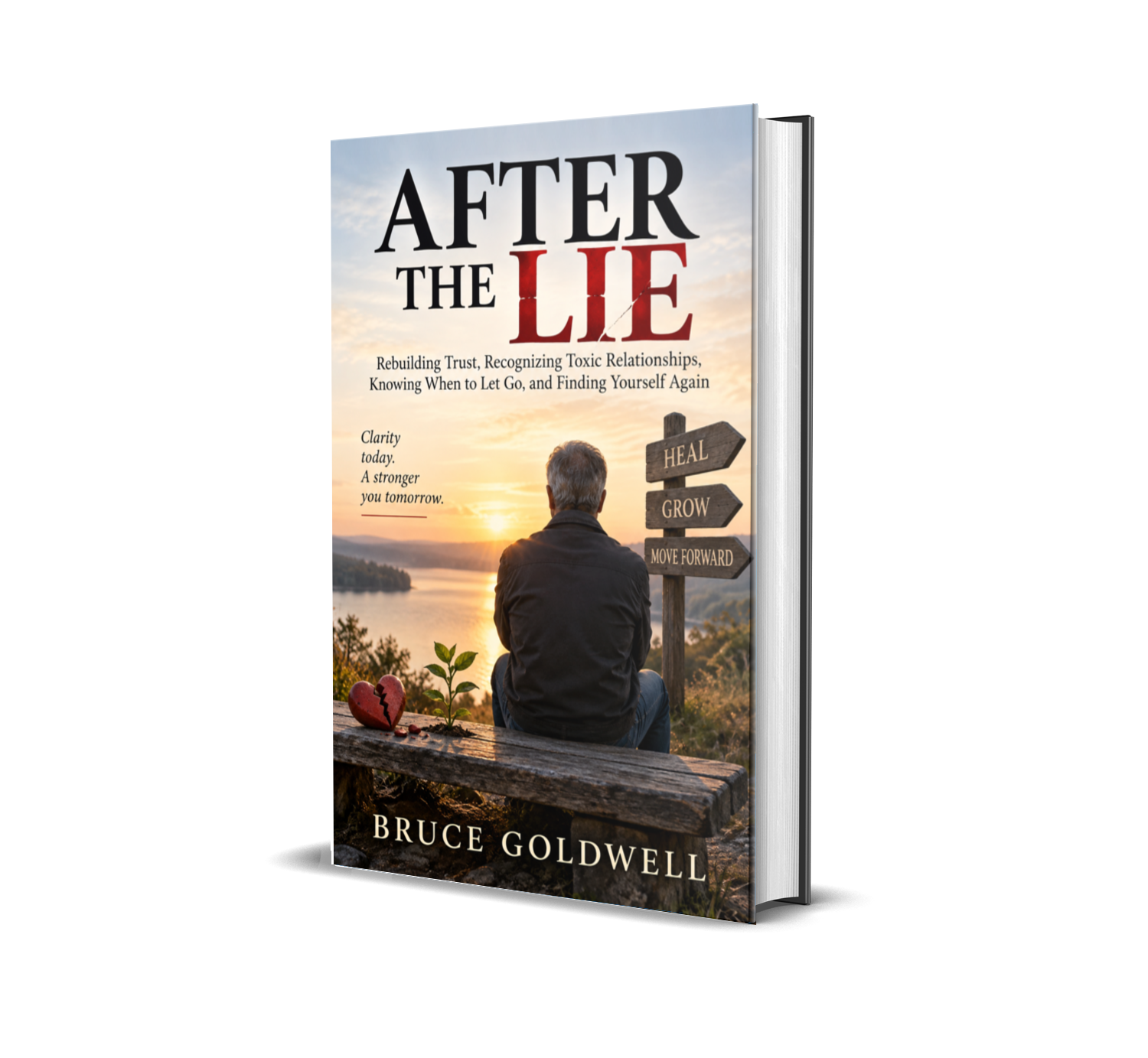
Millions of people eventually face a question they never expected to have to ask:
Can I trust them again?
That question can appear after infidelity, dishonesty, hidden messages, financial secrets, repeated broken promises, emotional betrayal, or simply the discovery that someone you love has not been completely honest about who they are or what they have been doing.
After seeing how many people search for answers to questions like these, Bruce Goldwell decided to create a book focused not simply on saving relationships, but on helping readers see their relationships more clearly.
After the Lie does not tell you that every relationship should be saved.
It also does not tell you that every betrayal should end one.
Instead, it helps you examine what happened, what has changed, what has not changed, and what the relationship is actually costing you.
After betrayal, many people ask:
“Do I still love them?”
But love does not always answer the question of whether a relationship is safe, healthy, respectful, or capable of being rebuilt.
A more useful question may be:
“Is trust actually being rebuilt—or am I just being asked to forget what happened?”
That distinction is at the heart of After the Lie.
Trust is not restored because someone says the right words. It is rebuilt when behavior repeatedly supports those words.
TRUTH → ACCOUNTABILITY → CONSISTENCY → TIME → TRUST
Betrayal rarely creates only one question. It creates dozens.
Learn the difference between remorse, promises, accountability, and lasting behavioral change.
Understand where healthy independence ends and deception begins.
Learn to distinguish ordinary relationship struggles from destructive patterns involving control, manipulation, contempt, dishonesty, or chronic blame.
Explore the difference between staying because a relationship is healing and staying because you are afraid to let go.
Recognize when generosity becomes overgiving and when one person is carrying a relationship that should belong to two people.
Rebuild confidence in your own judgment after betrayal has made you question what you saw, what you believed, and what you missed.
One of the central ideas in After the Lie is that healthy relationships should not be built around “give and take.”
When one person becomes the giver and another becomes the taker, the relationship can slowly become unbalanced.
Healthy relationships are better described as give and receive.
That does not mean every day is divided evenly.
During illness, grief, financial difficulty, stress, or other challenging seasons, one person may temporarily carry more.
But over time, both people should experience care, support, affection, respect, listening, understanding, and appreciation.
Explore Give and Receive“Don't give until you disappear.”
“A healthy relationship isn't give and take. It is give and receive.”
Another central lesson of the book is simple:
“Never confuse someone's potential with their pattern.”
Potential is what someone could become.
Pattern is what they repeatedly choose.
Relationships are often prolonged because one person remains committed to the future version of someone they hope will eventually appear.
But your life is being lived with the person who exists today.
Hope matters.
Evidence matters more.
Potential vs. PatternSometimes the question is not whether you can keep a relationship.
The question is what keeping it requires you to surrender.
Are you constantly anxious, suspicious, or waiting for the next painful discovery?
Are you accepting behavior that once would have been unacceptable to you?
Have you gradually stopped being yourself in order to keep the relationship?
Have important people slowly disappeared from your life?
Have your goals and possibilities been repeatedly postponed?
Are you remaining because of history rather than because the future still makes sense?
“Don't ask only, ‘How do I keep this person?’ Ask, ‘What is keeping this person costing me?’”
No author can know every detail of your relationship.
After the Lie does not exist to tell you what decision you should make.
It exists to help you see what is happening clearly enough to make your own decision.
Sometimes that decision will be to rebuild.
Sometimes it will be to establish stronger boundaries.
Sometimes it will be to leave.
And sometimes the most honest answer is:
“I don't know yet. Show me.”
“Love can tell you why you want the relationship. Trust helps tell you whether the relationship can safely hold that love.”
The 23 chapters move from the moment trust breaks to the moment you begin trusting yourself again.
Understand betrayal, apologies, secrecy, questions, checking, rumination, and the evidence required to rebuild trust.
Examine toxic patterns, overgiving, potential versus pattern, fear of being alone, and whether the relationship still belongs in your future.
Learn how to let go when necessary, avoid rushing into a replacement relationship, rebuild your identity, attract healthier relationships, and trust yourself again.
And never lose yourself trying to keep someone else.
Whether your journey leads toward rebuilding the relationship or walking away from it, there is one relationship this book will continually bring you back to:
The relationship you have with yourself.