Reviews of After the Lie

A plainspoken guide to what happens after trust breaks— and how to decide what comes next.

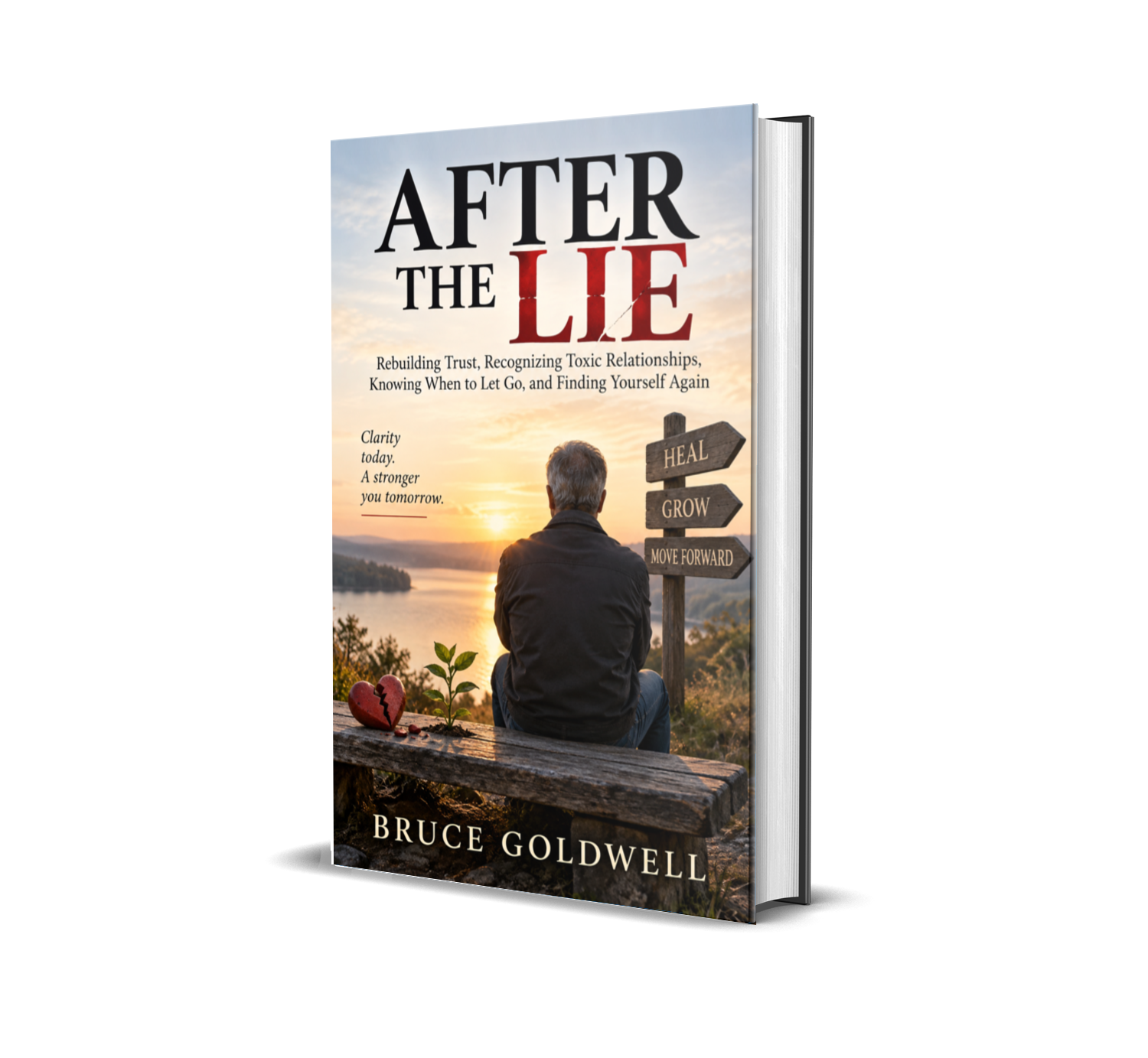
After the Lie by Bruce Goldwell

Why This Book Was Written

After the Lie began with a simple observation: people are searching for answers after trust has been broken.

They are searching questions such as:

“Can I trust them again?”

“Should I stay or leave?”

“How do I know if this relationship has become toxic?”

“How do I stop thinking about what happened?”

“How do I let go of someone I still love?”

“How do I trust myself again?”

Those are not abstract relationship questions.

They are questions people ask when something has happened and they are trying to decide what to do next.

“The real question after the lie is not simply, ‘Can I forgive what happened?’ It is, ‘What do I do now that I know?’”

After the Lie Is About What Comes Next

The book is not written merely to describe betrayal.

It is written to help readers respond to it.

Can Trust Be Rebuilt?

Learn why trust requires truth, accountability, consistency, and time—not promises alone.

Is the Apology Enough?

Understand the difference between regret, accountability, and actual behavioral change.

Is This Difficult—or Destructive?

Examine repeated dishonesty, control, manipulation, contempt, chronic blame, and other destructive patterns.

Should I Stay or Leave?

Step away from fear and promises long enough to examine the evidence in front of you.

How Do I Let Go?

Learn why loving someone and leaving them can sometimes both be true.

How Do I Trust Myself Again?

Rebuild confidence in your judgment, boundaries, decisions, and future.

Grok Review

An AI review of the manuscript highlighted the book's practical focus and clear central framework.

“A plainspoken guide to what happens after trust breaks— how to tell repair from a cycle, and how to decide without disappearing.”

— Grok review of After the Lie

What the Review Found Strongest

A Clear Framework

The review highlighted the book's central sequence:

Truth → Accountability → Consistency → Time → Trust

Practical Questions

The early chapters were noted as especially strong because they focus directly on the questions people ask after betrayal.

Give and Receive

The book's distinction between “give and take” and “give and receive” was recognized as a memorable idea.

Potential vs. Pattern

The review highlighted the importance of separating who someone might become from what they repeatedly do.

Privacy vs. Secrecy

The book's distinction between healthy individuality and hidden behavior that changes the meaning of the relationship was another strong theme.

A Responsible Stay-or-Leave Approach

The book does not tell readers what decision to make. It allows room for:

“I don't know yet. Show me.”

“Love can tell you why you want the relationship. Trust helps tell you whether the relationship can safely hold that love.”

Sample Reader Reactions

The following are illustrative sample reviews showing the kinds of reader responses the book is designed to inspire. They are not presented as verified customer reviews.

“This is the kind of book I would have wanted immediately after discovering the lie. It doesn't tell you to forgive, leave, stay, or pretend everything will be fine. Instead, it gives you questions to ask and things to watch. The section on potential versus pattern hit me hardest. I realized I had been making decisions based on who I hoped someone would become instead of who they repeatedly showed me they were.”

— Sample Reader Review

“What I liked most is that this book doesn't make every relationship problem a reason to leave. It also doesn't tell you that love means staying no matter what. The truth-accountability-consistency-time framework helped me understand the difference between an apology and actual repair. The biggest lesson for me was that rebuilding trust isn't only about whether I can trust someone else again. It is also about whether I can trust myself.”

— Sample Reader Review

What Do You Do After the Lie?

That is the question this entire book is designed to help answer.

Not with one universal answer.

But with a process for seeing clearly.

DISCOVERY Something changes what you thought was true.
TRUTH You determine what actually happened.
ACCOUNTABILITY You look for responsibility rather than excuses.
CONSISTENCY You watch what happens after the promises.
TIME You allow behavior to reveal whether change is real.
DECISION You decide what the evidence means for your future.

This Is Not Just a Book About Saving Relationships

Sometimes the relationship deserves another chance.

Sometimes trust can be rebuilt.

Sometimes both people become more honest, more accountable, and more committed.

But sometimes the evidence points in another direction.

The book allows for both possibilities.

“The question is not only, ‘Can this relationship be saved?’ It is also, ‘Does this relationship deserve to be saved?’”

Promises Are Not the Final Evidence

One of the central ideas running throughout After the Lie is simple:

“An apology can begin the conversation. It cannot finish the repair.”

The reader is encouraged to watch what comes afterward.

Is there more truth?

Is there accountability?

Are boundaries respected?

Does the behavior change?

Does that change continue after the crisis passes?

A Different Question About Staying

Many people ask:

“How do I keep this person?”

After the Lie asks another question.

“What is keeping this person costing me?”

Peace

Confidence

Self-Respect

Friendships

Dreams

Yourself

Who Is After the Lie For?

This book may be especially useful if you are asking:

Can I ever trust them again?

How do I know whether their apology is real?

Is this relationship toxic or simply going through a difficult period?

Should I stay or leave?

Why do I keep thinking about what happened?

Am I holding on to the person—or their potential?

How do I let go when I still love them?

How do I learn to trust myself again?

The Destination Is Clarity

The goal of After the Lie is not to make the decision for the reader.

It is to help the reader see enough clearly to make the decision for themselves.

“Know when to repair. Know when to release. Never lose yourself trying to keep someone else.”

What Do You Do After the Lie?

Start with truth. Look for accountability. Watch for consistency. Give it time. Then decide what the evidence is telling you.