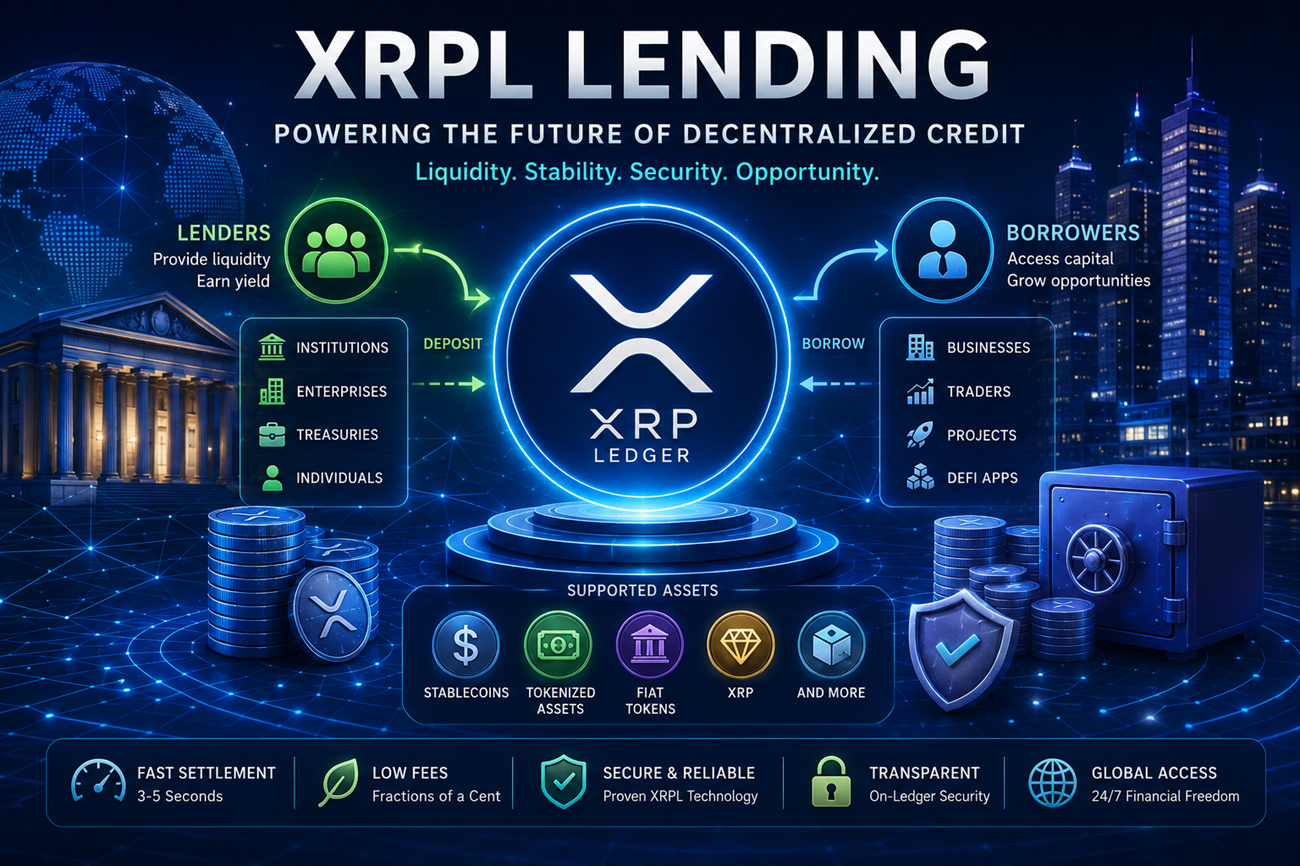
Lending is one of the major financial activities being explored across blockchain ecosystems. On the XRP Ledger, lending concepts may connect to tokenized credit, institutional DeFi, stablecoins, liquidity, payment flows, and regulated financial infrastructure.
This page explains XRPL lending from an educational perspective, focusing on how lending may fit into the broader XRP Ledger ecosystem without making investment promises or assumptions about future adoption.
Educational note: XRPL lending is an evolving topic. Availability, design, adoption, regulation, and risk controls may change over time. Always verify current details through official XRPL, Ripple, regulatory, and independent research sources.
Blockchain lending generally involves using digital assets, stablecoins, tokenized assets, or smart financial infrastructure to support borrowing and lending activity. In some models, users deposit assets and borrowers access liquidity. In institutional models, lending may involve verified parties, collateral rules, compliance, custody, and credit agreements.
Lending does not become risk-free simply because it uses blockchain. Credit risk, collateral risk, liquidity risk, regulatory risk, and counterparty risk still matter.
Borrowers seek access to liquidity, capital, stablecoins, or digital assets.
Lenders provide capital or assets in exchange for potential yield, interest, or repayment terms.
Many blockchain lending models require collateral to reduce risk and protect lenders.
Strong lending systems need rules for liquidation, credit quality, custody, compliance, and repayment.
If tokenized finance expands on the XRP Ledger, lending may become part of the broader institutional ecosystem. Tokenized assets, stablecoins, AMMs, permissioned markets, and liquidity tools could all support more advanced financial activity.
Lending may create additional demand for settlement, collateral movement, stablecoin liquidity, credit markets, and institutional infrastructure. This is why lending belongs in the larger discussion of XRPL utility.
Stablecoins may play an important role in blockchain lending because they provide digital liquidity in fiat-denominated terms. Borrowers and lenders may prefer stablecoins for credit markets because stable pricing can make repayment and accounting easier than using highly volatile assets.
Ripple’s RLUSD and other issued stablecoins may become part of the broader XRP Ledger finance ecosystem if they are adopted for payments, treasury movement, lending, liquidity, or settlement.
Stablecoins can support lending, but users must still evaluate reserves, issuer credibility, redemption terms, regulation, liquidity, and custody.
One of the most discussed opportunities in institutional blockchain finance is the tokenization of credit markets. Rather than lending only cryptocurrencies, future blockchain platforms may support tokenized loans, business financing, treasury products, private credit, and other real-world financial instruments.
The XRP Ledger's support for issued assets, tokenization, fast settlement, and enterprise infrastructure makes it relevant to these discussions, although the specific lending products available will continue evolving over time.
Businesses may eventually access tokenized financing through regulated blockchain infrastructure.
Government securities and treasury products may become part of blockchain-based lending ecosystems.
Invoice financing, trade finance, and working capital are examples of markets that may benefit from tokenization.
Lending markets may increasingly use tokenized real-world assets as collateral or investment products.
Large financial institutions require much more than a lending platform. They also require governance, legal agreements, compliance, secure custody, identity verification, reporting, collateral management, and operational controls.
This is why lending naturally connects with other institutional XRPL developments such as Permissioned Domains, Permissioned DEX, Confidential Transfers, and Institutional DeFi.
Institutions may need KYC, AML, sanctions screening, and regulatory reporting before loans can be originated.
Collateral and digital assets must be securely stored throughout the life of the loan.
Collateral values may need continuous monitoring as markets change.
Smart technology does not replace contracts, regulations, or enforceable lending agreements.
Lending does not necessarily require XRP itself to be loaned. Instead, lending activity may increase demand for settlement infrastructure, liquidity, collateral movement, stablecoin transfers, and efficient value exchange across blockchain networks.
If lending markets grow on the XRP Ledger, XRP could indirectly benefit by supporting settlement, bridge liquidity, transaction fees, and movement between digital assets where appropriate.
Loans, repayments, collateral transfers, and interest payments may settle efficiently on the XRP Ledger.
Growing lending markets generally require deeper liquidity across participating assets.
XRP may help connect assets and payment flows when liquidity conditions support its use.
Lending represents one more layer within a broader institutional blockchain ecosystem.
Lending always involves risk. Blockchain technology improves certain operational processes, but it does not eliminate financial risk. Borrowers may default, collateral values may decline, regulations may change, and liquidity may disappear during market stress.
Borrowers may fail to repay loans according to agreed terms.
Collateral values can fluctuate significantly during volatile markets.
Assets used as collateral may become difficult to sell quickly.
Digital asset lending regulations continue evolving worldwide.
Blockchain lending combines finance, technology, regulation, custody, risk management, and economics. Understanding how these pieces work together is far more valuable than focusing only on interest rates or short-term opportunities.
The strongest participants in any financial market understand both the opportunities and the risks before committing capital. Learning how institutional lending works provides valuable perspective regardless of future market developments.
XRPL Lending connects many areas of the XRP Ledger ecosystem, including liquidity, tokenization, institutional finance, payments, and blockchain infrastructure. Continue your education through these related pages.
Learn how regulated financial institutions may use blockchain technology.
Discover how real-world assets may be represented and transferred digitally.
See how controlled participation may support compliant financial markets.
Understand regulated decentralized trading environments.
Explore how liquidity pools support decentralized trading.
Learn how privacy and compliance may work together on blockchain networks.
Understand why liquidity remains fundamental to XRP's long-term utility.
Continue learning using official documentation and independent research.
Bruce Goldwell's XRP books examine blockchain technology from practical, educational, institutional, and valuation perspectives.
A balanced examination of XRP utility, liquidity, valuation, and realistic expectations.
Explore liquidity, settlement, tokenization, and institutional finance through the XRP ecosystem.
An overview of XRP during the emerging institutional era of blockchain finance.
Browse the growing XRP educational library.
Traditional lending relies on multiple intermediaries, lengthy settlement times, and fragmented systems. Blockchain technology offers the possibility of faster settlement, improved transparency, programmable financial agreements, and more efficient movement of digital assets.
Whether blockchain lending becomes widely adopted will depend on regulation, market demand, institutional participation, liquidity, technology maturity, and public confidence. The XRP Ledger is positioning itself as infrastructure capable of supporting many of these future financial services.
The future of lending may involve both traditional financial institutions and blockchain infrastructure working together rather than replacing one another.
XRPL Lending represents one piece of a much larger institutional finance ecosystem that includes:
These technologies continue evolving. Readers should view this page as educational material designed to explain how these concepts fit together rather than as a prediction of future market outcomes.
This page is provided solely for educational purposes and should not be interpreted as financial, investment, legal, or regulatory advice. Blockchain lending, tokenized credit, stablecoins, institutional finance, XRP, and XRP Ledger capabilities continue to evolve. Readers should verify current information through official Ripple resources, XRPL documentation, regulatory agencies, and independent research before making financial or business decisions.