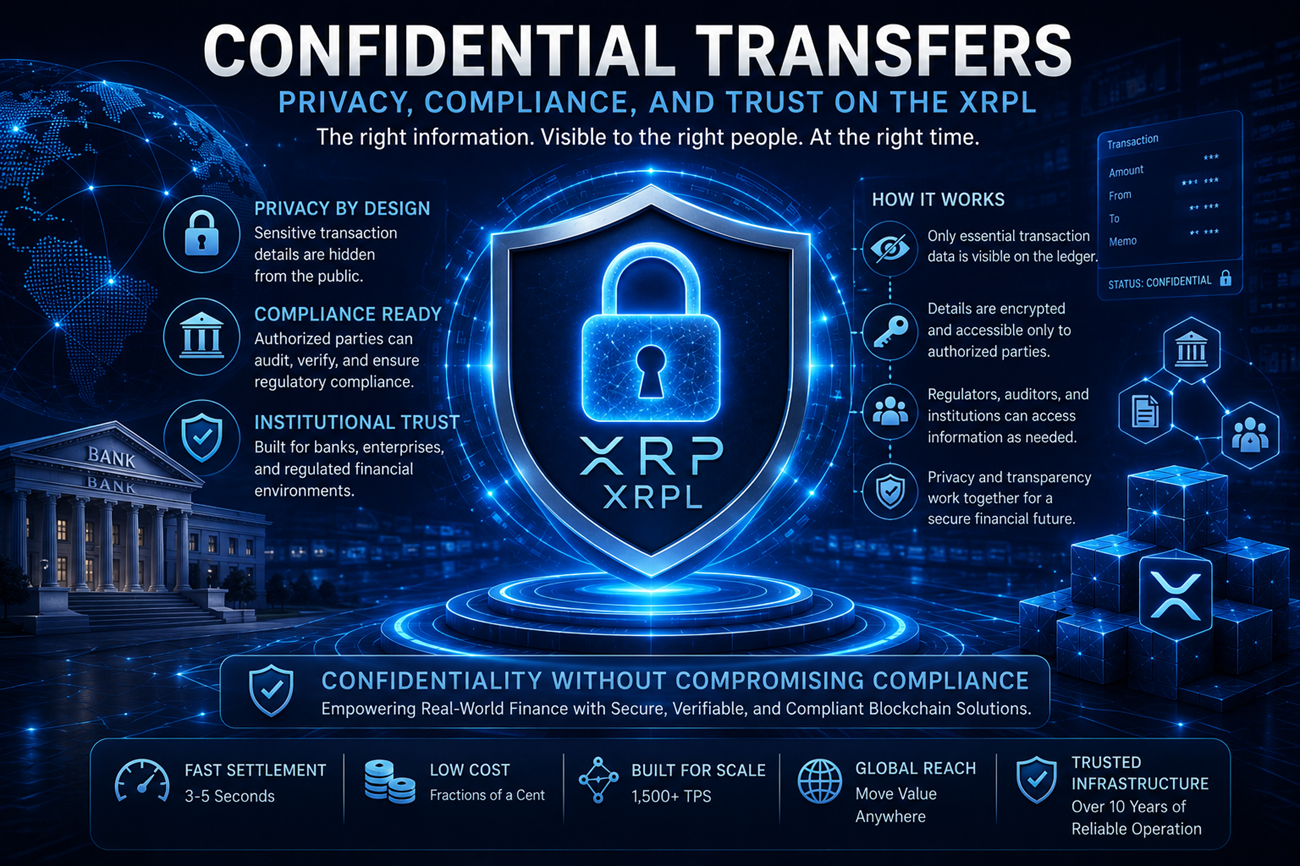
Confidential Transfers are an important concept in the future of institutional blockchain finance. They are designed to help protect sensitive transaction details while still allowing blockchain-based settlement, auditability, and compliance where required.
For the XRP Ledger, this topic connects to tokenized assets, institutional DeFi, permissioned environments, regulated settlement, privacy controls, and financial infrastructure that can serve real-world institutions.
Educational note: Confidential transfer technology is an evolving area. Availability, implementation, rules, and regulatory treatment may change over time. Always verify current details through official XRPL and Ripple resources.
Public blockchains are transparent by design. That transparency can be useful for verification, auditability, and trust, but it can also create challenges for regulated financial institutions.
Banks, funds, enterprises, and payment providers may not want sensitive transaction amounts, counterparties, treasury movements, or business relationships fully visible to the public. Confidential Transfers may help solve this by allowing certain details to remain private while still using blockchain rails.
Institutions may need to protect sensitive payment flows, trading activity, or treasury movements.
Authorized parties may still need access to required information for compliance and audit purposes.
Privacy tools may make blockchain more practical for banks, funds, enterprises, and governments.
Confidentiality may allow sensitive transactions to settle on-chain without exposing unnecessary details.
In regulated finance, privacy and compliance must work together. Confidential Transfers are not simply about hiding information. They may be designed so approved parties can verify or review transaction details when required.
This is important because institutions often need privacy from the public while still maintaining reporting, auditability, risk controls, and legal accountability.
The goal is controlled visibility: sensitive information can be protected from public exposure while remaining available to authorized participants, auditors, regulators, or compliance systems when appropriate.
Institutional DeFi requires more than fast settlement. It also needs identity, compliance, custody, risk management, reporting, and privacy. Confidential Transfers may become one of the privacy layers that helps institutions use blockchain infrastructure responsibly.
Tokenized assets may represent sensitive financial instruments such as securities, funds, treasury products, private credit, institutional payments, or settlement obligations. In many cases, the public visibility of every transaction detail may not be appropriate.
Confidential Transfers may help tokenized assets operate on blockchain infrastructure while protecting information that institutions do not want fully exposed to competitors, markets, or the public.
Certain securities may require privacy controls while still preserving compliance and auditability.
Lending and credit markets may involve sensitive borrower, lender, and transaction information.
Large payment flows may need confidentiality to protect business relationships and treasury strategy.
Confidentiality may help institutions settle value without revealing unnecessary commercial details.
Stablecoins may become important tools for treasury management, cross-border payments, remittances, settlement, and institutional liquidity. However, businesses may not want every payment amount, wallet balance, or counterparty relationship visible to the public.
Confidential transfer tools may help stablecoins and issued assets become more practical for enterprise finance by balancing privacy with compliance.
Stablecoins such as RLUSD may support fiat-denominated movement, while XRP may continue serving roles related to native settlement, fees, liquidity, and bridge asset use cases where appropriate.
Confidential Transfers become especially relevant when combined with Permissioned Domains and Permissioned DEX environments. Together, these tools may allow institutions to control who participates, what assets can move, and who can view sensitive details.
Define approved environments for regulated participants, assets, or applications.
Support regulated trading between approved counterparties and qualified market participants.
Sensitive information may be visible only to participants or authorized oversight parties.
Privacy controls can support compliance when designed with audit, reporting, and access rules.
Confidential Transfers do not change what XRP is. XRP remains the native digital asset of the XRP Ledger. However, privacy features may make the broader XRPL ecosystem more useful for institutional settlement, tokenized assets, regulated markets, and enterprise payment flows.
If institutions can use XRPL infrastructure while protecting sensitive transaction details, the ledger may become more attractive for real-world finance. That could indirectly support XRP utility by increasing the range of use cases, liquidity needs, and settlement activity on the network.
Institutions may move value while protecting sensitive commercial information.
XRP may support movement between assets where liquidity and market demand exist.
More usable tokenized markets may create more demand for efficient settlement infrastructure.
Privacy plus compliance may help institutions participate more confidently.
Confidential transfer systems must be designed carefully. Too much public visibility can discourage institutions, but too little oversight can raise regulatory, legal, and compliance concerns.
Rules around privacy, reporting, stablecoins, securities, and digital asset transfers may continue evolving.
A strong system may need ways for authorized parties to verify transaction details when required.
Privacy systems require careful design, testing, security review, and integration.
Technology only matters if institutions, issuers, custodians, and users choose to adopt it.
Confidential Transfers are one component of the XRP Ledger's growing institutional ecosystem. Explore these related topics to better understand how privacy, liquidity, tokenization, and compliance work together.
Learn how blockchain infrastructure is evolving to support banks, financial institutions, and enterprise finance.
Discover how controlled participation may support compliant blockchain applications.
Explore regulated decentralized trading for approved market participants.
Understand tokenized real-world assets, stablecoins, and digital financial infrastructure.
See how liquidity pools complement institutional trading and settlement.
Learn how the XRP Ledger's technical foundation supports enterprise applications.
Explore why liquidity remains central to XRP's long-term utility.
Continue your education using official documentation and independent research.
Bruce Goldwell's XRP book collection explores blockchain technology from educational, technical, valuation, and institutional perspectives.
A practical examination of XRP valuation focused on utility, liquidity, and realistic expectations.
Discover how settlement, liquidity, tokenization, and institutional finance may work together.
Explore XRP's expanding role during the institutional era of blockchain adoption.
Browse the growing XRP educational library.
One of the most common misunderstandings about blockchain privacy is that it must come at the expense of transparency. Institutional finance often requires a more balanced approach. Businesses need to protect confidential commercial information while still allowing authorized audits, regulatory oversight, and compliance reporting.
Confidential Transfers represent an effort to balance these competing needs by combining blockchain efficiency with controlled visibility. If implemented successfully, they could help make blockchain technology more practical for enterprise finance, governments, banks, and global payment networks.
The future of blockchain may not be defined by choosing between complete transparency and complete privacy. Instead, it may be defined by intelligent systems that provide the right level of visibility to the right participants at the right time.
Confidential Transfers are one part of the XRP Ledger's broader institutional roadmap. Alongside tokenization, permissioned participation, stablecoins, liquidity solutions, and decentralized finance, they illustrate how blockchain technology continues evolving to meet the needs of modern financial institutions.
Readers should view this page as an educational overview rather than a prediction of future adoption. Technology, regulations, and implementation details continue to evolve rapidly. Always verify current information using official XRPL documentation, Ripple resources, regulatory agencies, and trusted independent research.
This page is provided solely for educational purposes and should not be interpreted as financial, investment, legal, or regulatory advice. Confidential transfer technology, XRP Ledger features, stablecoins, tokenized assets, institutional blockchain infrastructure, liquidity solutions, and regulations continue to evolve. Readers should verify current information through official Ripple resources, XRPL documentation, regulators, and independent research before making investment or business decisions.