Primary Documents
Begin with original constitutional text, statutes, court decisions, government reports, university course materials, institutional policies, and historical records whenever possible.
United We Stand asks readers to question claims, examine evidence, consult primary sources, consider competing interpretations, and reach their own conclusions.
United We Stand is written for a general audience rather than as an academic textbook.
The goal of this section is to provide readers with a pathway toward the historical records, constitutional documents, government information, university materials, economic research, court decisions, and other evidence underlying factual discussions in the book.
Where possible, priority should be given to primary sources.
These include:
The United States Constitution.
Federal statutes.
Court decisions.
Government records.
University materials.
Original research.
Historical documents.
Statements and publications from the institutions being discussed.
“Sources are provided so readers can examine the evidence themselves.”
United We StandSecondary sources can provide historical context, competing interpretations, and additional analysis.
The inclusion of a source does not imply endorsement of every conclusion expressed by that source.
Not every sentence in the book requires a citation. Personal observations, arguments, questions, and philosophical conclusions should be distinguished from factual claims that can be independently verified.
Begin with original constitutional text, statutes, court decisions, government reports, university course materials, institutional policies, and historical records whenever possible.
Peer-reviewed studies, economic research, historical scholarship, polling, and reputable institutional analysis can help evaluate broader claims.
Where credible scholars or institutions disagree, examine more than one interpretation rather than assuming disagreement itself proves bad faith.
The opening chapter addresses constitutional government, equal citizenship, liberty, freedom of speech, freedom of conscience, equal protection, and the American ideal expressed in E pluribus unum.
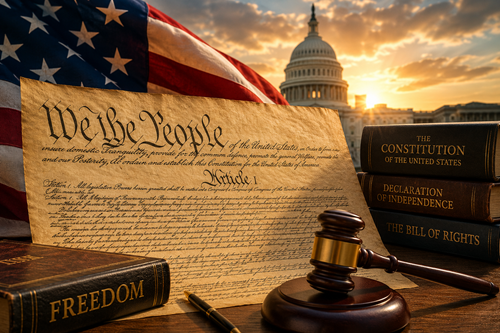
The Constitution is the primary starting point for understanding federal governmental structure, representative government, separation of powers, and constitutional limits.
Recommended source: National Archives — Constitution of the United States.
The first ten amendments provide foundational protections involving speech, religion, assembly, due process, criminal procedure, and limits on federal authority.
Recommended source: National Archives — Bill of Rights.
Historical materials concerning the national motto provide context for the phrase “Out of many, one” and its place in the development of American national identity.
The Reconstruction Amendments—particularly the Fourteenth Amendment—are central to the constitutional development of citizenship, due process, and equal protection.
This chapter distinguishes the historical and academic development of the concept from the way the term is sometimes used in everyday political conversation.
Readers should examine primary scholarly literature discussing the concept of white privilege, including how researchers define the term and what forms of advantage the concept is intended to describe.
Relevant historical records include slavery, Jim Crow laws, segregation, discriminatory housing policy, restrictions on interracial marriage, employment discrimination, and the development of civil-rights law.
Primary federal documents such as the Civil Rights Act of 1964 and related legislation provide direct evidence of the legal framework developed to confront racial discrimination.
The chapter distinguishes among several concepts that are often discussed under the same word.
Definitions involving attitudes, stereotypes, hostility, or prejudgment based upon race.
Unequal treatment of an individual because of race.
Policies or practices within institutions that may discriminate intentionally or produce discriminatory effects.
Academic and institutional definitions describing racial disparities as products of broader systems, historical patterns, institutions, and social structures.
Sources for this chapter should distinguish constitutional equality from institutional or policy concepts of equity.
Relevant areas include:
Equal protection.
Equality of opportunity.
Disparate treatment.
Disparate impact.
Disability accommodations.
Race-conscious government policy.
Educational and employment standards.
Readers should examine both the purposes of such policies and the constitutional or philosophical questions they raise.
These chapters ask readers to move beyond ideological slogans and examine economic mechanisms, incentives, historical outcomes, and the actual policies operating in different countries.
Relevant research includes private property, markets, voluntary exchange, entrepreneurship, investment, competition, innovation, regulation, monopoly, cronyism, economic growth, and poverty reduction.
Useful source categories include economic history, government statistics, World Bank data, international development research, and economic scholarship representing differing schools of thought.
Relevant sources should distinguish socialism, communism, democratic socialism, and social democracy rather than treating them as interchangeable.
Historical evidence should examine both political institutions and economic systems, including the continuing use of private ownership and markets in countries sometimes described politically as socialist.
“Do not judge an ideology by its slogan. Judge it by its principles, its incentives, its consequences, and its record.”
United We StandWhen specific universities, courses, programs, curricula, or institutional materials are discussed, readers should be able to examine those institutions' own documents whenever possible.
Official catalogs and course descriptions provide the best starting point for verifying what a university says it teaches.
University department websites, program descriptions, syllabi when publicly available, and institutional statements can document how academic frameworks are presented.
When evaluating controversial educational claims, readers should compare commentary about an institution with the institution's own published material.
Research concerning ideological polarization, partisan news consumption, audience sorting, and political identity can help evaluate claims about media fragmentation.
Advertising, subscription revenue, audience retention, engagement, and competition for attention create measurable incentives within modern journalism.
Primary platform material and independent research can help explain how social platforms recommend content and optimize for engagement.
Psychological research examines the human tendency to favor information that reinforces existing beliefs.
Studies differ over the extent and causes of political echo chambers, making this an area where competing research should be considered.
Research into emotional content, sharing behavior, virality, anger, moral outrage, and online engagement provides context for the book's discussion.
Immigration claims should be checked against government law, agency data, and official statistical sources rather than political slogans alone.
Federal statutes and official government guidance provide the legal framework governing immigration, lawful entry, visas, asylum, citizenship, and removal.
Government data can document encounters, apprehensions, removals, admissions, asylum processing, and changes over time.
Government sources can provide annual data on lawful permanent residents, temporary visas, naturalizations, refugee admissions, and other immigration categories.
The First Amendment should be the primary starting point for evaluating claims about government restrictions on expression.
Relevant sources include:
The First Amendment itself.
Supreme Court decisions involving protected speech.
Decisions defining narrow categories of speech receiving less or no constitutional protection.
Institutional speech codes.
Platform moderation policies.
Government communications concerning misinformation and online content.
“Popular ideas rarely need protection.”
United We Stand
This chapter requires particularly careful sourcing because scientific understanding, public recommendations, government policy, and available evidence changed during the COVID-19 pandemic.
Historical evaluation should distinguish the evidence actually available when a policy decision was made from evidence that emerged months or years later.
Public-health guidance, official statements, government documents, congressional material, and agency communications provide primary evidence of what institutions said and recommended.
Published research, medical journals, professional debate, later reviews, and subsequent evidence can help distinguish genuine scientific disagreement from unsupported claims.
Platform policies, government records, litigation records, and public communications should be used when evaluating claims involving the moderation or suppression of disputed medical information.
An incentive does not prove wrongdoing. It identifies reasons institutions or individuals may respond predictably to rewards involving money, power, attention, influence, status, votes, or organizational survival.
Campaign-finance records and political fundraising data can help document the economic scale of political messaging and mobilization.
Audience measurement, advertising models, subscription systems, and engagement metrics provide context for the competition for attention.
Public financial filings, fundraising campaigns, stated missions, and measurable organizational goals can help readers evaluate institutional incentives.
Advertising, memberships, subscriptions, sponsorships, donations, and audience growth can create incentives for increasingly provocative content.
Historical examples of divide-and-rule strategies should be documented carefully rather than using broad analogy alone.
Historical scholarship can document how rulers and empires exploited existing ethnic, religious, political, regional, or economic divisions.
Primary historical records and modern scholarship can help distinguish actual divide-and-rule policies from conflicts that had independent local origins.
Research into political targeting, recommendation systems, social networks, foreign influence operations, and personalized messaging can help explain how old political strategies operate through modern tools.
The Constitution itself should remain the primary source for this chapter.
Supplemental materials may include:
Supreme Court opinions.
Congressional records.
National Archives documents.
Historical material concerning the Constitutional Convention.
The Federalist Papers.
Scholarship concerning federalism, separation of powers, checks and balances, due process, equal protection, and individual rights.
Explore Constitution and Freedom
Historical references in this chapter span some of America's greatest achievements and some of its most serious failures.
Primary records, constitutional amendments, congressional documents, historical archives, and scholarly histories provide the foundation for understanding slavery and abolition.
Federal law, court decisions, historical records, speeches, civil-rights archives, and government documents provide direct evidence of segregation and the struggle against it.
Constitutional amendments, federal legislation, court decisions, and election-law history document the expansion and protection of voting rights.
Government records and court decisions can document periods in which constitutional freedoms were restricted or contested.
Military records, presidential archives, congressional materials, historical scholarship, veterans' accounts, protest records, and contemporary journalism provide context for the national divisions surrounding the Vietnam War.
American history repeatedly demonstrates the role of speech, assembly, petition, litigation, elections, and peaceful protest in challenging government and demanding reform.
The purpose of sourcing is not to create a collection of authorities readers are expected to obey.
Sources allow claims to be examined.
They allow readers to ask:
What does the original document actually say?
What evidence supports the claim?
Is the quotation complete?
Is there credible evidence pointing in another direction?
Has later information changed what we know?
Would I apply the same standard if the evidence supported the other political side?
“Do not give allies a discount on truth.”
United We Stand
Read the original law, study, speech, court opinion, university document, government report, transcript, dataset, or institutional statement whenever possible.
Look for additional reputable sources capable of verifying the underlying facts independently.
Examine what occurred before and after a quotation, statistic, video clip, event, or policy decision.
Ask how an informed critic would interpret the same evidence and whether that interpretation reveals something the preferred account overlooks.
Especially in science, economics, law, and public policy, determine whether newer evidence has changed the picture.
A claim should not become trustworthy merely because it supports our political tribe—or suspicious merely because it challenges it.
United We Stand does not ask readers to surrender judgment to the author.
“Which experts? What study? What data? What actually happened?”
United We Stand“If a claim supports your beliefs, verify it anyway. Especially then.”
United We Stand“Am I trying to discover what is true, or am I trying to prove my side is right?”
United We StandBegin with the full free sample and the book's foundational argument about equal citizenship, freedom, and disagreement.
Read Chapter 1 →See how race, economics, education, media, immigration, free speech, science, tribalism, and patriotism fit together.
Explore the Themes →Explore the constitutional principles that provide common ground for Americans who disagree.
Constitution and Freedom →The goal is not to replace one set of slogans with another. It is to encourage Americans to question, verify, think independently, and defend the freedom that allows everyone else to do the same.