Slavery
The existence of slavery represented a profound contradiction between the language of liberty and the reality experienced by millions of human beings.
Loving America does not require pretending America has never made mistakes. It means believing its principles are worth preserving while working to correct its failures.
A mature patriot should be able to say two things at the same time:
America has done things wrong.
And:
America is worth defending.
Those statements are not contradictory.
Love of country does not require blindness.
When we love a person, we do not have to pretend that person is perfect.
When we love a family, we can acknowledge mistakes within that family.
When we love a community, we can confront problems while still wanting the community to succeed.
Patriotism should be capable of the same maturity.
“A mature patriot can say: America has done things wrong. And simultaneously: America is worth defending.”
United We Stand
A nation should be able to examine its history honestly without either glorifying everything it has done or condemning everything it represents.
The existence of slavery represented a profound contradiction between the language of liberty and the reality experienced by millions of human beings.
American law and institutions denied equal treatment and opportunity to citizens because of race.
The country has repeatedly struggled over who was permitted full political participation and how voting rights should be protected.
Government has sometimes exceeded constitutional boundaries during periods of war, fear, emergency, or political pressure.
Americans have experienced discrimination based upon race, religion, sex, ancestry, and other characteristics.
Political leaders and institutions can make serious mistakes, abuse authority, and adopt policies later recognized as unjust or harmful.
There is an important difference between saying:
America has sometimes failed to live according to its principles.
and saying:
America's principles themselves are worthless.
The first statement can lead toward reform.
The second can lead toward abandoning the very standards used to identify injustice.
When Americans were denied equality, the answer was a more faithful application of equality.
When speech was suppressed, the answer was stronger protection for liberty.
When government abused authority, the answer was accountability and constitutional restraint.
When citizens were denied rights, the answer was extending those rights more fully.
“The answer to America's failures is not less freedom. It is living more consistently according to the promise of freedom.”
United We Stand
Symbols matter. But patriotism requires more than displaying them.
A patriot should defend constitutional rights even when the person exercising them belongs to the opposing political side.
Government abuse should concern citizens regardless of which political party currently controls the government.
Race should not determine whether another citizen deserves dignity, freedom, fair treatment, or constitutional protection.
Violence does not become acceptable merely because the person committing it claims a cause we support.
Patriotism requires enough independence to criticize political allies when evidence shows they are wrong.
Political victory should never become more important than the constitutional system that makes peaceful political disagreement possible.
Blind loyalty can become another form of tribalism.
Individuals should possess meaningful freedom to live, speak, believe, create, and participate.
Constitutional worth should not depend upon race, wealth, religion, sex, ancestry, or political identity.
Political authority should operate through law rather than the temporary wishes of whoever possesses power.
Government should not determine which religious, political, philosophical, or social ideas citizens are required to believe.
Evidence and lawful procedure should matter even when accusation is politically popular.
Law should constrain rulers, institutions, majorities, and citizens alike.
It is easy to defend freedom of speech when we agree with the speaker.
The test comes when the speaker says something we despise.
It is easy to demand fairness for political allies.
The test comes when the person seeking fair treatment belongs to the opposing political tribe.
It is easy to condemn government overreach when another political party controls government.
The test comes when our own side possesses power.
That is where principle becomes visible.
“Patriotism should make us more protective of liberty, not less tolerant of dissent.”
Bruce Goldwell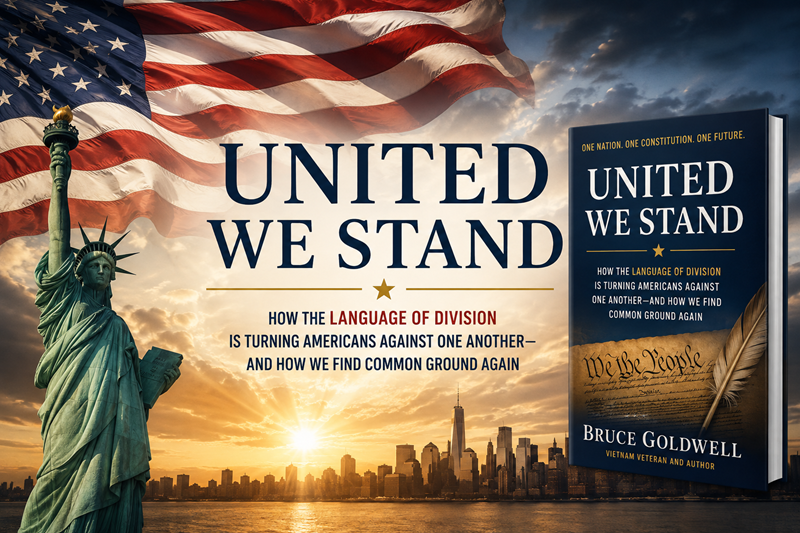
Presidents come and go. Congresses change. Political movements rise and fall.
No president owns the American flag.
No political party owns the Constitution.
No race owns America.
No religion owns America.
No ideology owns America.
The nation belongs to its citizens.
All of them.
The American who votes differently remains an American.
The citizen who worships differently remains an American.
The citizen who criticizes government remains an American.
The citizen who disagrees with this book remains an American.
Political rhetoric often tells citizens that the other side is not merely mistaken but dangerous, immoral, or fundamentally opposed to America.
Millions of Americans vote Republican for many different reasons. A party label cannot tell you everything they believe.
Millions of Americans vote Democratic for many different reasons. A party label cannot tell you everything they believe.
Many Americans reject simple party categories altogether or change their votes according to candidate and issue.
Conservative beliefs range across economics, religion, foreign policy, constitutional interpretation, culture, and government power.
Progressive beliefs also vary widely across economics, civil rights, government programs, social policy, and institutional reform.
The only fair way to know what a person believes is to ask that person rather than allowing a political category to answer for them.
If constitutional protection belongs only to citizens considered good by the people in power, it is no longer a right.
Rights exist precisely because people can become unpopular.
Political majorities can become angry.
Governments can become impatient.
Movements can become convinced that their cause is so important that normal protections should no longer apply.
That is when constitutional restraint matters most.
Once citizens begin asking:
the Republic has entered dangerous territory.
Rights cannot safely depend upon whether today's majority considers a person virtuous.
Otherwise rights become privileges granted by power.
They can disagree profoundly about the role of government while accepting one another's right to participate in the Republic.
They can disagree about God while standing together for freedom of conscience.
They can disagree about a war while sharing a belief in the right to speak and protest.
They can debate economic systems while using peaceful constitutional processes to advocate change.
Neither must surrender conviction in order to recognize the citizenship and dignity of the other.
Americans can live very different lives and still possess a common interest in constitutional freedom and national stability.
The Vietnam era was a period of profound American division.
Citizens argued bitterly about war.
Government.
Patriotism.
Protest.
Military service.
National direction.
Some supported the war.
Some opposed it.
Some served.
Some protested.
Some did both at different times in their lives.
One of the lessons from that era is that America is not weakened because Americans ask difficult questions.
America is weakened when citizens become incapable of asking those questions without hating one another.
“America is not weakened when Americans ask difficult questions. America is weakened when Americans become incapable of asking those questions without hating one another.”
Bruce Goldwell
You disagree with me, therefore you are not patriotic.
You criticize America, therefore you hate America.
You support this policy, therefore you are a traitor.
You oppose this movement, therefore you are an enemy.
Those accusations are easy.
Citizenship is harder.
Citizenship asks us to listen.
Think.
Question.
Vote.
Speak.
Participate.
And sometimes admit that the other American has a point.
Recognize the achievements, institutions, sacrifices, innovations, freedoms, and opportunities worth preserving.
Study history honestly rather than pretending failure never occurred.
Use historical failure as a warning rather than as an excuse for permanent national self-hatred.
Liberty, constitutional government, equal citizenship, freedom of conscience, due process, and peaceful political change.
Patriotism should never prevent citizens from confronting corruption, injustice, discrimination, government failure, or broken institutions.
Citizenship becomes meaningful when criticism is accompanied by participation, responsibility, service, and constructive action.
No generation finished the work of creating a freer and more just country.
The Founders did not finish America.
The generation that abolished slavery did not finish America.
The generations that expanded voting rights did not finish America.
The generation that confronted segregation did not finish America.
No generation will.
Every generation inherits both achievements and unfinished work.
Our responsibility is to preserve what deserves preserving, correct what deserves correcting, and pass a functioning republic to those who follow.
Not blind patriotism.
Not partisan patriotism.
Not patriotism built upon anger toward other Americans.
Patriotism with humility.
Patriotism with courage.
Patriotism with gratitude.
Patriotism willing to confront injustice.
Patriotism willing to defend liberty.
Patriotism strong enough to tolerate disagreement.
Patriotism wise enough to understand that loving America does not require hating anyone else.
“Loving America does not require hating anyone else.”
Bruce Goldwell
Beneath our political parties, races, religions, movements, backgrounds, and disagreements remains an identity we still share.
Republican.
Democrat.
Conservative.
Progressive.
Christian.
Jewish.
Muslim.
Atheist.
Black.
White.
Rich.
Poor.
Rural.
Urban.
Native-born.
Naturalized citizen.
Those descriptions can matter.
But they do not erase:
And if that word is going to mean something, it must include the citizen standing on the other side of the argument.
“We can fight over policy. We can fight at the ballot box. We can fight through arguments. We can fight unconstitutional actions through the courts. We can fight bad ideas with better ones. But when the country truly needs us, we must still be capable of standing beside one another.”
United We Stand“Unity means loyalty to something larger than the disagreement.”
Bruce GoldwellExplore the constitutional framework that allows Americans with profoundly different beliefs to remain free citizens of one republic.
Constitution and Freedom →Examine how labels, political incentives, media, social platforms, and tribalism can turn disagreement into hostility.
America and Division →Explore the historical sources, constitutional documents, and research areas behind the arguments in United We Stand.
Examine the Sources →Patriotism does not require silence. It does not require blindness. And it does not require hatred.
It requires citizens willing to defend freedom, confront failure, preserve constitutional government, and remember that the person on the other side of an argument remains a fellow citizen.
Choose America over division.