Freedom of Speech
Citizens must be free to criticize government, political movements, institutions, public officials, social ideas, and one another.
America does not require millions of citizens to think alike. It requires a framework within which disagreement can coexist with liberty.
The Constitution was not written for a nation in which everyone would share the same religion, political philosophy, economic interests, background, or opinions.
It was created because people with different interests and competing ideas needed rules capable of holding a republic together.
That may be one of the most important things Americans can remember today.
Political disagreement is not automatically evidence that the constitutional system has failed.
In many cases, disagreement is evidence that freedom exists.
Citizens are free to argue because government does not possess unlimited authority to decide what every citizen must believe.
“The Constitution does not require Americans to agree. It provides a framework within which disagreement can coexist with freedom.”
United We Stand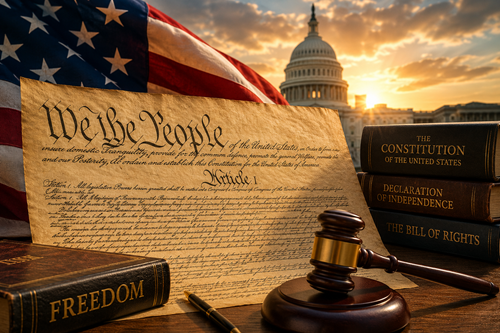
Political parties change. Presidents change. Congressional majorities change. The principles of constitutional government are supposed to outlast temporary political victories.
Citizens must be free to criticize government, political movements, institutions, public officials, social ideas, and one another.
Americans may practice a religion, reject religion, change beliefs, question religious teachings, and follow conscience without government establishing a required faith.
Government should not deprive people of life, liberty, or property merely because accusation, anger, or public pressure demands it.
Fundamental legal protection should not rise or fall according to race, wealth, religion, political affiliation, or membership in a favored group.
Citizens have peaceful mechanisms for choosing leaders, replacing leaders, debating laws, and attempting to change public policy.
Government power requires boundaries even when the people exercising that power belong to our preferred political side.
Freedom of speech is easy to defend when the speaker says something we agree with.
The real test comes when another citizen expresses an idea we strongly dislike.
Perhaps we believe the idea is offensive.
Misguided.
Harmful.
Foolish.
Even then, a free society must be cautious about giving institutions broad authority to decide which political or social ideas citizens may express.
Because an unavoidable question follows:
Today, the people making that decision may agree with you.
Tomorrow, they may not.
Constitutional protection cannot depend upon which faction temporarily possesses political power.
Freedom protects everyone or eventually it protects no one.
A free society must distinguish between regulating conduct under law and attempting to control what citizens are permitted to think.
Citizens should remain free to support, reject, challenge, or criticize political ideologies and movements.
Freedom of conscience protects believers and nonbelievers alike.
Students and citizens should remain free to question ideas presented by institutions and authorities.
Scientific claims should be open to evidence, testing, questioning, replication, and revision.
Citizens may debate capitalism, socialism, regulation, taxation, markets, and government intervention without ideological conformity.
Readers should remain free to question the arguments in United We Stand itself.
Equal citizenship does not mean Americans will possess equal wealth, identical talents, identical opportunities, or identical outcomes.
Human lives differ.
Circumstances differ.
Choices differ.
Abilities differ.
But constitutional worth should not depend upon demographic or political identity.
If racial discrimination is wrong, the identity of the victim should not determine whether we oppose it.
If political violence is wrong, the political identity of the offender should not change our standard.
If censorship concerns us when directed at our side, it should concern us when used against people we oppose.
“Principles mean the most when we apply them to people we do not like.”
United We Stand
A constitutional republic cannot function safely if outrage replaces process.
Due process expresses a simple but vital principle:
Government power must operate through established rules.
Accusations should be tested.
Evidence should matter.
People should have the opportunity to answer charges.
Procedures should not change merely because the accused person is unpopular.
Political anger can be intense.
Public opinion can be intense.
Social-media campaigns can be intense.
But the stronger the anger, the more important consistent legal principles become.
One of the most difficult responsibilities of constitutional citizenship is accepting political defeat without abandoning the system itself.
Elections do not guarantee victory for any particular voter or political movement.
Political goals may require continued persuasion rather than immediate success.
Citizens may criticize decisions while continuing to use constitutional processes to seek change.
Representative government means other citizens possess political rights equal to our own.
Speak. Persuade. Campaign. Petition. Vote again.
Peaceful transitions depend upon recognizing that political opponents remain legitimate members of the nation.
Every political movement finds limits on government appealing when the opposing side controls government.
The amount of executive authority we consider acceptable should not change merely because we like or dislike the president exercising it.
Majorities possess political authority, but constitutional government also protects individuals and minorities from unlimited majority power.
Courts interpret law within a constitutional structure and remain part of the continuing argument over governmental limits.
Government agencies exercise significant authority, making transparency, lawful procedure, and accountability important regardless of administration.
Crises may require action, but emergencies also test whether temporary authority remains genuinely temporary and constitutionally restrained.
A constitutional principle that changes according to which political party benefits is not much of a principle.
The Constitution protects freedom.
Citizenship asks how we use it.
Freedom of speech may allow us to insult a neighbor.
Citizenship asks whether doing so accomplishes anything worthwhile.
We can repeat rumors.
Share inflammatory headlines without reading the story.
Pass along edited videos without context.
Repeat accusations we have never verified.
But constitutional liberty assumes something more than unrestricted reaction.
It assumes citizens capable of judgment.
“Freedom without responsibility eventually becomes chaos. Responsibility without freedom becomes authoritarianism. A healthy republic requires both.”
United We Stand
Americans are free to criticize political ideologies, challenge public policies, and oppose movements they believe conflict with constitutional liberty.
But there is an important principle:
Bad ideas should be answered with better ideas.
Speech with speech.
Political movements with elections.
Unconstitutional government action with courts, legislation, oversight, elections, petitions, and peaceful protest.
Citizens may seek constitutional amendments.
They may seek new laws.
They may campaign to replace public officials.
They may criticize the Constitution itself.
What constitutional patriotism should resist is the temptation to destroy constitutional liberty while claiming to defend it.
Political tribalism becomes especially dangerous when citizens demand one standard for allies and another for opponents.
Laws and constitutional protections should not change depending upon party affiliation.
Equal citizenship requires opposition to racial discrimination regardless of who commits it or who experiences it.
Poverty does not erase responsibility, and wealth does not erase legal rights.
Constitutional protections become meaningful when they apply beyond fashionable or widely accepted ideas.
Violence should not become acceptable because the offender claims a cause we support.
Facts should not become more or less true according to which political tribe benefits from them.
The American constitutional experiment never required the many to become identical.
Americans can possess different ancestries.
Different religions.
Different occupations.
Different political philosophies.
Different economic circumstances.
Different cultures.
Different opinions.
The challenge is not eliminating those differences.
The challenge is maintaining something larger beneath them.
A shared understanding that every citizen possesses basic dignity.
That the same constitutional protections apply.
That political opponents remain citizens.
That elections can be won and lost without destroying the Republic.
That freedom allows disagreement.
And that America belongs to all of us.
“United does not mean identical.”
Bruce Goldwell
Explore why loving America does not require pretending America has never failed—and does not require hating other Americans.
Explore Patriotism →Examine the words, incentives, media systems, political strategies, and social pressures that can turn citizens into opposing tribes.
Explore Division →Explore the constitutional documents, historical records, research areas, and supporting evidence behind the book.
Examine the Sources →America does not need citizens who agree on everything. It needs citizens willing to defend the freedom that allows everyone else to disagree.
Choose constitutional liberty over political tribalism.