Language and Labels
How words such as racist, privileged, extremist, fascist, socialist, woke, and MAGA can move from description to condemnation.
How the Language of Division Is Turning Americans Against One Another—and How We Find Common Ground Again
ONE NATION. ONE CONSTITUTION. ONE FUTURE.
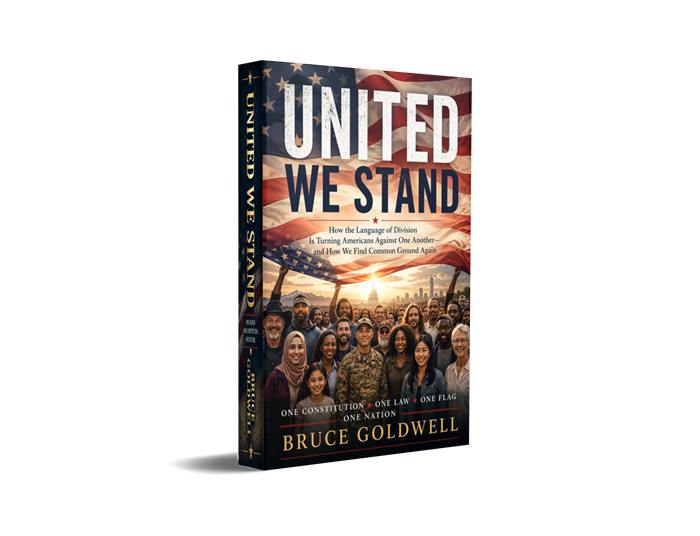
America has always been a nation of different beliefs, backgrounds, religions, races, economic circumstances, and political opinions.
We were never supposed to agree on everything.
Our constitutional system was designed so free people could disagree and still remain one nation.
But something has changed.
Americans are increasingly divided into competing categories: Black and white. Rich and poor. Privileged and oppressed. Left and right. Woke and MAGA. Immigrant and native-born. Urban and rural.
In United We Stand, Vietnam veteran and author Bruce Goldwell asks a question every American should consider:
Are these labels helping us understand one another—or teaching us which Americans we are supposed to dislike?
United We StandRather than asking readers to choose another political side, the book examines the language, institutions, incentives, and cultural forces that can turn legitimate disagreement into resentment, fear, and tribalism.
This is not a book about telling Americans what political party to choose. It is about examining the forces that turn disagreement into hostility.
How words such as racist, privileged, extremist, fascist, socialist, woke, and MAGA can move from description to condemnation.
Whether Americans should encounter one another primarily as racial, political, economic, or cultural groups—or as individuals.
Where equality of treatment and opportunity can complement equity—and where efforts to guarantee outcomes can conflict with individual equality.
A practical examination of markets, ownership, opportunity, wealth, economic freedom, and the historical record of competing systems.
How traditional media, social platforms, campaigns, activists, and influencers can benefit from keeping Americans emotionally engaged and divided.
Why freedom of speech, freedom of religion, due process, equal protection, representative government, and limited power remain common ground.
Americans can disagree about race, economics, immigration, education, gender, free speech, science, religion, and government while still recognizing one another as fellow citizens.
The danger begins when disagreement becomes moral condemnation.
When:
You disagree with me
becomes:
You are wrong
then:
You are ignorant
then:
You are dangerous
and finally:
People like you are the problem.
At that point, persuasion becomes almost impossible.
Bruce Goldwell's United We Stand is exactly what the subtitle promises: an examination of how loaded language has shifted from describing problems to assigning enemies, and a practical argument for how Americans can still share a country without agreeing on everything.
The review praises the book's insistence on clear definitions, consistency, individual responsibility, constitutional principles, and its refusal to assign collective guilt to entire groups.
America does not need every citizen to agree.
The Constitution provides a framework within which disagreement can coexist with freedom.
Freedom of speech.
Freedom of religion.
Due process.
Equal protection.
Representative government.
Limits on governmental power.
Individual liberty.
The question is not whether Americans will disagree.
The question is whether we can disagree without destroying one another's freedom.
Explore Constitution and Freedom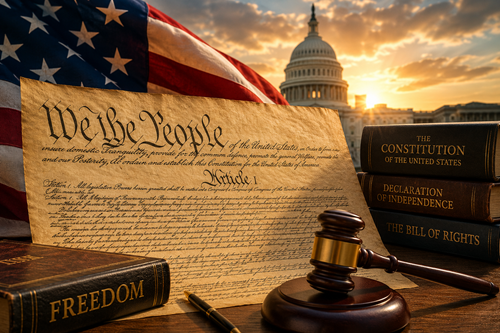
A person's race, income, religion, politics, education, or ZIP code does not tell you the person's character.
Challenge ideas, evidence, and policies without immediately condemning the person holding them.
Ask what happened, what was actually said, and whether the same standard would be applied to your own political side.
Popular opinions rarely need protection. Freedom matters most when another citizen says something you cannot stand.
Truth should not change depending upon whether a fact helps Republicans, Democrats, conservatives, or progressives.
We can fight fiercely about America's future without forgetting that we share that future.
“The greatest threat to freedom is when we stop seeing fellow Americans as fellow Americans.”
Bruce Goldwell“Liberty is not the right to agree with everyone. It is the right to live free among those who disagree.”
Bruce Goldwell“We can challenge bad ideas without hating the people who hold them.”
Bruce Goldwell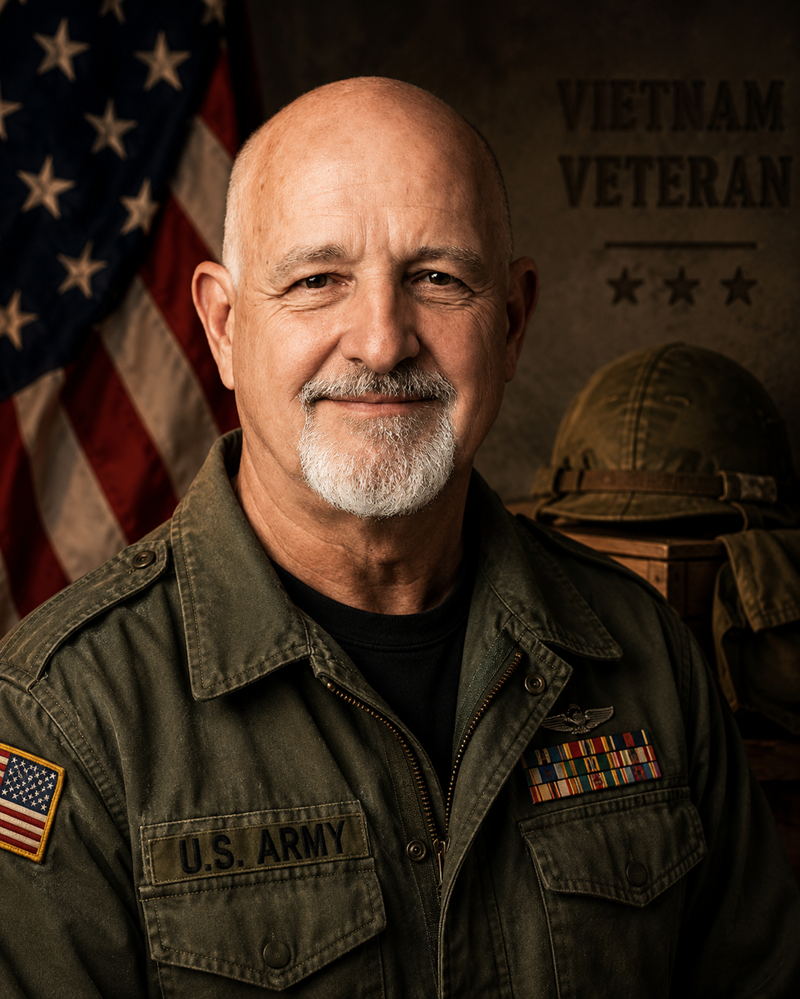
Bruce Goldwell is an American author, songwriter, entrepreneur, and Vietnam veteran whose work is grounded in a lifelong belief in freedom, personal responsibility, opportunity, and the ability of individuals to change the direction of their lives.
In United We Stand, Goldwell writes not as a politician or political theorist, but as an American citizen and veteran concerned about the increasing tendency to divide Americans according to race, wealth, ideology, political affiliation, religion, geography, and identity.
His message is not:
Choose my side.
It is:
Choose America over division.
Read About Bruce GoldwellAmerica does not need citizens who never disagree. It needs citizens capable of disagreeing fiercely while still defending one another's freedom.
That is citizenship. That is patriotism. That is freedom.