Should I Quit My Job?
If you're asking that question, something has probably already changed.
Maybe you dread going to work. Maybe you're exhausted. Maybe you're underpaid, overlooked, overworked, or dealing with a boss who makes every day harder than it needs to be.
Maybe nothing dramatic happened at all.
You simply reached a point where you thought:
That feeling matters.
But it doesn't automatically mean you should walk into work tomorrow and resign.
A better first question may be:
What is happening at this job that has made me want to quit?
You Have More Than Two Choices
When people become unhappy at work, they often reduce the decision to two choices:
Stay or quit.
But there are usually more possibilities.
You may discover that the job is still worth keeping.
You may discover that one specific problem needs to change.
You may decide that leaving is probably right, but you're not financially or professionally prepared yet.
Or you may realize that you've already done everything reasonable and it's time to move on.
Start With the 12-Month Question
Imagine that absolutely nothing about your current job changes.
Same boss.
Same pay.
Same workload.
Same schedule.
Same environment.
Same problems.
If nothing changed at this job during the next 12 months, would I willingly stay?
There are three perfectly legitimate answers:
YES.
NO.
I DON'T KNOW YET.
Don't force yourself to choose an answer you aren't ready to give.
If your answer is I don't know yet, your next step isn't necessarily resignation.
Your next step is gathering information.
Are You Having a Bad Week—or Are You in a Bad Job?
Everyone has bad days at work.
Projects go wrong. Customers become difficult. Deadlines pile up. Managers have bad days. Coworkers make mistakes.
A temporary problem doesn't always require a permanent solution.
The question is whether you're experiencing an unusually difficult period or seeing a pattern that has been repeating for months or years.
Don't judge your job by its best day or its worst day. Judge the pattern.
Ask yourself whether the problem is temporary, fixable, or unlikely to change.
That distinction can completely change what you should do next.
What Is Your Job Costing You?
Your paycheck tells you what your job pays.
It doesn't tell you what your job costs.
Time
Consider commuting, after-hours messages, preparation, weekend work, and the hours required to recover from work.
Relationships
Ask whether the people you care about are receiving the exhausted version of you after work takes everything else.
Energy
There's a difference between being tired after a productive day and feeling continuously depleted by your job.
Opportunity
Every year spent in one position is also a year you aren't spending somewhere else.
Dignity
A paycheck can compensate you for your labor. It should not require you to surrender your self-respect.
Money
Consider commuting, parking, clothing, meals, childcare, and other expenses required to maintain the job.
Can the Job Be Fixed?
Before deciding that you need another job, determine whether the problem could realistically be solved inside the job you already have.
Maybe you need a different schedule.
Maybe the workload needs to be addressed.
Maybe compensation needs to be discussed.
Maybe another department would be a better fit.
Maybe you need to speak with your supervisor—or, depending on the situation, another appropriate person higher in the organization.
If the problem were fixed tomorrow, would I genuinely want to stay?
If the answer is yes, you may not need a new employer.
You may need a change in your current workplace.
Never Quit on Your Worst Day
Your worst day at work may reveal something important.
But that's different from saying your worst day should determine exactly when you resign.
Unless you're dealing with an immediate safety issue or another serious circumstance requiring immediate action, give yourself enough time to think strategically.
Instead of asking:
Do I need to quit today?
Ask:
Do I need to leave today—or do I need to start preparing to leave?
If You Think You Should Leave, Prepare First
Wanting to leave is emotional.
Being ready to leave is practical.
Before resigning, consider your monthly expenses, savings, health insurance, benefits, résumé, references, professional contacts, and available opportunities.
If possible, begin investigating the job market while you're still employed.
Looking doesn't mean leaving.
Looking gives you information.
You may discover that you're more marketable than you thought.
You may discover that you need to update a skill first.
You may even discover that your current job looks better after comparing it with the alternatives.
That's useful information too.
Prepare because you've had enough.
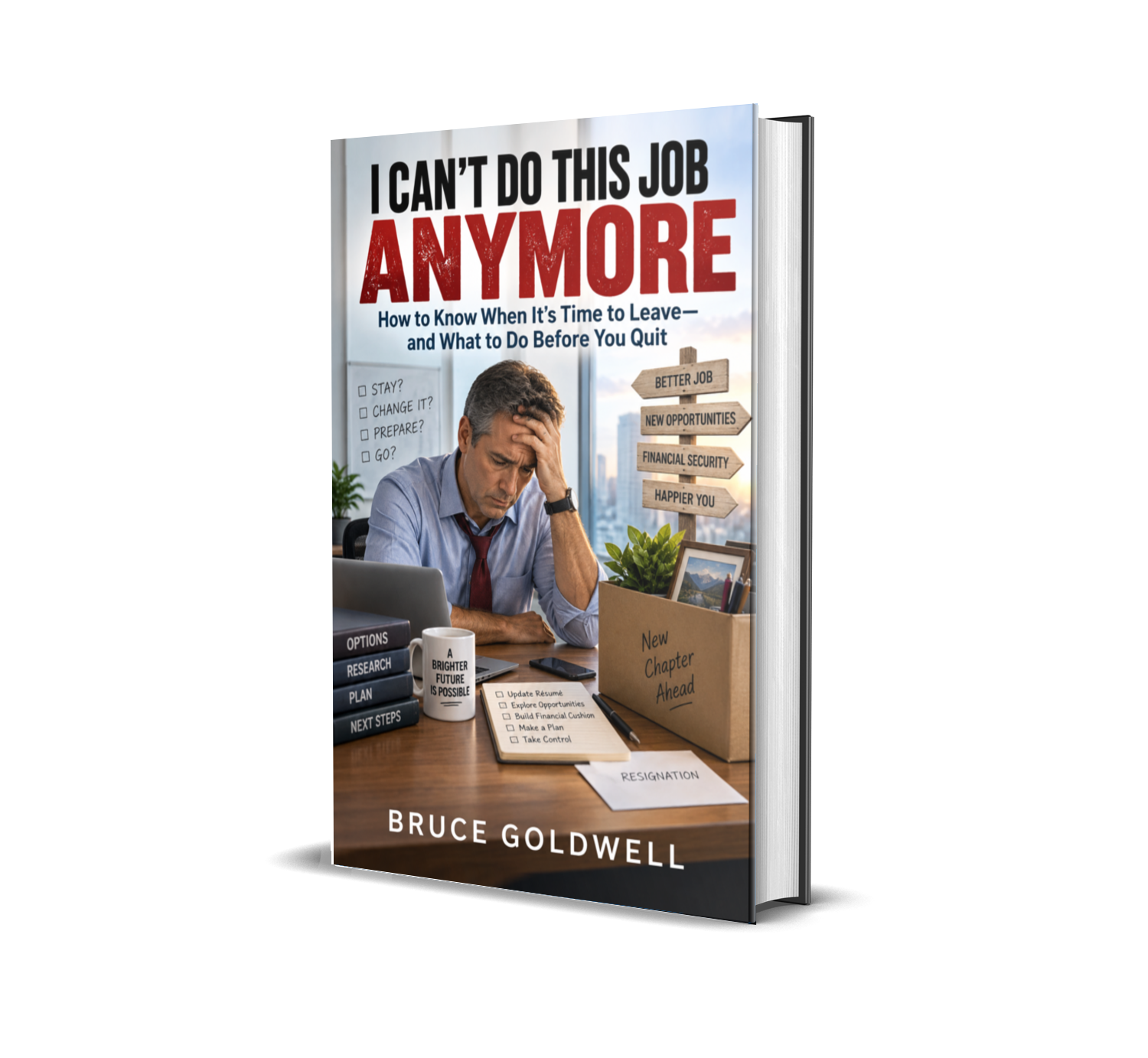
I CAN'T DO THIS JOB ANYMORE
How to Know When It's Time to Leave—and What to Do Before You Quit
Bruce Goldwell's practical decision guide takes you through the questions that can help you determine whether you should STAY, CHANGE IT, PREPARE TO LEAVE, or GO.
It isn't about convincing you to quit.
It's about helping you make a better-informed decision before anger, fear, exhaustion, or circumstances make the decision for you.
Don't quit angry. Quit prepared.
GET THE EBOOK GET THE PAPERBACKYou Don't Have to Decide Everything Today
But if you're asking, "Should I quit my job?", don't ignore the question.
Find out what's really wrong, what can change, what can't, and what options you have.
Then decide what makes sense for you.
READ THE EBOOK GET THE PAPERBACKThis page is provided for educational and informational purposes and is not legal, financial, tax, employment, career, or other professional advice. Employment laws, workplace policies, benefits, and individual circumstances vary.