What Should You Do Before Quitting Your Job?
You've had enough.
Maybe you've been thinking about leaving for months. Maybe something happened today that pushed you to the edge.
You may already be imagining the moment when you tell your boss:
"I quit."
Before you do, there is another question worth asking:
What can I do before I quit that will make whatever happens next easier?
Quitting is an action.
Leaving well is a strategy.
Prepare because you've had enough.
1. Don't Quit on Your Worst Day
Your worst day at work may tell you something important.
It may confirm a pattern you've been ignoring.
But unless you're facing an immediate safety issue or another serious circumstance requiring immediate action, you don't have to make a major financial and career decision in the middle of an emotional explosion.
Do I need to leave today—or do I need to start preparing to leave?
Those are very different questions.
2. Know Why You're Leaving
"I hate my job" may be completely true.
But it isn't specific enough to guide your next decision.
What do you actually hate?
- Your boss?
- The workload?
- The schedule?
- The pay?
- The commute?
- The company culture?
- The lack of advancement?
- The way you're treated?
- The work itself?
This matters because if you don't identify the real problem, you can leave one job and accidentally accept the same problem somewhere else.
I can't do this job anymore because __________________.
Fill in that blank as specifically as possible.
3. Find Out Whether the Job Can Be Fixed
Before leaving an entire company, ask whether the real problem could be changed.
Perhaps you need a different schedule.
A different supervisor.
A transfer.
More reasonable responsibilities.
A compensation discussion.
A clearer path to advancement.
Depending on the situation, consider speaking with your supervisor or another appropriate person higher in the organization.
If the problem were fixed tomorrow, would I genuinely want to stay?
If the answer is yes, there may still be something worth trying.
If the answer is no, that tells you something too.
4. Know Your Number
Before voluntarily stopping a paycheck, know how much money your household actually needs each month.
Don't guess.
Look at your real expenses.
Must Pay
Housing, utilities, food, insurance, transportation, minimum debt payments and other essential obligations.
Should Keep
Expenses that aren't absolutely essential but would be difficult or unwise to eliminate during a transition.
Can Reduce
Expenses that can temporarily be lowered if your income changes.
Can Pause
Optional spending that could temporarily stop while you're between jobs.
Then calculate your approximate financial runway:
Available transition money ÷ monthly between-jobs expenses = approximate financial runway
If you have $12,000 available and need $4,000 a month to keep your household operating, you have approximately three months of runway.
Knowing that number doesn't make the decision for you.
It tells you what options you can realistically afford.
5. Know What Happens to Your Benefits
Your paycheck isn't the only thing you may be leaving.
Before giving notice, understand what happens to benefits such as:
- Health insurance
- Dental and vision coverage
- Retirement benefits
- Vesting
- Unused paid time off
- Bonuses
- Stock or equity compensation
- Employer reimbursements
- Other company benefits
Find out when coverage ends and what alternatives may be available to you.
A departure date that seems insignificant could sometimes affect a bonus, benefit, vesting date, or other compensation.
Verify before you resign.
6. Update Your Résumé Before You Need It
Don't wait until you're unemployed to start remembering everything you've accomplished.
While the information is fresh, write down:
- Major responsibilities
- Projects completed
- Promotions
- New skills
- Software and systems you use
- Training and certifications
- Awards and recognition
- Problems you've solved
- Measurable improvements you've helped create
- Teams, people, budgets, or projects you've managed
The worst time to begin remembering everything you've accomplished during the last ten or twenty years is the afternoon you've just been told you no longer have a job.
Even if you ultimately decide to stay, keeping your résumé current is simply good career preparation.
7. Think About Your References
Who knows the quality of your work?
Consider former supervisors, managers, coworkers, clients, professional contacts, or others who can legitimately speak about your experience and abilities.
Don't wait until an employer asks for references before remembering that you haven't spoken with yours in five years.
Reconnect appropriately and make sure you have current contact information.
8. Look Before You Leap
You don't have to resign before discovering whether better opportunities actually exist.
Look at current openings.
Read job descriptions.
Compare salaries.
Notice which skills employers repeatedly request.
Talk with trusted professional contacts.
Apply for positions that genuinely interest you.
Looking gives you information.
Your current job may even be financing your escape from your current job.
While you're still receiving a paycheck, you may have more freedom to reject opportunities that don't actually improve your situation.
Read more: How to Find Another Job While You're Still Employed
9. Decide What the Next Job Must Do Better
Don't search only for another job.
Search for a job that solves the problems you're trying to leave.
Create two lists:
MUST HAVE
The conditions, compensation, schedule, opportunities, management style, flexibility, or other qualities your next job should provide.
MUST NOT HAVE
The conditions you don't want to repeat from your current job.
The goal isn't simply to get away from something.
It's to move toward something better.
10. Don't Resign Because an Interview Went Well
An interview isn't a job.
A second interview isn't a job.
An enthusiastic conversation isn't a job.
A verbal indication that the company "really likes you" still isn't the same as having a finalized opportunity you are prepared to accept.
Don't give up a real job because you're excited about a possible job.
Review the details of any new opportunity carefully before resigning from your current position.
11. Plan to Leave Professionally
If you decide to go, don't turn your resignation into one final argument.
You don't have to explain every frustration you've experienced.
You don't have to convince your boss that leaving is justified.
You are communicating a decision.
Keep your resignation clear, professional, and appropriate for your circumstances.
The coworker or manager you leave today may become a reference, client, colleague, or professional contact years from now.
Before You Give Notice, Ask Yourself
- Do I know exactly why I'm leaving?
- Have I determined whether the problem can be fixed?
- Do I know my monthly financial survival number?
- Do I understand what happens to my benefits?
- Is my résumé current?
- Do I have potential references?
- Have I investigated other opportunities?
- Do I know what I want from my next job?
- Am I leaving strategically—or reacting emotionally?
- Am I prepared for what happens the day after I leave?
You don't need perfect certainty. You need enough information to make the best decision you reasonably can.
You Still Have Four Choices
Preparation doesn't automatically lead to resignation.
You may investigate your options and decide to stay.
That's still valuable.
Because now you're staying because you made a decision—not simply because you were afraid to make one.
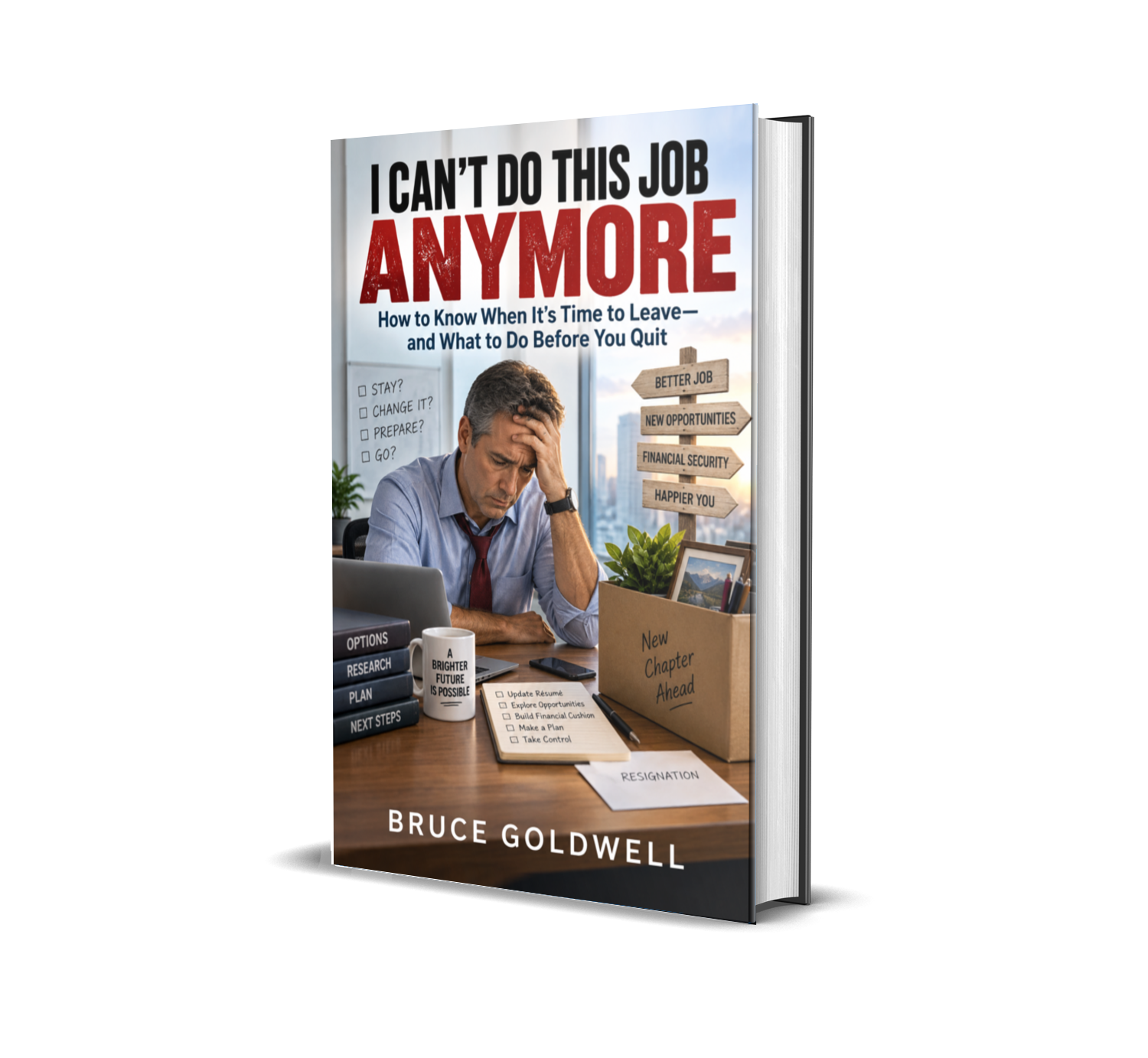
I CAN'T DO THIS JOB ANYMORE
How to Know When It's Time to Leave—and What to Do Before You Quit
Bruce Goldwell's practical decision guide walks you through the questions to consider before making one of the biggest decisions in your working life.
Examine the job, your finances, your fears, your alternatives, your résumé, and your exit plan before deciding whether to STAY, CHANGE IT, PREPARE TO LEAVE, or GO.
Don't quit angry. Quit prepared.
GET THE EBOOK GET THE PAPERBACKBefore You Quit, Build Your Options
The goal isn't to stay forever. And it isn't to leave as quickly as possible.
The goal is to put yourself in the strongest position possible to make the right decision for you.
Don't quit angry. Quit prepared.
READ THE EBOOK GET THE PAPERBACKThis page is provided for educational and informational purposes and is not legal, financial, tax, employment, career, or other professional advice. Employment laws, workplace policies, benefits, contracts, and individual circumstances vary. Verify information that applies to your specific situation before making employment or financial decisions.