Is This a Bad Week—or a Bad Job?
You had another terrible day at work.
Your boss irritated you.
The workload was ridiculous.
Something went wrong that shouldn't have.
You came home exhausted and thought:
Maybe you're right.
But before making a major decision, there is an important distinction to make.
Am I having a bad week—or am I in a bad job?
Those can feel exactly the same while you're living through them.
But they may require very different responses.
Every Job Has Bad Days
Even a good job can have a terrible Monday.
Projects fail.
Customers become difficult.
Equipment breaks.
Deadlines collide.
Coworkers make mistakes.
Managers become stressed.
You make mistakes too.
None of those things automatically means you should leave.
A temporary problem doesn't always require a permanent solution.
The Difference Is Often the Pattern
One bad day is an event.
The same bad day happening over and over is a pattern.
One unreasonable deadline may be unusual.
Impossible deadlines every week may be the way the company operates.
One disagreement with your boss may simply be a disagreement.
Being disrespected, ignored, belittled, or undermined repeatedly is something different.
or its worst day.
Judge the pattern.
Signs It May Be a Bad Week
A difficult period may be temporary when:
Something Unusual Happened
A major project, staffing shortage, emergency, seasonal rush, or unexpected problem temporarily increased the pressure.
The Problem Has an End Date
You can reasonably identify when the unusually difficult situation should improve.
You Usually Like the Work
Despite the current frustration, most of your experience with the job has been acceptable or positive.
Management Is Responding
Problems are acknowledged and reasonable steps are actually being taken to address them.
You Still See a Future There
When you imagine the current problem disappearing, you can still see yourself wanting to remain.
Rest Changes Your Perspective
After getting away from work for a while, the situation begins to feel manageable again.
Signs It May Be More Than a Bad Week
The situation deserves closer examination when:
The Same Problems Keep Returning
The names or circumstances may change, but the underlying problem never really goes away.
Promises Never Become Changes
You've raised concerns, been promised improvements, and watched everything return to normal.
You Dread Work Consistently
The dread isn't tied to one project or one difficult week. It has become part of your normal routine.
The Job Follows You Home
Work regularly consumes your evenings, weekends, relationships, thoughts, or ability to enjoy time away.
You No Longer Believe It Will Improve
You've stopped asking when things will get better because experience has taught you that they probably won't.
You Wouldn't Choose It Again
Knowing what you know today, you would not accept the same job under the same conditions.
Try the 12-Month Test
One way to remove some of the emotion from the decision is to stop imagining that things will somehow become different.
Imagine that nothing changes.
Same boss.
Same pay.
Same workload.
Same schedule.
Same environment.
Same problems.
If nothing changed at this job during the next 12 months, would I willingly stay?
If your immediate answer is yes, the current problem may be more temporary than it feels.
If your answer is no, pay attention to why.
If your answer is I don't know yet, don't force a decision.
Gather more information.
How Long Have You Been Saying "Just a Little Longer"?
Sometimes people stay in a difficult job because they believe the situation is temporary.
The busy season will end.
The new manager will settle in.
Staffing will improve.
The promotion will come through.
The schedule will change.
Things will calm down next month.
Sometimes those things happen.
Sometimes next month becomes next year.
How long have I been waiting for this job to become the job I keep hoping it will become?
Potential Is Not the Same as Pattern
Maybe your boss says things will improve.
Maybe you've been told a promotion is coming.
Maybe management promises to hire more people.
Maybe you've been told that the workload will become more reasonable.
Those possibilities may be real.
But don't evaluate your job only by what might happen.
Evaluate what actually happens.
Pattern tells you what has been happening.
Both matter.
But when the same promise has been made repeatedly without meaningful change, the pattern deserves more weight.
What Would Have to Change for You to Stay?
This question can reveal whether the problem is the entire job or something specific inside it.
Finish this sentence:
I would seriously consider staying if __________________.
Maybe the answer is:
- If my schedule changed.
- If I reported to someone else.
- If the workload became reasonable.
- If my compensation improved.
- If I could transfer departments.
- If I had a real opportunity to advance.
- If management addressed a recurring problem.
Now ask another question:
How realistic is that change?
If the change is both possible and realistic, there may be something worth trying before leaving.
If the only way you could enjoy the job would require changing almost everything about it, that tells you something too.
Is It the Job—or One Person?
Sometimes one person can make an otherwise good job feel terrible.
If your manager disappeared tomorrow, would you still want to leave?
If one difficult coworker transferred, would your experience change dramatically?
If you moved to another department, would most of the problem disappear?
Don't automatically abandon an entire organization because of a problem that may have another solution.
At the same time, if the organization repeatedly tolerates or rewards destructive behavior, the problem may be larger than one person.
What Is Staying Costing You?
People often calculate the cost of leaving.
Lost income.
Insurance.
Benefits.
Financial uncertainty.
Those are real costs.
But staying can have costs too.
Time
How much of your life is being consumed by work and recovery from work?
Relationships
Are the people you care about receiving an exhausted or frustrated version of you?
Energy
Is the job leaving you enough energy for the rest of your life?
Opportunity
What opportunities are you not exploring because all your energy is going into surviving this job?
Try a Two-Week Reality Check
If you aren't sure whether you're reacting to a temporary situation or a persistent pattern, pay attention for the next two weeks.
At the end of each workday, briefly record:
- What went well?
- What went badly?
- What caused the biggest frustration?
- Was the problem unusual or recurring?
- Did anything improve?
- How did you feel when the workday ended?
Don't try to prove that the job is terrible.
Don't try to convince yourself that everything is fine.
Just collect the evidence.
At the end of two weeks, read what you wrote.
You may see a pattern that is difficult to recognize when you're experiencing each day separately.
Don't Quit on the Worst Day
Suppose your two-week reality check confirms what you've been feeling.
The job really isn't working anymore.
That still doesn't necessarily mean you should resign tomorrow.
When circumstances allow, use what you've learned to begin preparing.
Update your résumé.
Review your finances.
Understand your benefits.
Explore other opportunities.
Decide what your next job must do better.
Then make your decision from a stronger position.
A Bad Job Doesn't Always Mean "Quit Tomorrow"
Once you recognize the pattern, you still have choices.
Maybe the problem can be fixed.
Maybe you've decided to leave but need three months to prepare.
Maybe another opportunity is already available.
Or maybe, after examining the evidence, you realize that the terrible week really was just a terrible week.
Any of those conclusions can be useful.
The goal is clarity—not quitting.
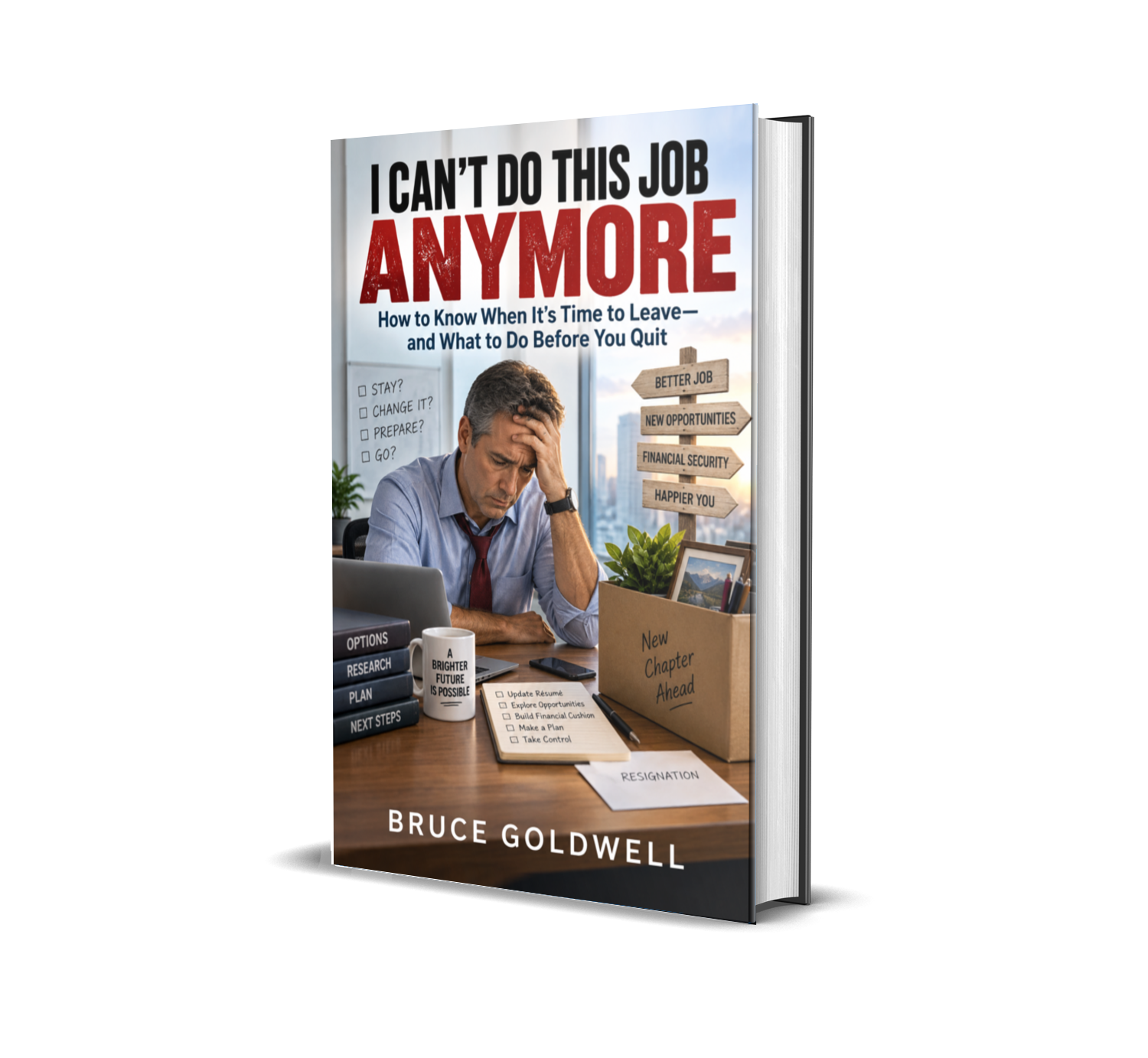
I CAN'T DO THIS JOB ANYMORE
How to Know When It's Time to Leave—and What to Do Before You Quit
Bruce Goldwell's practical decision guide begins with one of the most important questions you can ask when you're unhappy at work:
Is this a bad week—or a bad job?
From there, the book helps you examine what the job is costing you, whether it can be fixed, your financial readiness, your fears, your alternatives, and what needs to happen before you leave.
The goal is to help you determine whether you should STAY, CHANGE IT, PREPARE TO LEAVE, or GO.
Don't quit angry. Quit prepared.
GET THE EBOOK GET THE PAPERBACKDon't Decide From One Day. Decide From the Pattern.
A terrible day can make you want to walk out.
A continuing pattern can tell you that something genuinely needs to change.
Learn the difference, understand your options, and then decide what makes sense for you.
Don't quit because you've had enough. Prepare because you've had enough.
READ THE EBOOK GET THE PAPERBACKThis page is provided for educational and informational purposes and is not legal, financial, tax, employment, career, medical, or other professional advice. Employment laws, workplace policies, benefits, and individual circumstances vary.