I Hate My Job. What Should I Do?
Maybe you wake up already dreading the day.
Maybe Sunday afternoon has become the beginning of Monday morning.
Maybe you spend your commute thinking about leaving.
Maybe you've started saying:
That feeling matters.
But it doesn't automatically mean the smartest thing to do is walk into work tomorrow and quit.
Before deciding what to do, you need to understand what you're actually trying to escape.
What exactly do I hate about my job?
Start by Naming the Real Problem
"I hate my job" describes how you feel.
It doesn't yet explain why you feel that way.
And the reason matters.
The Boss
Is one manager making an otherwise acceptable job miserable?
The Work
Do you dislike the actual work you're being paid to do?
The Workload
Are you constantly expected to accomplish more than can reasonably be done?
The Pay
Do you believe your compensation no longer reflects your responsibilities or value?
The Schedule
Is the job interfering with the life you want outside of work?
The Environment
Is the culture built around conflict, fear, disrespect, favoritism, or constant instability?
Be specific.
I hate my job because ______________________________.
That sentence can be far more useful than simply repeating, "I need to get out of here."
Is This a Bad Week—or a Bad Job?
Every job has bad days.
Sometimes even a good job has a terrible month.
A difficult project, temporary staffing shortage, management change, demanding customer, missed deadline, or unexpected problem can make work miserable for a while.
The question is whether you're experiencing an unusual period or seeing the same problems repeatedly.
or its worst day.
Judge the pattern.
If you aren't sure, take a closer look at Bad Week or Bad Job?
Ask the 12-Month Question
Imagine that nothing improves.
Don't imagine the promotion.
Don't imagine your boss suddenly changing.
Don't imagine management finally fixing everything you've complained about.
Imagine the job exactly as it is now.
If nothing changed at this job during the next 12 months —same boss, same pay, same workload, same environment— would I willingly stay?
Your answer doesn't automatically tell you to quit.
But it can tell you whether waiting for things to improve has become your entire strategy.
Can the Part You Hate Be Changed?
Suppose you actually like your profession.
You like your coworkers.
You like the company.
But you can't stand your schedule.
That may not require leaving the company.
Or perhaps the problem is one supervisor, one department, one responsibility, or one condition that could realistically change.
Ask yourself:
If the problem were fixed tomorrow, would I genuinely want to stay?
If the answer is yes, investigate whether the problem can actually be fixed.
Depending on your situation, that could involve discussing:
- Your schedule
- Your workload
- Your responsibilities
- Your compensation
- A transfer
- A different supervisor
- Additional staffing or resources
- A clearer path for advancement
Don't leave an entire organization before determining whether the real problem has a smaller solution.
Is the Job Difficult—or Toxic?
Not every unpleasant workplace is toxic.
But some problems are more serious than ordinary job frustration.
Repeated humiliation, intimidation, retaliation, impossible expectations, favoritism, constantly changing rules, or an environment where fear is used as a management tool deserve closer attention.
Again, look for patterns rather than isolated incidents.
If you're asking that question, read Is Your Job Toxic?
What Is This Job Costing You?
Your salary tells you what the job pays.
It doesn't tell you what the job costs.
Look beyond the paycheck.
Your Time
How much of your life is being consumed by the job, commute, overtime, and recovery from work?
Your Energy
When the workday ends, do you have anything left for the rest of your life?
Your Relationships
Are frustration and exhaustion from work following you home?
Your Future
Is the job helping you build valuable skills and opportunities—or keeping you stuck?
Who else is paying for my job?
Sometimes the cost of a job is being paid by people who never receive a paycheck from it.
Why Are You Still There?
This isn't criticism.
There may be very good reasons.
You need the paycheck.
You need health insurance.
You have a family depending on you.
You're close to a retirement or vesting milestone.
Jobs in your field are difficult to find.
You aren't financially ready to leave.
Or maybe you're simply afraid of what comes next.
Understanding why you're staying is just as important as understanding why you want to leave.
Am I staying because staying is still the best choice for me—or because I'm afraid to make another choice?
Don't Quit on Your Worst Day
When you've reached your limit, quitting can feel like the fastest way to regain control.
Sometimes leaving quickly may be necessary because of serious circumstances.
But when circumstances allow, don't let your most emotional moment make the entire decision.
Prepare because you've had enough.
There is a huge difference between:
"I can't take this anymore, so I'm quitting."
and:
"I can't take this anymore, so I'm beginning my exit plan."
Turn "I Hate My Job" Into a Plan
If you've concluded that the job probably isn't going to become what you need it to be, start preparing.
- Know your essential monthly expenses.
- Build whatever financial runway you reasonably can.
- Understand what happens to your benefits if you leave.
- Update your résumé.
- Identify potential references.
- Research jobs in your field.
- Identify skills employers are requesting.
- Reconnect with professional contacts.
- Decide what your next job must do better.
- Begin applying when you're ready.
You can explore these steps in more detail at What to Do Before You Quit Your Job.
You Don't Have to Quit Before You Look
One of the most useful things you can do is find out what else is available while you're still employed.
Looking doesn't commit you to leaving.
It gives you information.
Search current openings.
Compare compensation.
Read job descriptions.
See which skills employers want.
Apply for positions that genuinely interest you.
Looking gives you options.
Your current paycheck may even help finance your transition into something better.
Read How to Find a New Job While Still Employed for more.
Don't Escape Into the Same Job Somewhere Else
When you're desperate to leave, almost anything different can look better.
That's when you need to be especially careful.
Suppose the biggest problem with your current job is an unpredictable schedule.
A new job paying more money but requiring an even less predictable schedule may not solve your problem.
Suppose you hate being micromanaged.
Then management style should matter when you interview with another company.
Before searching, create two lists.
My Next Job Must Have
Identify the conditions, compensation, opportunities, schedule, flexibility, or environment that matter most.
My Next Job Must Not Have
Identify the conditions you refuse to knowingly repeat.
Don't search only for a way out. Search for something worth moving toward.
You Have More Than Two Choices
When you hate your job, the decision can feel binary:
Stay miserable or quit.
But there are at least four possible paths:
STAY if the job still makes sense and the current frustration is temporary.
CHANGE IT if the real problem can realistically be fixed without leaving.
PREPARE TO LEAVE if you know the job isn't right anymore but you're not yet ready to resign.
GO when you've decided leaving is the right move and you're prepared to take the next step.
The Goal Isn't to Convince You to Quit
You may examine your situation and decide to leave.
You may decide to stay.
You may decide to give your employer one opportunity to fix the problem.
You may decide that you need several months to prepare your exit.
Any of those can be reasonable decisions.
What matters is that the decision becomes intentional.
Don't leave because you're angry.
Decide because you're ready.
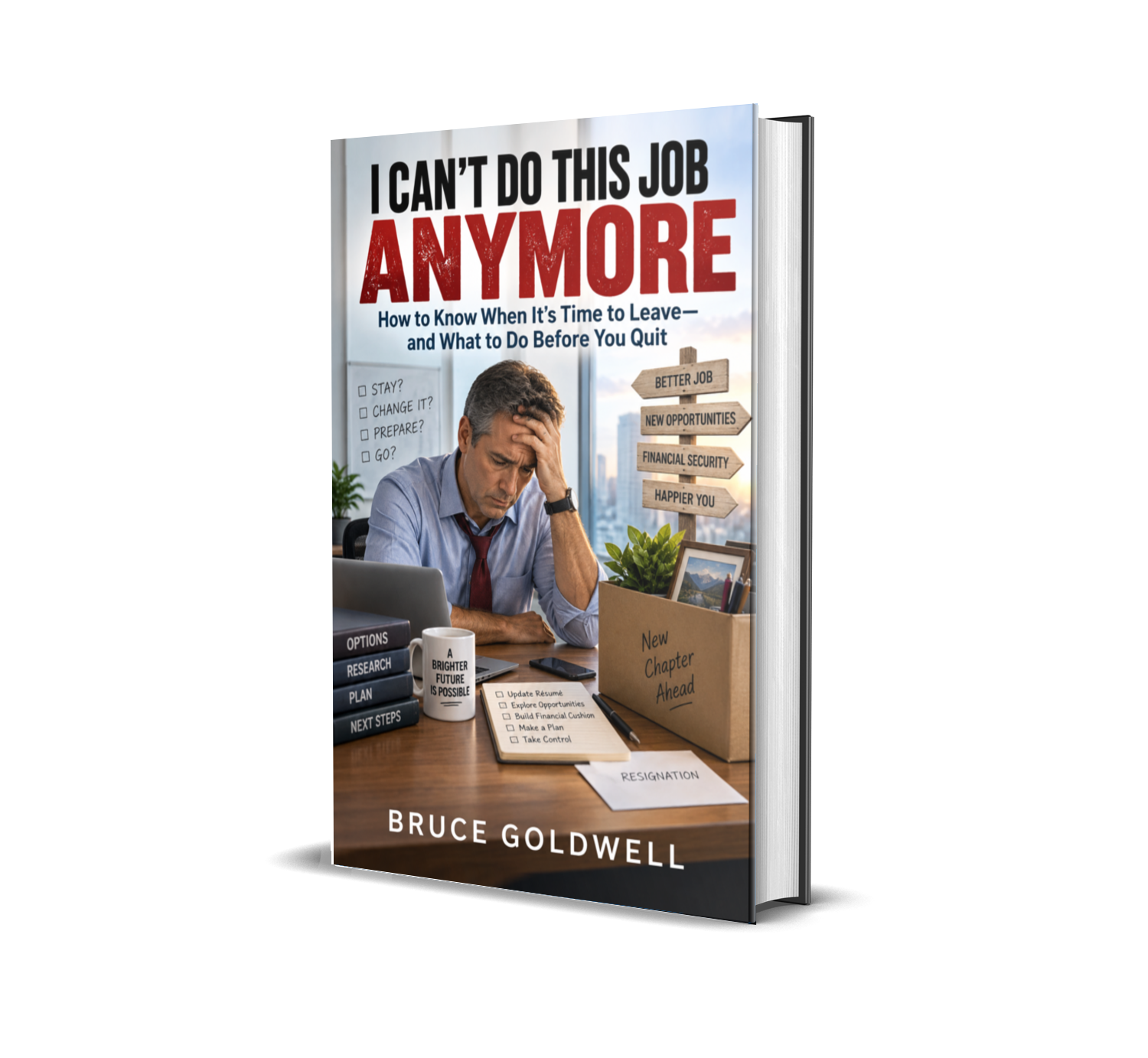
I CAN'T DO THIS JOB ANYMORE
How to Know When It's Time to Leave—and What to Do Before You Quit
If you've reached the point where you're saying, "I hate my job," Bruce Goldwell's practical decision guide can help you slow the decision down long enough to understand what is really wrong and what you can do about it.
Examine the job, what it's costing you, whether it can be fixed, your finances, fears, opportunities, résumé, and exit plan before deciding whether to STAY, CHANGE IT, PREPARE TO LEAVE, or GO.
Don't quit angry. Quit prepared.
GET THE EBOOK GET THE PAPERBACKIf You Hate Your Job, Don't Waste the Message
Your frustration may be telling you that something needs to change.
The change might be your attitude, your schedule, your boss, your responsibilities, your workplace—or your job.
Find out which one before you make the move.
Don't quit because you've had enough. Prepare because you've had enough.
READ THE EBOOK GET THE PAPERBACKThis page is provided for educational and informational purposes and is not legal, financial, tax, employment, career, medical, mental health, or other professional advice. Employment laws, workplace policies, benefits, and individual circumstances vary. If your workplace situation involves threats, harassment, discrimination, retaliation, safety concerns, or other serious issues, consider seeking appropriate professional or official guidance for your circumstances.