Should You Find Another Job Before You Quit?
If you're thinking about leaving your job, one of the smartest things you can do may be to begin exploring your options while you're still employed.
Looking for another job doesn't mean you've decided to leave.
It means you're gathering information.
What jobs are available?
What are employers paying?
Are your skills in demand?
What qualifications keep appearing in job descriptions?
Would another employer actually improve your situation?
Looking gives you information.
Why Look While You're Still Employed?
When you're receiving a paycheck, you may be able to approach your job search differently than you would if you urgently needed income.
You can evaluate an opportunity instead of feeling pressured to accept it.
You can ask:
Is this job actually better than the job I already have?
If the answer is no, you may be able to walk away from the offer and keep looking.
That can be an important advantage.
Your Current Job May Be Financing Your Exit
It's easy to think of your current job only as the thing you're trying to escape.
But until you leave, that job may also be providing the resources you need to build your next step.
Your paycheck may allow you to:
- Build your emergency savings
- Reduce debt
- Update your résumé
- Complete training or certifications
- Attend interviews without financial desperation
- Research other employers
- Wait for a stronger opportunity
Your current job may be financing your escape from your current job.
Update Your Résumé Before You Start Applying
Don't wait until you find the perfect job posting to discover that your résumé hasn't been updated in six years.
Start now.
Create a master list of what you've actually accomplished.
- Responsibilities you've taken on
- Projects you've completed
- Promotions you've earned
- Problems you've solved
- Skills you've developed
- Training and certifications
- Software or systems you know
- Teams or projects you've managed
- Money you've saved or revenue you've helped generate
- Measurable improvements you've helped create
Focus on what you accomplished, not simply what your job description says you were responsible for.
Your résumé should show the value you created, not merely the chair you occupied.
Keep Your Job Search Discreet
Looking for another job while employed doesn't mean you need to announce your plans.
Discretion is not dishonesty.
Until you're ready to make a decision, your job search is generally your business.
Consider keeping your search separate from your current workplace.
- Use your personal email address.
- Use your personal phone.
- Use your own computer or device.
- Search and apply on your own time.
- Be cautious about telling coworkers.
- Review privacy settings on professional profiles.
- Don't use confidential company information in applications.
A possibility doesn't need an audience.
Reconnect Before You Need Something
A job search doesn't have to begin with hundreds of online applications.
Think about people you've worked with over the years.
Former coworkers.
Former supervisors.
Customers or clients you can appropriately remain connected with.
People who left your company and moved somewhere else.
Professional acquaintances.
Networking doesn't have to mean asking:
"Can you get me a job?"
Sometimes a much better question is:
Do you know anyone you think I should talk to?
Run a Quiet Market Test
Before making a major career decision, find out what the marketplace says.
Search for positions you would realistically consider.
Read the qualifications carefully.
Look for patterns.
If the same skill appears in ten job descriptions, that tells you something.
If salaries are substantially different from what you expected, that tells you something.
If you begin receiving interview requests, that tells you something.
If you're getting no response at all, that is information too.
Maybe your résumé needs work.
Maybe you need another skill.
Maybe you're targeting the wrong positions.
The point is to discover these things while you still have time to respond strategically.
Don't Reject Yourself Before the Employer Does
Job descriptions sometimes read like wish lists.
You may see ten qualifications and immediately focus on the two you don't have.
If you meet much of what an employer is seeking and believe you could perform the job, consider applying.
Let the employer decide whether your background deserves an interview. Don't automatically make that decision for them.
How Do You Interview While You're Still Working?
Scheduling interviews can be one of the trickiest parts of searching while employed.
Depending on your work situation, possible options may include:
- Early-morning interviews
- Late-afternoon interviews
- Lunch periods
- Video interviews
- Personal time
- Vacation or paid time off
- Flexible scheduling when available
You can also tell a prospective employer that your current employer is not aware of your search and ask whether interview scheduling can be handled discreetly.
Many employers understand that employed applicants need reasonable discretion.
Don't Create Elaborate Lies
Discretion doesn't require inventing emergencies.
You don't need a fictional sick relative, medical crisis, family disaster, or dead grandparent every time you have an interview.
Keep explanations simple and appropriate to your workplace.
The goal is to conduct a professional job search—not create another problem at the job you still have.
Prepare for the Question: Why Do You Want to Leave?
An interviewer will probably want to know why you're considering leaving your current position.
This isn't the time to unload every complaint you have about your boss.
Even if your complaints are legitimate, an angry answer can make the interviewer wonder how you might someday talk about them.
Keep your answer professional and focused on the future.
Leave the old job emotionally before you describe it professionally.
Talk about what you're looking for: growth, responsibility, opportunity, schedule, skills, culture, challenge, or another legitimate reason that accurately reflects your situation.
Handle References Carefully
A prospective employer may eventually want references.
If your current employer doesn't know you're searching, you can explain that and ask that they not contact your current workplace without discussing it with you first.
Prepare other legitimate references in advance when possible.
Former supervisors, coworkers, managers, or professional contacts may be able to speak about your work without exposing your search prematurely.
Don't Mentally Quit Before You Actually Leave
Once you start imagining another job, your current job can begin to feel temporary.
Be careful.
An application isn't an offer.
An interview isn't an offer.
A second interview isn't an offer.
A recruiter telling you that you're a great candidate isn't an offer.
Continue doing your current work professionally until you're actually ready to leave.
Remember: You're Interviewing Them Too
If you're trying to escape a bad situation, almost any new job can look attractive.
That's dangerous.
Don't simply ask:
Do they want me?
Ask:
Do I want them?
Ask questions about the manager, expectations, schedule, turnover, workload, culture, advancement, compensation, and anything else important to you.
You don't want to leave one bad situation and unknowingly reproduce it somewhere else.
You don't want to fall in love with the lobby and discover the job later.
Don't Compare Salary to Salary. Compare Life to Life.
Suppose another company offers you more money.
Great.
But what else changes?
Compensation
Compare salary, bonuses, retirement contributions, insurance costs and other benefits.
Time
Compare commute, schedule, overtime, flexibility, travel and expected availability.
Work
Compare responsibilities, workload, authority, expectations and advancement.
Life
Consider how the new job may affect your family, energy, stress, personal time and future goals.
A larger salary doesn't automatically mean a better job.
A smaller salary doesn't automatically mean a worse one.
Compare the whole life attached to the offer.
Negotiate From Strength
When you already have a job, you may have something valuable during negotiations:
The ability to say no.
That doesn't mean making unreasonable demands.
It means you can evaluate whether the offer actually improves your situation.
Depending on the position, compensation may not be the only thing worth discussing.
Schedule, remote work, vacation, start date, title, responsibilities, flexibility, and other conditions may also matter.
Income gives you runway.
Preparation gives you leverage.
Options give you power.
Don't Resign Until You're Ready
When a new opportunity appears, excitement can make you want to resign immediately.
Slow down long enough to understand what you're accepting.
Review the important details of the offer and any conditions attached to it.
Understand the compensation.
Understand the benefits.
Confirm the expected start date.
Consider what you're giving up at your current employer.
Make sure you're prepared for the transition.
The goal isn't to get an offer. The goal is to improve your situation.
Your Search May Change Your Decision
Remember, looking for another job doesn't automatically mean you need to leave.
You may discover a great opportunity and decide to go.
You may discover that you need several months to prepare.
You may discover that your current employer can fix the problem.
You may even compare the marketplace with your current job and decide that staying is the best choice.
That's the point.
You made the decision with information.
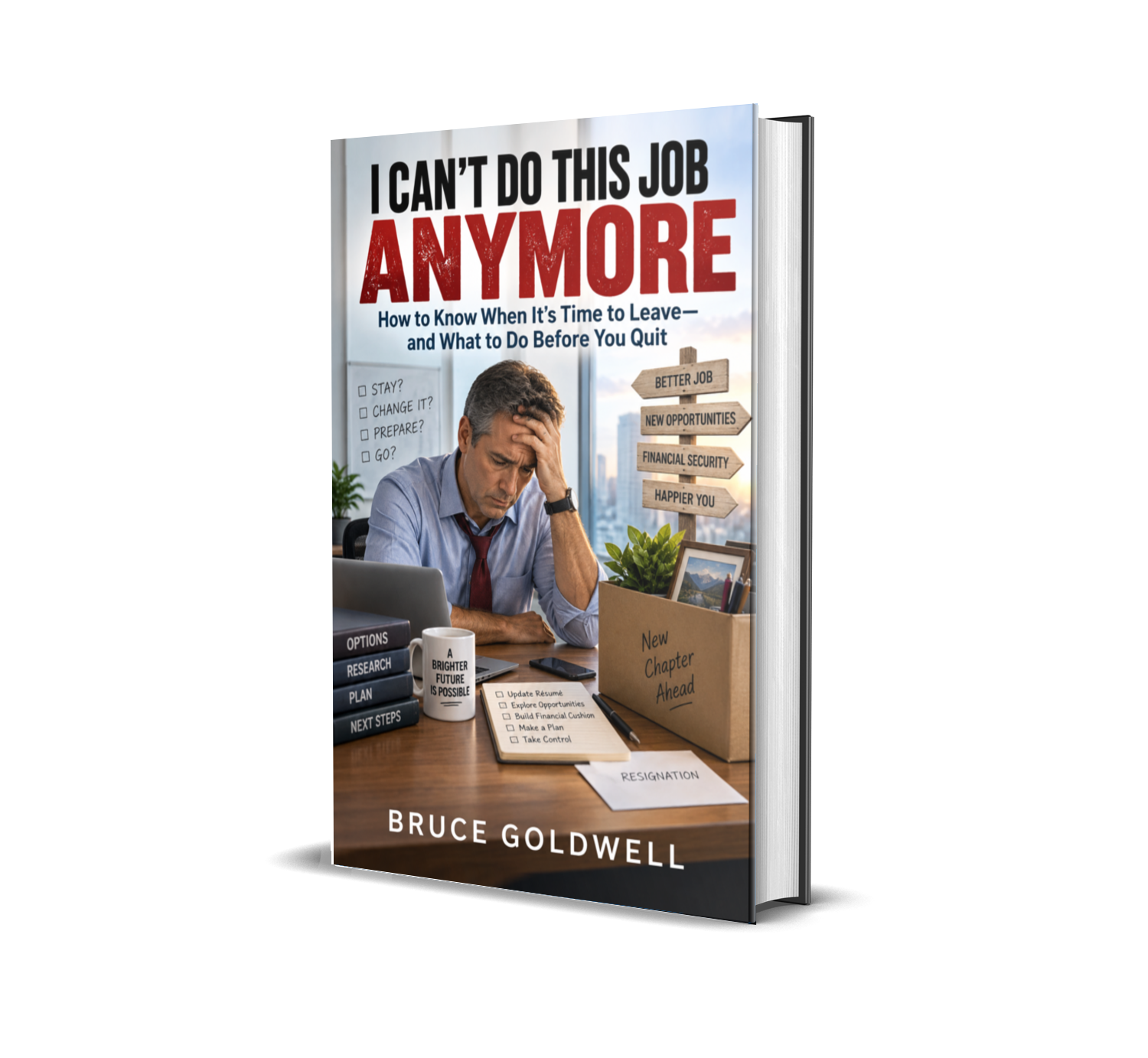
I CAN'T DO THIS JOB ANYMORE
How to Know When It's Time to Leave—and What to Do Before You Quit
Bruce Goldwell's practical decision guide helps you examine your current job, finances, fears, alternatives, résumé, job search and exit strategy before deciding what comes next.
The goal isn't to convince you to quit. It's to help you determine whether you should STAY, CHANGE IT, PREPARE TO LEAVE, or GO.
Don't quit angry. Quit prepared.
GET THE EBOOK GET THE PAPERBACKLook Before You Leap
You don't have to wait until you're unemployed to discover what opportunities are available.
Build your résumé. Explore the market. Have conversations. Apply selectively. Compare opportunities.
Then decide.
Don't quit angry. Quit prepared.
READ THE EBOOK GET THE PAPERBACKThis page is provided for educational and informational purposes and is not legal, financial, tax, employment, career, or other professional advice. Employment laws, workplace policies, benefits, hiring practices, and individual circumstances vary. Verify information that applies to your specific situation before making employment or financial decisions.