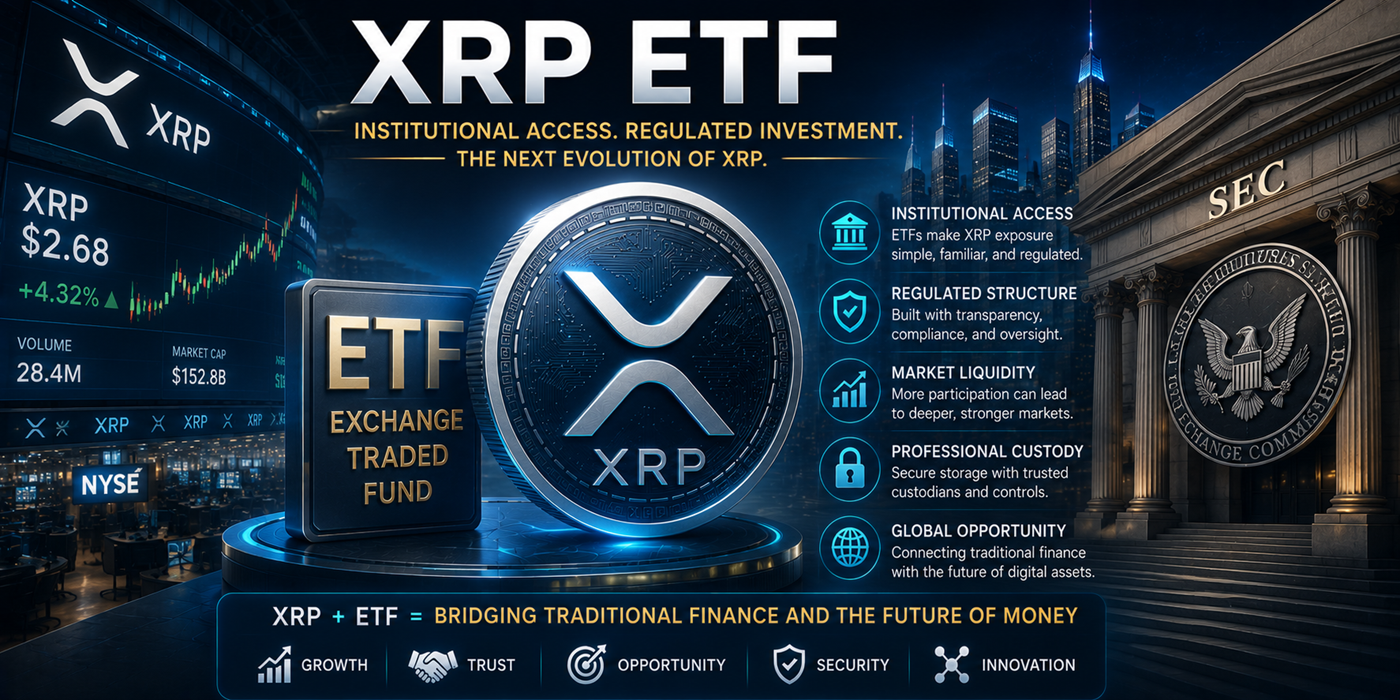
An XRP ETF would be an exchange-traded fund designed to give investors exposure to XRP through a traditional investment product. Instead of buying and holding XRP directly, investors could potentially gain exposure through a regulated market structure.
ETF discussions matter because they connect XRP to institutional access, custody, regulation, liquidity, market confidence, and the larger evolution of digital asset investing.
An ETF is a fund that trades on an exchange like a stock. A crypto ETF can make it easier for some investors to gain exposure to a digital asset without managing wallets, private keys, exchanges, or direct custody.
For XRP, an ETF would not change what XRP is. XRP would still be a digital asset. The ETF would simply create another possible access point for investors through traditional financial markets.
An ETF could make XRP exposure easier for investors who prefer traditional brokerage accounts.
Funds, advisors, and institutions may find ETFs easier to use than direct crypto custody.
ETF products require professional custody arrangements and regulated operational frameworks.
ETF activity could influence liquidity, trading volume, market depth, and investor attention.
| Topic | Direct XRP Ownership | XRP ETF Exposure |
|---|---|---|
| Custody | User manages exchange account, wallet, or self-custody. | Fund structure handles custody through regulated providers. |
| Access | Usually through crypto exchanges or wallets. | Potentially through brokerage or retirement accounts. |
| Use of XRP | User may transfer, hold, or use XRP directly. | Investor receives exposure but usually does not use XRP directly. |
| Risk | Includes wallet, exchange, private key, market, and regulatory risk. | Includes market, fund, custody, regulatory, fee, and tracking risk. |
ETF approval depends heavily on regulation. Digital asset ETFs require oversight, custody rules, market surveillance, disclosure standards, and confidence that the product can operate within existing financial frameworks.
This is why ETF discussions often connect directly to legal clarity, exchange access, institutional confidence, and the broader regulatory treatment of XRP.
An ETF may allow more investors to gain exposure to XRP through familiar financial platforms.
Some institutions are more comfortable with regulated fund products than direct digital asset custody.
ETF filings, approvals, or trading activity can bring more mainstream attention to XRP.
If demand is strong, ETF products may contribute to deeper markets and greater trading activity.
ETF access can increase attention and participation, but price still depends on demand, supply, liquidity, market cycles, regulation, and investor behavior.
ETF investors may gain exposure to XRP price movement without directly using XRP for payments, settlement, wallets, or value transfer.
ETF products require regulatory review, compliance, custody standards, market surveillance, and formal approval processes.
ETF investors should understand fund fees, tracking differences, custody arrangements, and product structure before making decisions.
Understand why legal clarity is central to ETF products and institutional confidence.
Explore how institutions may influence XRP access, liquidity, and credibility.
Learn why ETF access may connect to market depth and trading activity.
Study how ETF access fits into broader XRP valuation thinking.
A Spanish-language XRP ETF book focused on Latin America and digital finance opportunity.
A grounded look at valuation, adoption, risk, and realistic assumptions.
A guide focused on institutional shifts and digital asset market structure.
Explores institutions, liquidity, and future financial rails.
The core idea behind an XRP ETF is access. It could give more investors a familiar way to gain exposure to XRP, but it would not remove market risk or replace the need for independent research.