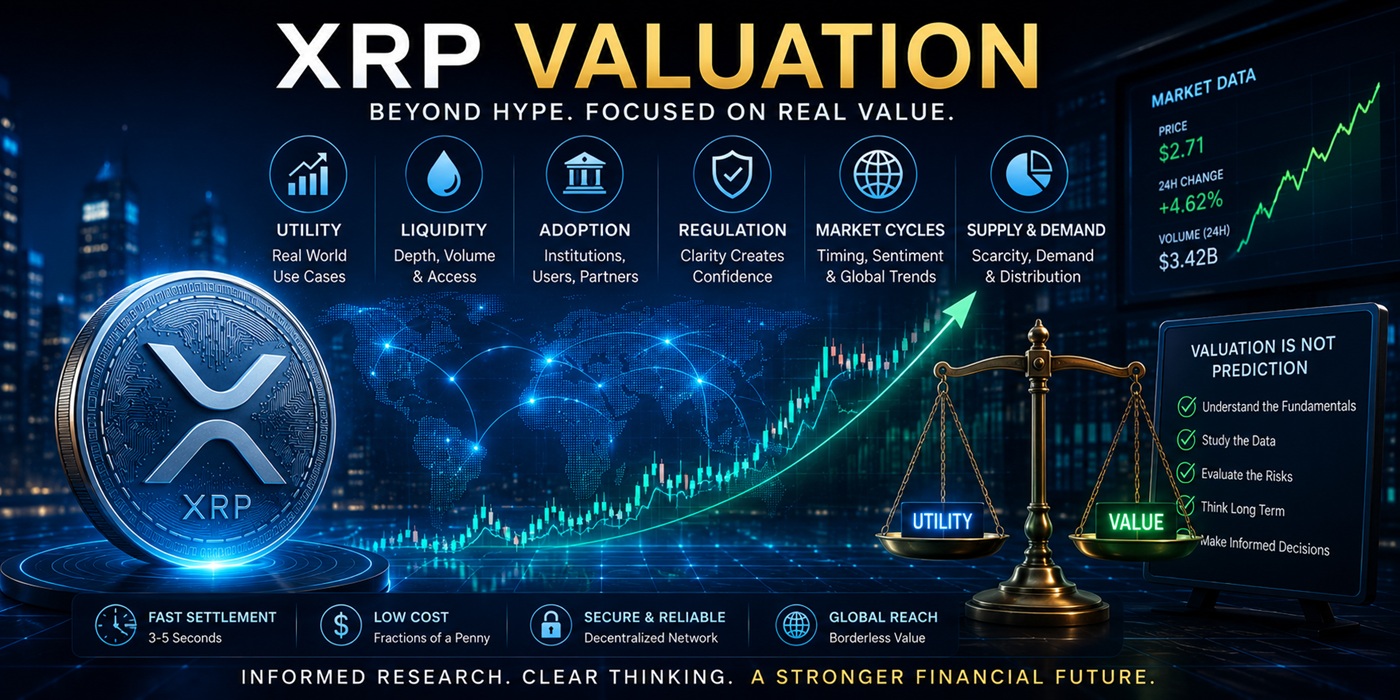
XRP valuation is one of the most debated topics in the digital asset world. Some people focus on bold price predictions. Others focus on utility, liquidity, market structure, institutional adoption, supply, demand, and risk.
This page takes the grounded approach. It is designed to help readers think clearly about XRP valuation without treating hype, social media predictions, or wishful thinking as serious research.
XRP valuation is not just about asking, “How high can XRP go?” A better question is: “What real forces could increase or decrease XRP's value over time?”
Those forces may include utility, liquidity, adoption, regulation, market access, speculation, supply, demand, competition, macro conditions, and investor psychology.
Utility asks whether XRP and XRPL are solving real problems such as settlement, liquidity, payments, or digital asset movement.
Liquidity matters because large markets require enough buyers, sellers, volume, access, and confidence to support meaningful use.
Adoption may include users, developers, exchanges, institutions, payment companies, custody providers, and infrastructure builders.
Regulatory clarity can influence institutional confidence, exchange access, custody, compliance, and broader market participation.
A prediction says, “XRP will reach this number.” Valuation research asks, “What conditions would need to exist for a price range to become reasonable?”
That difference matters. Responsible valuation thinking studies assumptions. It asks whether adoption, volume, liquidity, token demand, market access, and real-world use are strong enough to support a valuation idea.
The strongest valuation arguments begin with utility. If XRP is useful in settlement, liquidity, tokenization, or payments, that utility may influence long-term demand.
Demand matters. Researchers should ask whether individuals, institutions, networks, payment providers, or markets have reasons to use or hold XRP.
If XRP is discussed as a bridge asset or liquidity tool, the size, depth, and reliability of markets become important factors.
Strong research also studies risks, including regulation, competition, lack of adoption, market downturns, liquidity limits, and changing narratives.
Supply affects valuation because the number of tokens available, circulating supply, escrow releases, market liquidity, and holder behavior can influence price dynamics.
Demand can come from speculation, utility, institutional access, exchange activity, payment use, developer activity, or long-term investor belief.
Exchange availability, custody options, regulatory clarity, ETFs, and institutional products can affect who is able to buy, hold, or use XRP.
Crypto markets often move in cycles driven by sentiment, liquidity, narratives, macro conditions, Bitcoin movement, and broader risk appetite.
| Topic | Utility-Based Thinking | Speculation-Based Thinking |
|---|---|---|
| Main Question | What real use could create demand? | How high could price go if people buy? |
| Focus | Adoption, liquidity, payments, settlement, infrastructure | Hype, narratives, momentum, social media excitement |
| Research Style | Evidence, assumptions, risks, market structure | Price targets, hope, comparison charts, viral claims |
| Weakness | Utility may take time and may not produce expected price impact | Speculation can rise quickly and collapse quickly |
Just because something could happen does not mean it will happen. Valuation requires weighing probabilities, not only possibilities.
Price targets should be evaluated against supply, market capitalization, liquidity, and realistic demand assumptions.
Regulation, competition, technology changes, market downturns, and adoption delays can affect XRP's long-term outlook.
Viral claims often simplify complex markets. Good research asks what evidence supports the claim and what assumptions are being made.
Scenario thinking can be more useful than single-point predictions. Instead of saying XRP must reach one number, researchers can study multiple possible futures.
XRP remains a major digital asset but adoption develops slowly, with price driven mostly by market cycles, sentiment, and limited utility growth.
XRP benefits from stronger exchange access, regulatory clarity, liquidity growth, and increased use in digital finance infrastructure.
XRP gains meaningful institutional attention, deeper liquidity, broader market access, and stronger real-world use-case discussion.
Adoption disappoints, competition grows, regulation limits use, or crypto markets enter a prolonged downturn.
A grounded guide to practical valuation in 2026 and beyond, focused on moving beyond hype.
Explores real value drivers of XRP beyond simplistic price targets and predictions.
Examines the idea of institutional rails and XRP through a broader digital asset comparison.
Explores liquidity, institutional adoption, and the multiplier effect often discussed around XRP.
Study the forces that can influence XRP market behavior over time.
Understand why liquidity is central to XRP adoption and valuation conversations.
Explore how institutions can influence market access, credibility, and utility.
Return to the XRP Research Center for connected digital finance topics.
XRP valuation should not begin with hype. It should begin with utility, liquidity, adoption, supply, demand, regulation, risk, and realistic assumptions. Better questions create better research.