More Than Preserving a Name
When a visionary founder creates something meaningful, an important question eventually appears:
Can the principles survive beyond the founder?
September Dohrmann became an important part of that question within the story of CEO Space.
She was closely connected to Berny Dohrmann's work and later assumed significant leadership responsibilities within the organization.
Her role was not simply to preserve an organizational name.
It was to help carry forward a philosophy built around entrepreneurship, connection, cooperation, learning, mentorship and possibility.
From Berny's Vision to a Living Philosophy
Berny Dohrmann built CEO Space around the belief that entrepreneurs did not need to operate in complete isolation.
They could learn from one another.
Share experience.
Build relationships.
Make introductions.
Help one another solve problems.
And recognize that another person's success did not automatically reduce their own.
September's role in that story became one of continuity.
Organizations change.
Technology changes.
Business culture changes.
The challenge is deciding what must adapt and what must remain at the center.
For CEO Space, the enduring center was never simply a schedule of events.
It was the philosophy of The Space itself.
What September Could See That Others Might Miss
Most participants experienced CEO Space from one perspective.
Their own.
They knew why they came.
What they needed.
Who they met.
Which conversations mattered to them.
Leadership had another vantage point.
September could observe patterns across many entrepreneurs, speakers, mentors and events.
She could see people arrive uncertain and later become confident contributors.
She could see relationships forming that participants themselves could not have predicted when they first entered the room.
She could see mentors sharing lessons earned over decades.
She could see experienced entrepreneurs helping people standing much earlier on the same path.
She could see introductions whose consequences might continue long after an event ended.
Watching Entrepreneurs Change
The people who entered CEO Space did not all begin from the same place.
Some had established companies.
Some were raising capital.
Some were speakers, authors or consultants.
Some were launching their first businesses.
Some were trying to recover after setbacks.
Others were carrying an idea they had not yet figured out how to build.
What united them was possibility.
They believed something could be created that did not yet exist.
Inside The Space, that possibility could encounter resources.
A speaker could encounter someone who understood publicity.
An author could encounter someone who understood publishing.
An entrepreneur could encounter someone with financial knowledge.
Someone discouraged could encounter a person whose own story demonstrated resilience.
The individual still had to do the work.
But they no longer necessarily had to discover every answer alone.
Preserving the Philosophy While the World Changed
Carrying a legacy forward does not mean freezing it in time.
Entrepreneurship changed.
Communication changed.
Remote technology changed how people could gather.
Digital media changed how ideas traveled.
Business education became increasingly accessible online.
The challenge for leadership was to preserve the principles that mattered while adapting how those principles were delivered.
September's leadership represented that bridge between continuity and change.
The format might evolve.
The people might change.
The tools might change.
But the deeper questions remained:
What knowledge should be shared?
What problem can someone in the network help solve?
How can entrepreneurs become stronger because they are connected?
Berny Created the Space. Others Had to Carry It.
Every visionary founder eventually creates something they cannot personally carry forever.
If the idea depends entirely upon the founder's personality, it may disappear when the founder does.
A stronger legacy happens when other people understand the principles deeply enough to continue expressing them in their own way.
That is why September's role matters in The Superconductors II.
She represents the transition from:
"Berny's idea"
to:
"principles other people can continue carrying."
That may be the real test of any legacy.
Read About BernyRecognizing the Superconductors
One of the important contributions September can make to the continuing story of CEO Space is helping preserve the memories of the people who embodied its philosophy.
The speakers.
Mentors.
Educators.
Connectors.
Entrepreneurs.
People who shared knowledge.
People who encouraged others.
People who made introductions.
People who helped others see paths that were invisible before the conversation began.
These are the people Bruce Goldwell describes as Superconductors.
Why September's Memories Matter
Bruce Goldwell experienced CEO Space personally.
But no participant saw everything.
One person's memory contains one part of the story.
September's perspective can preserve another.
Her memories of Berny, the people who repeatedly showed up, the relationships that formed and the moments that represented the culture of The Space can add something historical research cannot reproduce.
First-person memory.
The simple sentences matter:
"The thing about Berny was..."
"What people may not know is..."
"I watched this person..."
"One of the moments I will never forget..."
Those stories help turn an organizational history into a human one.
Explore The Superconductors IIThe Organization May Change. The Current Can Continue.
CEO Space as many graduates remember it belongs to a particular chapter in entrepreneurial history.
But organizations are not the only way ideas survive.
Ideas survive through people.
Someone learned a principle from Berny.
They carried it into another company.
Someone experienced contribution inside The Space.
They created the same culture inside their own community.
Someone received an introduction.
Years later, they became the person making introductions.
Someone was mentored.
Eventually they became a mentor.
That is how a philosophy can survive even when the room itself no longer exists in the same form.
Where Are the Superconductors Today?
Many of the people connected with the story of The Superconductors II continue their work as authors, speakers, coaches, entrepreneurs and leaders.
Visit the Connections page for official public websites and contact channels where available.
Visit Connections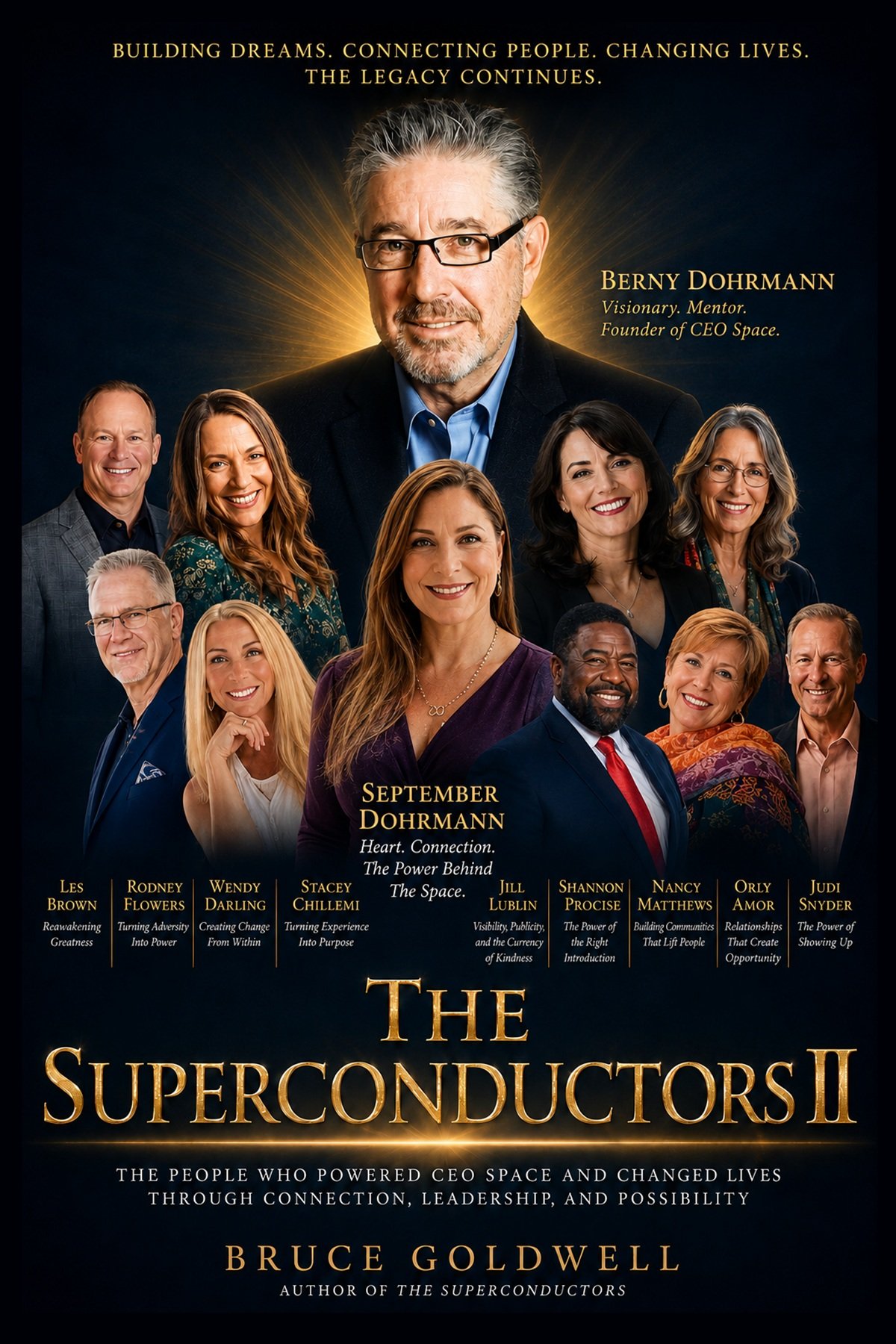
The Superconductors II
The People Who Powered CEO Space and Changed Lives Through Connection, Leadership, and Possibility
September Dohrmann occupies an important place in the story because she represents the bridge between Berny's vision, the people who experienced The Space, and the legacy those people continue to carry.
The book explores CEO Space not merely as an organization, but as an environment where human connection itself became a form of entrepreneurial capital.
Explore Book II View Book II on Amazon