Forget the Technology for a Minute
One reason artificial intelligence can seem intimidating is the name itself. "Artificial intelligence" sounds like something that belongs in a laboratory or computer science classroom.
But actually using AI can be much simpler.
Think of it as having a conversation with a very capable assistant. You type what you want to know or what you need help doing. The AI responds. Then you continue the conversation.
You don't need to speak computer. You can use the same everyday language you would use when talking to another person.
Your First AI Conversation
Open an AI assistant and type something this simple:
"Hello. I have never used AI before. Can you help me learn how to use it?"
That's it.
You have started.
You could follow that with:
"Give me one simple thing I can try right now."
You don't need to understand everything AI can do before you begin. In fact, one of the best ways to learn AI is simply to use it.
Try Something You Already Understand
For your first few conversations, don't choose something complicated. Choose something from your own life.
For example:
"Give me three easy dinner ideas using chicken."
"Help me write a short birthday message for my granddaughter."
"Give me five ideas for things I could do this weekend."
"Help me make a checklist for cleaning out my garage."
The purpose isn't to test the AI. It's to get comfortable having a conversation with it.
The Secret to Better AI Answers
Here's one of the first things worth learning: AI can usually help you more when you give it more useful information.
Suppose you ask:
"Where should I go on vacation?"
AI has very little to work with.
Now try:
"I am retired and would like a relaxing three-day vacation in Florida. I enjoy beaches, seafood, history, and scenic drives. I don't want an exhausting schedule. Give me three ideas."
That's a much better question because the AI knows more about what you actually want.
You don't need to learn a complicated formula for writing AI prompts. Just remember:
You Can Keep Talking
Your first question does not have to be perfect.
This may be the biggest difference between AI and an ordinary Internet search. You can continue the conversation.
Suppose AI gives you three vacation ideas and you like one of them.
You can say:
"Tell me more about the second choice."
Then:
"Make it a four-day trip instead."
Then:
"I don't want to drive more than two hours on any day. Change the plan."
Each answer can become the beginning of the next question.
Say "I Don't Understand"
This may be one of the most useful things a new AI user can learn.
If AI gives you an answer you don't understand, you don't have to pretend that you do.
Tell it:
"I don't understand that. Explain it using simpler words."
Or:
"Give me an example."
Or:
"Explain this one step at a time."
Or even:
"You're going too fast. Slow down."
AI won't become impatient with you. Ask again as many times as you need.
Let AI Ask You the Questions
Here's a technique many beginners don't discover right away.
You don't always have to know what to ask.
Let AI interview you.
"Ask me the questions you need before answering."
You can make it even easier:
"Ask me one question at a time."
Now the AI does part of the work.
This can be useful when planning a trip, choosing a hobby, thinking about a purchase, organizing a project, learning something new, or exploring an idea.
You Are Allowed to Disagree With AI
AI is not your boss.
If it gives you something you don't like, say so.
"No. That's not what I mean. Let me explain it another way."
Or:
"I don't like those choices. Give me three different ideas."
You are directing the conversation.
Ask AI to Give You Choices
Sometimes you don't want AI to decide something for you. You want help thinking.
Try:
"Give me three choices and explain the advantages and disadvantages of each."
That's often more useful than simply asking: "What should I do?"
AI can help you see possibilities. You still make the decision.
Try This Five-Minute AI Exercise
If you're new to AI, try these five questions.
- "What is one simple thing you can help me do today?"
- "Explain something interesting to me in simple language."
- "Ask me three questions to discover something I might enjoy learning."
- "Give me three ways AI could make my everyday life easier."
- "What is something useful I could ask you that I probably haven't thought of?"
Five minutes of actually using AI may teach you more than an hour of worrying about how complicated it might be.
Don't Automatically Believe Everything AI Says
There's another habit you should develop from the beginning.
AI can be wrong.
For everyday low-risk questions, that may not matter much. But when an answer involves your health, money, taxes, legal matters, safety, or another important decision, verify the information.
You can even ask AI:
"What parts of this answer should I verify?"
AI can help you understand a subject and prepare better questions, but important decisions may still require reliable sources or an experienced professional.
Then Something Interesting Can Happen
At first, you may use AI for little things: a recipe, a letter, a travel idea, or help understanding your phone.
But once you become comfortable with the tool, another question becomes possible:
Maybe AI helps you return to a hobby you haven't enjoyed in years. Maybe it helps you finally write down your family stories. Maybe you learn something you've always wanted to understand.
Or maybe it helps you recognize that something you've learned during 30, 40, or 50 years of life could be useful to somebody else.
Your Experience Plus AI
This is where AI becomes particularly interesting for seniors.
You may have decades of knowledge from a career, business, hobby, family, military service, volunteer work, or simply from solving real problems throughout your life.
AI doesn't have that experience.
But it may be able to help you organize what you know, turn scattered ideas into a plan, create a first draft, explore possibilities, or discover ways your knowledge could help someone else.
That's Where the Book Takes You Next
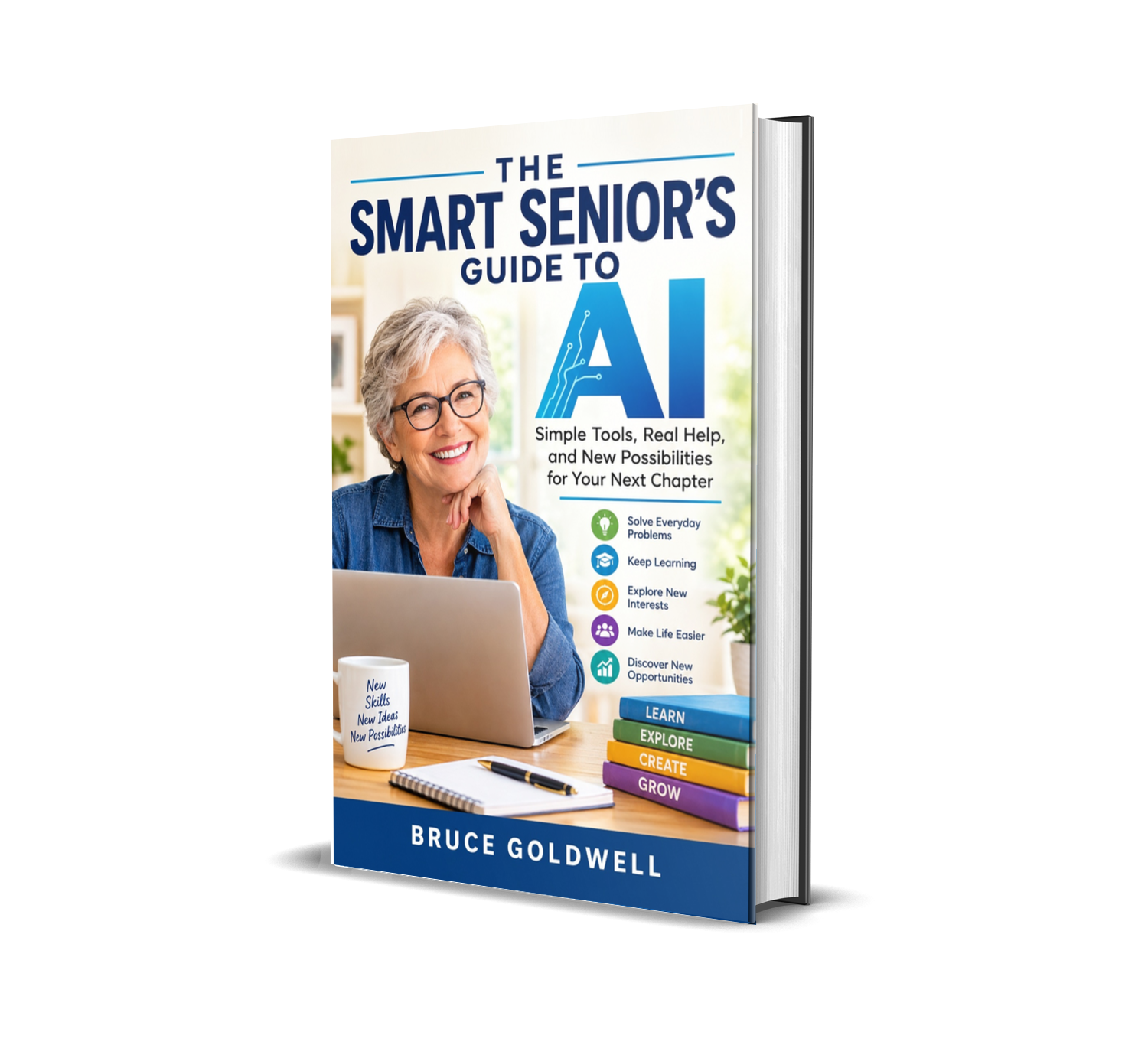
The Smart Senior's Guide to AI doesn't stop after showing you how to ask your first question. It walks you through ways to make AI useful in your everyday life and shows you how to become more confident using it.
You'll learn how to use AI as a patient personal teacher, discover skills and knowledge you may have overlooked, explore realistic possibilities for additional income, develop an idea with AI, recognize scams and misinformation, check AI when it may be wrong, get a second AI opinion, and understand when you still need a human expert.
The book also includes a practical Smart Senior AI Toolkit filled with ready-to-use questions and prompts for everyday life, learning, travel, money-saving, hobbies, family, technology, business, and income ideas.
You don't have to memorize any of it. Keep the guide handy, find the kind of help you need, and try the examples yourself.