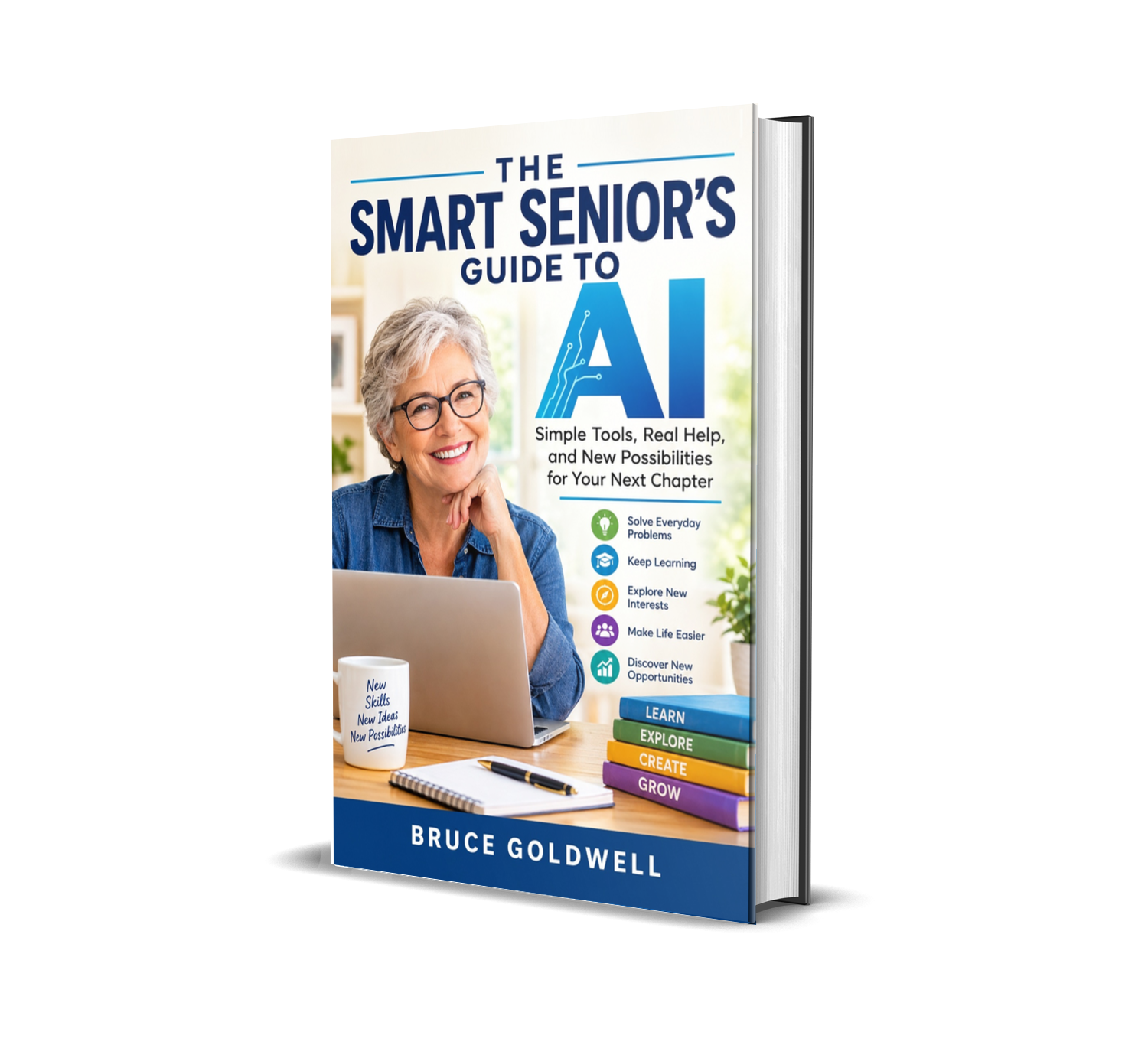
AI Doesn't Have to Be Complicated
Artificial intelligence is suddenly everywhere. People are talking about AI at work, on television, online, and around the dinner table.
If you're a senior, you may be wondering whether this new technology is really something you need—or whether it is mainly for younger people who grew up with computers and smartphones.
The Smart Senior's Guide to AI begins with a simple message:
You don't need to understand computer programming. You don't need to learn complicated technical language. You don't need to know how artificial intelligence works deep inside a computer.
You need to learn how to talk to it, ask useful questions, question the answers when necessary, and discover where this new tool might fit into your life.
Written for Seniors, Not Computer Experts
This book was written to make AI understandable to someone who may be opening an AI assistant for the very first time.
The explanations use ordinary language. The examples come from everyday life. And when a new idea is introduced, the goal is to explain why it matters and how you might actually use it.
Maybe you're 65 and just beginning retirement. Maybe you're still working. Maybe you're 75 or 85 and simply curious about what everyone is talking about.
You don't have to catch up with anybody.
What Can AI Actually Help You Do?
One of the easiest ways to understand AI is to stop thinking about the technology and start thinking about problems, questions, and things you would like to accomplish.
AI can help you:
- Write letters, emails, messages, and notes
- Plan meals and organize shopping lists
- Plan trips and create travel checklists
- Learn new subjects at your own pace
- Understand confusing information
- Organize projects and everyday tasks
- Explore hobbies and interests
- Learn more about computers and smartphones
- Prepare questions before important appointments
- Preserve family stories and memories
- Brainstorm ideas and compare possibilities
- Explore whether your experience could help other people
And those are only starting points.
Start With the Small Compressor
One of the central lessons in the book comes from author Bruce Goldwell's experience working at Sears.
A customer might come in looking for a small air compressor because he wanted to paint his car.
But there was another question worth asking.
What if someone sees the finished car and asks you to paint theirs? What if another person asks? Could something that began as one project eventually become a part-time job?
If that possibility existed, perhaps the smallest compressor wasn't necessarily the best choice.
The lesson wasn't to buy the biggest tool. The lesson was to think beyond today's project and ask where it might lead.
That's how this book approaches AI.
Start small.
Use AI for something useful. Learn how it works. Get comfortable with it. Then ask:
You Have Something AI Doesn't Have
Artificial intelligence can work with enormous amounts of information.
But it hasn't lived your life.
It hasn't spent decades teaching, repairing, building, selling, managing, cooking, raising children, caring for people, running a business, serving customers, practicing a trade, developing a hobby, or learning from mistakes.
You have.
Many seniors underestimate how much they know because skills developed over decades eventually begin to feel ordinary.
Something that seems easy to you may be difficult for someone who has never learned it.
Could What You Know Be Valuable to Someone Else?
This book also explores a possibility that many introductions to AI overlook.
Could AI help you do something with the knowledge you have accumulated during your life?
That might mean tutoring, consulting, teaching, freelance help, a local service, a book, a practical guide, a digital product, educational material, content creation, or helping a small business.
It doesn't have to become a large business. For some people, even a modest amount of additional income could be useful.
The book does not promise that AI will make you rich. There are no claims of instant income, automatic businesses, or money appearing simply because you typed something into an AI program.
Instead, the process is much more practical:
Could AI help me turn that knowledge into something useful?
Would anyone pay for it?
What's the smallest, safest, and least expensive way I could find out?
AI Is a Tool, Not a Magic Money Machine
A compressor doesn't create a painting business by itself. A hammer doesn't create a carpenter. A computer doesn't automatically create a successful company.
The person still matters.
AI is the same way.
It can help research, organize, explain, brainstorm, write, plan, practice, and create first drafts. But you still bring the judgment, experience, relationships, reputation, and understanding of real people.
The tool can help you do more.
It doesn't replace you.
Learn How to Use AI Safely
The book doesn't present AI as perfect.
AI can make mistakes. Sometimes it can produce an answer that sounds very convincing and still be wrong.
You'll learn when an AI answer deserves additional checking, how to ask what should be verified, and how another AI can sometimes provide a useful second perspective.
You'll also learn why two AI systems agreeing with each other does not automatically make something true.
The simple habit taught in the book is:
Don't Let AI—or Anyone Using AI—Fool You
AI can also be used by dishonest people.
Fake voices, fake images, fake videos, convincing emails, bogus investment opportunities, suspicious messages, and get-rich-quick offers can all become easier to create.
The book teaches a rule worth remembering whether AI is involved or not:
If someone suddenly demands money, a password, a verification code, banking information, or immediate action, slow down and verify independently.
Know When You Still Need a Human
AI can explain medical terms, but it isn't your doctor. It can help you understand legal language, but it isn't automatically a substitute for a lawyer.
The same principle applies to accountants, financial professionals, contractors, and other people with specialized training and real-world experience.
AI can help you become better prepared.
It can help you organize information and prepare better questions before talking with a professional.
Sometimes the smartest answer AI can help you reach is:
What's Inside the Book?
The Smart Senior's Guide to AI takes you from your first conversation with artificial intelligence through increasingly useful ways of putting the technology to work.
- You're Not Too Old, and You're Not Too Late — Why AI isn't just for younger generations.
- What Is AI? — A simple explanation without technical language.
- Your First Conversation With AI — How to start using AI without being intimidated.
- Start With the Small Compressor — Begin with one need and consider where it could lead.
- Make Everyday Life Easier — Practical uses for ordinary tasks and problems.
- Your Patient Personal Teacher — Use AI to learn almost anything at your own pace.
- You Have Something AI Doesn't Have — Combine technology with decades of experience.
- Could What You Know Make You Money? — Identify knowledge, skills, and interests that may have value to others.
- From Experience to Income — Explore practical possibilities without get-rich-quick promises.
- Let AI Help You Build the Idea — Research, question, test, and develop an idea.
- Don't Let AI—or Anyone Using AI—Fool You — Scams, fake voices, misinformation, privacy, and safety.
- AI Can Be Wrong — Understand mistakes and learn when to verify.
- Know When You Still Need a Human — Recognize when professional expertise still matters.
- Get a Second AI Opinion — Use another AI to challenge important answers.
- Your Smart Senior AI Toolkit — Ready-to-use prompts for everyday life, learning, travel, family, hobbies, technology, business, and more.
- What Could the Next Ten Years Look Like? — Think about what you still want to learn, create, experience, or build.
A Book You Can Keep Beside You
You don't have to memorize everything in this book.
Keep it handy. Return to the examples and prompts when you need them. Try something. See what happens. Then come back and try something else.
The goal isn't to turn you into an AI expert.
The goal is to make AI useful to you.
Where Could This Take You?
Maybe AI simply makes a few everyday tasks easier.
Maybe it helps you learn something you've always wanted to understand.
Maybe you preserve stories your grandchildren will someday treasure.
Maybe you rediscover an old interest.
Maybe something you learned during decades of work becomes useful to another person.
Maybe it even leads to a small source of additional income.
You don't have to know the answer today.
Start small. Ask one question. Learn as you go.
You are not too late.
You may be just getting started.