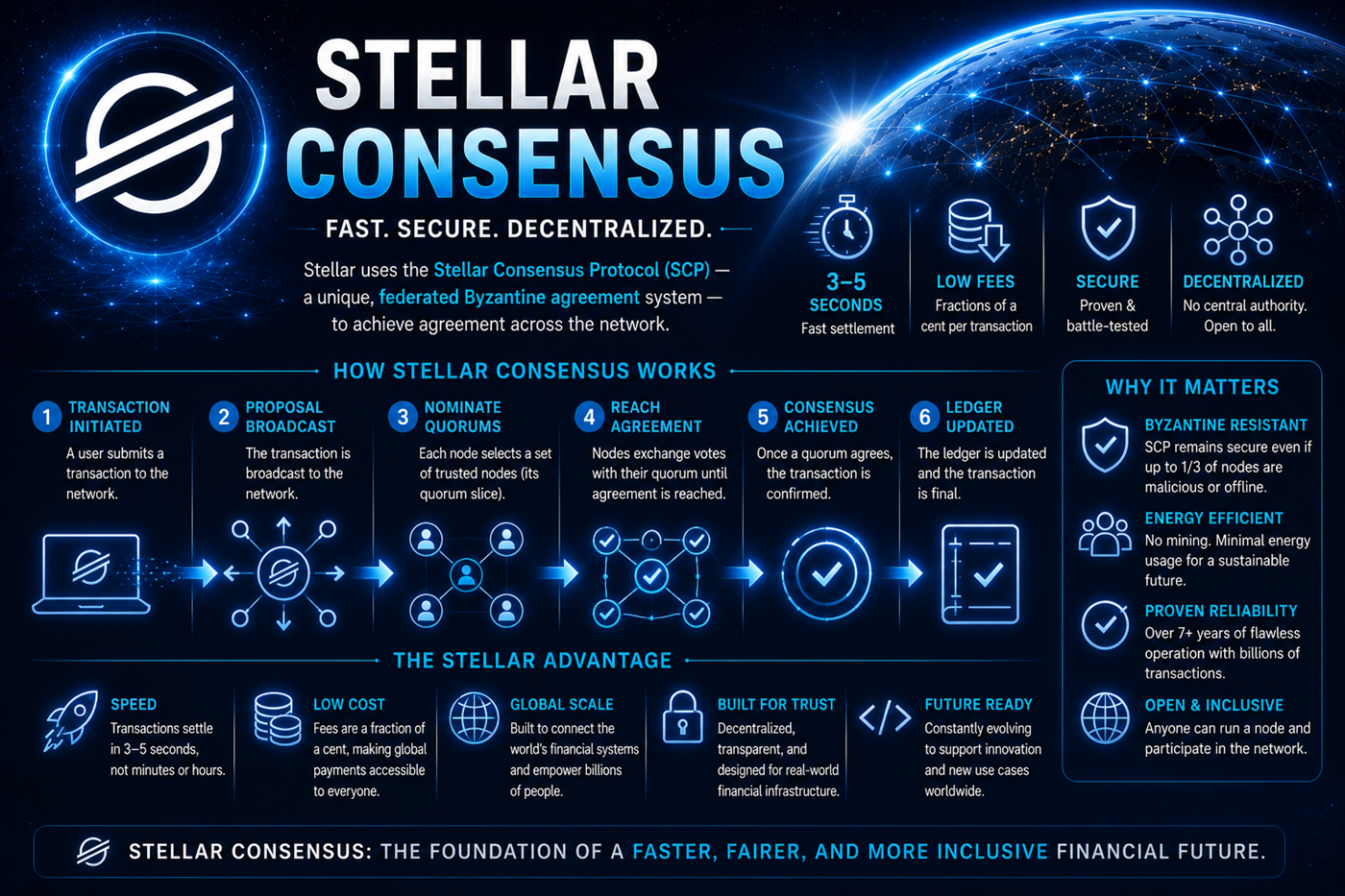
Stellar does not use proof-of-work mining. Instead, it uses a consensus system known as the Stellar Consensus Protocol, often shortened to SCP. This process allows the network to agree on transactions without requiring energy-intensive mining.
Consensus is what helps the Stellar network decide which transactions are valid, what the current ledger state should be, and how value moves across the network.
Simple idea: Stellar consensus helps independent network participants agree on transactions quickly and efficiently without mining.
Every blockchain needs a way to agree on what is true. If one account sends XLM or a Stellar-based asset, the network must agree that the transaction is valid and update the ledger correctly.
Without consensus, different servers could disagree about balances, payments, assets, or transaction history. Stellar consensus helps create a shared version of the ledger that participating nodes can rely on.
Consensus helps the network agree which transactions should be accepted.
Once agreement is reached, the ledger updates account balances and asset records.
Participants can rely on a shared ledger history rather than separate conflicting records.
Efficient agreement helps Stellar support quick transaction settlement.
Some blockchains use proof-of-work mining, where computers compete to solve difficult mathematical problems. Stellar takes a different approach. It does not rely on miners, mining rewards, or energy-intensive competition.
Instead, Stellar uses validator participation and network agreement to confirm transactions. This allows Stellar to support fast, low-cost transfers while avoiding the high energy use associated with proof-of-work systems.
XLM is not mined through proof-of-work. The Stellar network uses consensus to process transactions and maintain the ledger.
In Stellar, validators are network participants that help confirm transactions and maintain agreement. A key concept in Stellar Consensus Protocol is the quorum slice.
A quorum slice is a group of trusted validators that a node relies on for agreement. Instead of every participant needing to trust one central authority, Stellar allows trust to be formed through overlapping groups of validators.
Servers that participate in the consensus process and help maintain network agreement.
Groups of validators that a node chooses to rely on when participating in consensus.
Network agreement emerges when trusted validator groups overlap across participants.
Consensus does not depend on one single company or one single server making every decision.
Stellar is often discussed as a network for remittances, stablecoins, anchors, and financial access. Those use cases require fast and reliable settlement. Consensus helps the network process payments and update balances quickly.
When someone sends XLM or a Stellar-based asset, the network uses consensus to confirm the transaction and record the result. This makes Stellar useful for payment systems where speed, cost, and reliability matter.
Fast confirmation can help users send value across borders more efficiently.
Consensus supports movement of issued assets such as digital dollars and other tokenized currencies.
Anchors depend on reliable settlement when connecting local money systems to Stellar.
Wallet users benefit from transactions that can settle quickly and predictably.
The value of consensus is practical. It helps Stellar operate as a network for moving value, issuing assets, supporting wallets, connecting anchors, and enabling stablecoin payments.
The stronger and more reliable the network becomes, the more useful it may be for real-world financial applications. This is why consensus is one of the most important foundations of Stellar.
This page is for educational purposes only and is not financial advice. Stellar technology, validator participation, consensus details, regulations, network activity, and ecosystem development may change over time. Always verify current information through official Stellar resources and independent research.