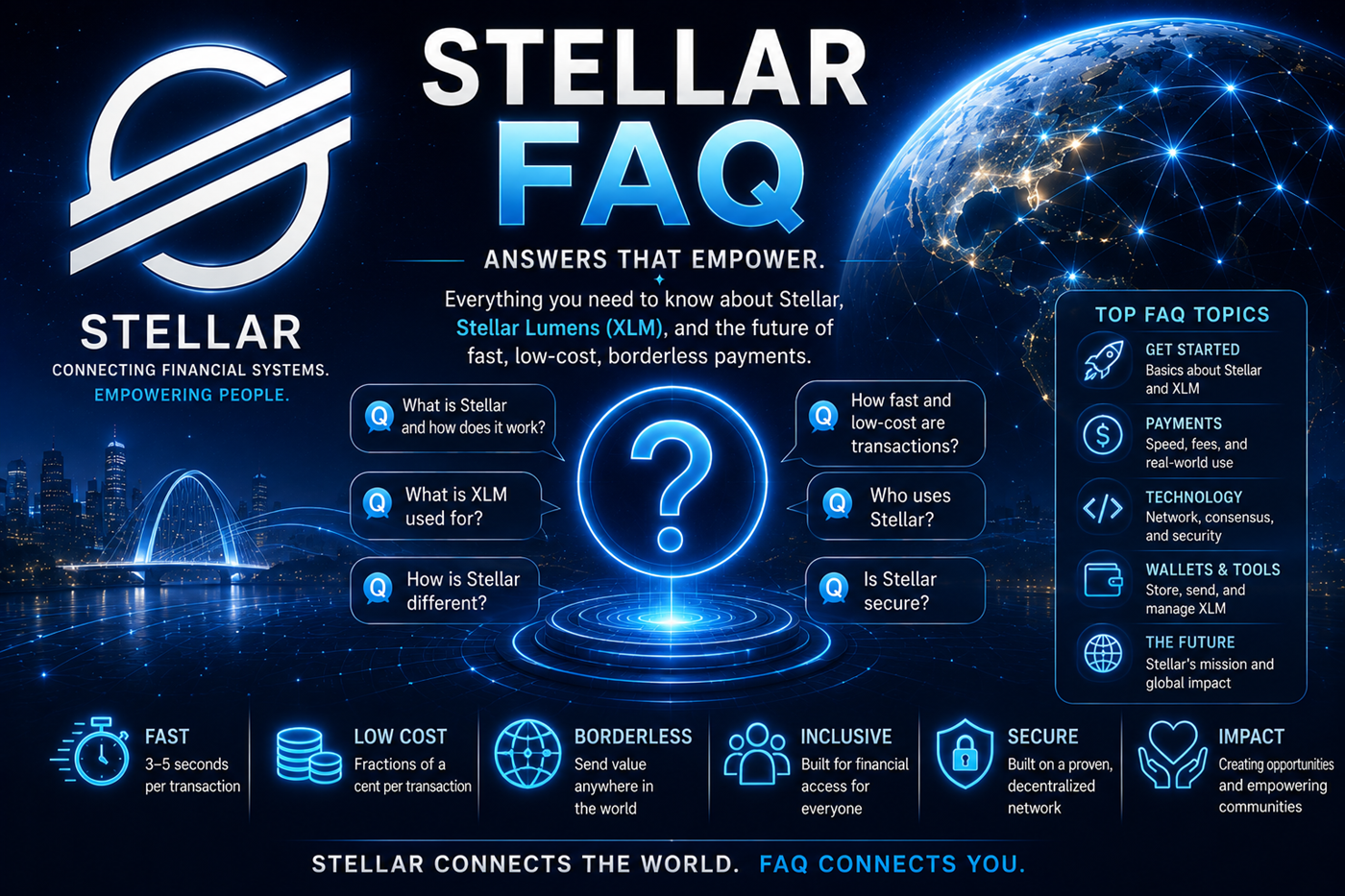
This FAQ answers common beginner questions about Stellar, XLM, stablecoins, anchors, wallets, remittances, Uphold, and how Stellar compares with XRP.
Reminder: This page is educational only. Digital assets are volatile, and technology, regulations, platform features, and market conditions can change.
Stellar is a decentralized blockchain network designed to move digital value quickly and at low cost across borders, currencies, wallets, and financial systems.
XLM, also called Lumens, is the native digital asset of the Stellar network. It is used for small transaction fees, account requirements, and basic network utility.
Yes. Lumens is the asset name, while XLM is the ticker symbol used by exchanges, wallets, and market platforms.
No. Stellar is often discussed in connection with stablecoins, remittances, anchors, aid payments, financial inclusion, tokenization, and digital payment access.
No. Stellar and XRP are separate ecosystems. XRP is the native digital asset of the XRP Ledger, while XLM is the native digital asset of the Stellar network.
Yes. XRP is often discussed in connection with institutional liquidity and large-scale settlement, while Stellar is often discussed in connection with financial inclusion, stablecoins, remittances, and consumer-focused access.
Visit the XRP Knowledge Center for deeper educational resources about XRP, Ripple, XRPL, liquidity, tokenization, valuation, and institutional finance.
Stablecoins are issued assets designed to track the value of another asset, often a national currency such as the U.S. dollar. On Stellar, stablecoins may support payments, remittances, wallets, and digital financial access.
Anchors are organizations that help connect traditional money systems to Stellar. They may support deposits, withdrawals, issued assets, local currencies, or stablecoin access.
Anchors help users move between blockchain-based value and real-world money systems. Without reliable on-ramps and off-ramps, digital assets may be harder to use in everyday life.
Stellar may support remittance-style payments by enabling low-cost, fast digital transfers through supported wallets, stablecoins, anchors, and local access points.
Yes. A wallet is how users hold, send, receive, and manage XLM or Stellar-based assets. Some platforms are custodial, while self-custody wallets give users more direct control over their keys.
Beginners often start with a simple platform such as Uphold for buying, holding, swapping, and learning about XLM, XRP, and other digital assets. Larger long-term holdings may require stronger self-custody or hardware wallet planning.
Uphold is a multi-asset digital money platform that allows users to buy, hold, trade, and manage cryptocurrencies, currencies, and other assets depending on location and availability.
You can review Uphold through the guide below and decide whether it fits your own needs, location, and risk comfort.
No. XLM is a digital asset and can be volatile. Users should understand market risk, platform risk, custody risk, regulation, and personal security before buying or holding any cryptocurrency.
No. Stablecoins may reduce price volatility, but they still involve issuer risk, reserve risk, redemption risk, regulatory risk, and platform risk.
For larger long-term holdings, many users research hardware wallets such as Ledger, Trezor, Tangem, or SafePal. For active use, hot wallets or custodial platforms may be more convenient but require careful security practices.
Avoid rushing, investing more than you can afford to lose, sharing seed phrases, clicking suspicious links, using fake wallet apps, or trusting guaranteed profit claims.
This FAQ is for educational purposes only and is not financial, investment, legal, tax, or regulatory advice. Stellar, XLM, stablecoins, wallets, platforms, fees, regulations, and market conditions can change over time. Always verify current information and consult qualified professionals when needed.