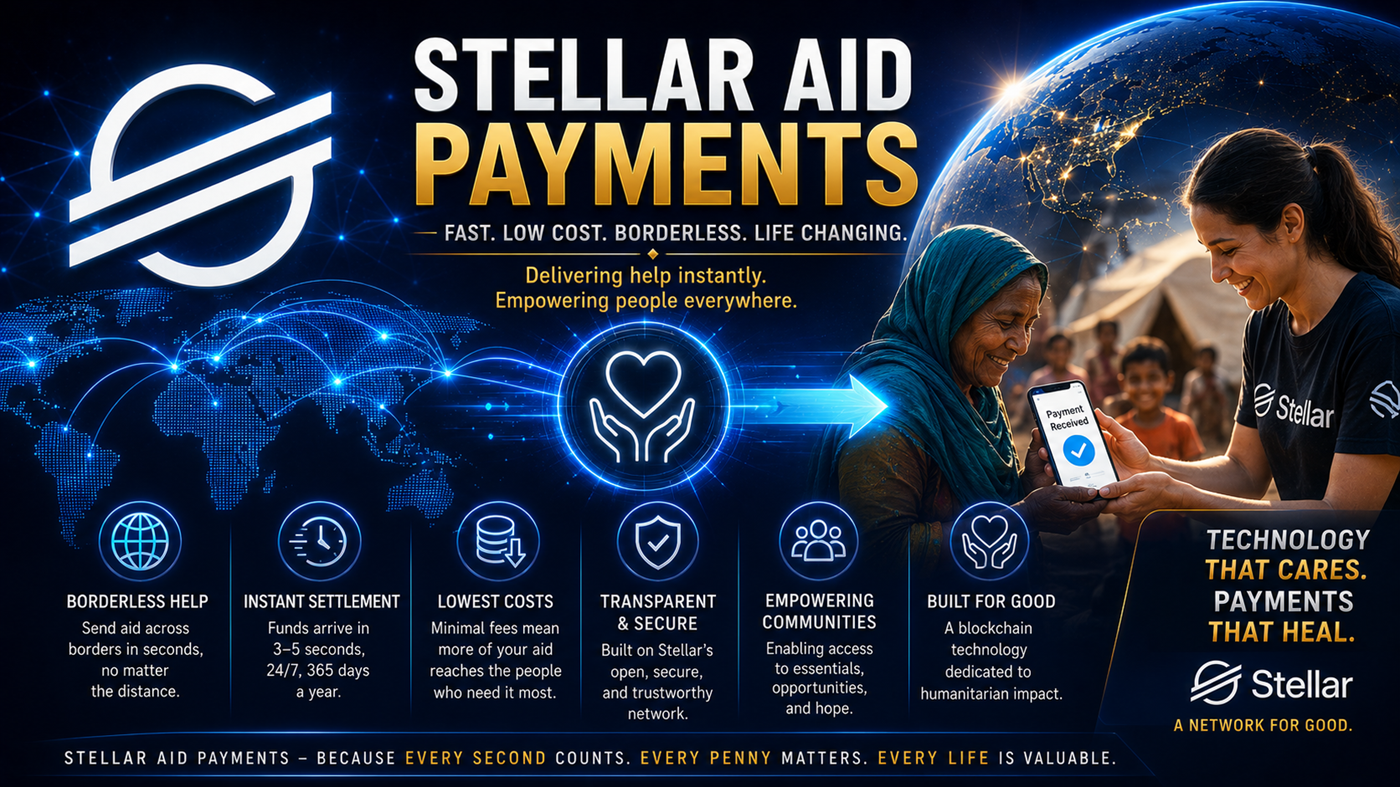
Humanitarian aid payments are one of the most meaningful real-world use cases for blockchain-based financial tools. When people need support quickly, traditional payment systems can be slow, expensive, difficult to access, or unavailable in crisis areas.
Stellar may support aid payments by enabling low-cost digital transfers, stablecoins, wallet-based access, and local conversion through supported partners or anchors.
Simple idea: Stellar can help organizations move aid digitally, while wallets and local access points help recipients receive and use that value.
Aid distribution often happens under challenging conditions. Recipients may be displaced, unbanked, underbanked, or located in regions where local financial infrastructure is limited.
Recipients may not have access to traditional bank accounts or reliable financial services.
Fees can reduce the amount of aid that actually reaches the people who need it.
Traditional aid distribution can involve delays, intermediaries, and administrative friction.
Organizations may need transparency, reporting, and proof that aid reached intended recipients.
Stellar’s low-cost and fast transaction design may help organizations send digital value more efficiently. Stablecoins can provide familiar currency units, while wallets can give recipients a way to receive, hold, or spend aid.
Aid may be distributed as digital value instead of physical cash or slow bank transfers.
Stablecoins may help recipients receive value tied to familiar currencies such as the U.S. dollar.
Mobile wallets may allow recipients to receive aid even when traditional banking access is limited.
Digital transfers can settle quickly, helping aid reach recipients sooner.
In a simple aid payment flow, an organization distributes digital value through a supported platform. Recipients receive that value in a wallet and may hold it, spend it, or convert it through supported local services where available.
Stablecoins can make aid payments easier to understand because they may represent familiar currency value. Instead of receiving a highly volatile asset, recipients may receive digital value designed to track a currency such as the U.S. dollar.
This can be especially useful when local currency is unstable or when recipients need predictable purchasing power.
Stablecoin aid still depends on issuer trust, wallet access, local usability, redemption options, and regulatory support.
Aid can potentially reach recipients faster than some traditional distribution methods.
Fewer intermediaries may reduce delays and administrative burdens.
Blockchain records may help organizations track payment flows and improve accountability.
Digital aid can give recipients more flexibility in how and when they use funds.
Technology alone is not enough. Aid recipients need safe wallets, reliable phones, internet access, local partners, education, and ways to convert or spend digital value.
Recipients may need phones, internet access, or supported applications.
People must understand how to receive, protect, and use digital funds safely.
Digital value must be useful in the recipient’s local environment.
Strong programs need safeguards against fraud, loss, coercion, or misuse.
Aid payments reflect Stellar’s broader focus on financial access. The network’s strengths in low-cost transfers, stablecoins, anchors, wallets, and global movement can support use cases where money needs to reach people quickly and efficiently.
This makes humanitarian payments one of the clearest examples of digital finance serving real human needs.
This page is for educational purposes only and is not financial, legal, humanitarian, or operational advice. Aid programs, stablecoins, wallets, local regulations, recipient access, and platform availability can change over time. Organizations should conduct careful due diligence before using any digital payment system.