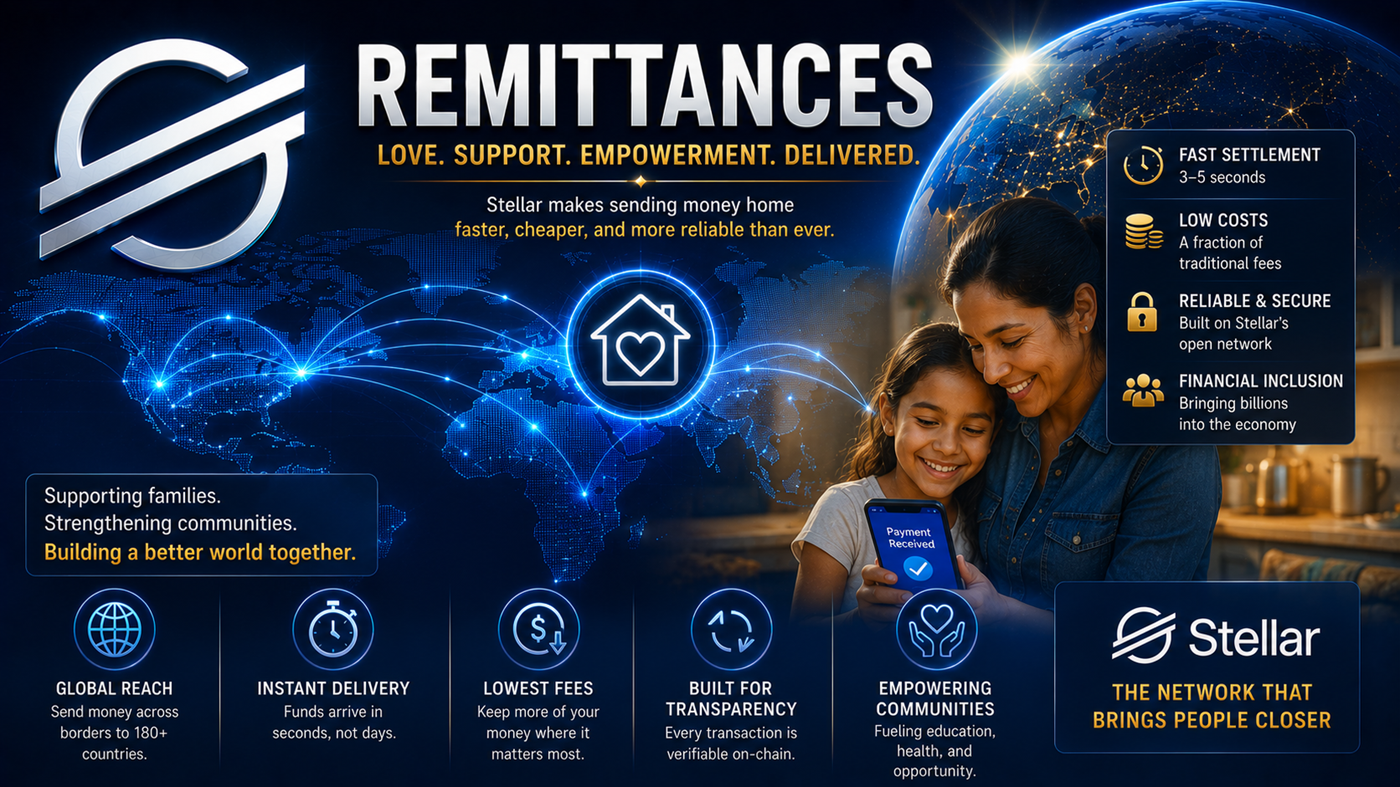
Every year, hundreds of billions of dollars are sent around the world by people supporting family members who live in another country. These international transfers are called remittances.
For many families, remittances help pay for food, housing, education, healthcare, and daily living expenses. Reducing transfer costs and speeding up delivery can make a meaningful difference.
Simple idea: Stellar was designed to make moving money across borders faster, less expensive, and more accessible.
Traditional international money transfers often involve multiple financial institutions, currency exchanges, and payment processors. Each step may add cost, time, or complexity.
Transfer fees can reduce the amount of money received by families.
International transfers sometimes require several business days before funds arrive.
Converting between currencies may introduce additional costs.
Some recipients may not have access to traditional banking services.
Stellar provides digital payment rails that may allow value to move more efficiently between countries. Instead of relying solely on traditional banking infrastructure, digital assets and stablecoins can travel across the Stellar network within seconds.
Many remittance users prefer stable value rather than volatile cryptocurrencies. Dollar-backed stablecoins can provide familiar purchasing power while benefiting from Stellar's fast settlement.
Stablecoins allow money to move digitally while remaining tied to familiar currencies.
Recipients receive value that is generally designed to remain stable.
Payments may settle within seconds rather than days.
Lower network fees may allow more money to reach the recipient.
Anchors connect Stellar's blockchain to local banking systems, payment providers, and financial services. They make it possible to convert between traditional money and digital assets.
Without anchors, blockchain payments would remain entirely digital. Anchors allow recipients to receive usable local currency where supported.
Lower fees can leave more money available for the recipient.
Families may receive funds much sooner than with traditional transfers.
Digital wallets may provide access where banking services are limited.
Recipients may access funds through supported wallets, payment providers, or local partners.
While blockchain technology can improve the movement of money, successful remittances still depend upon local infrastructure. Wallet availability, internet access, regulations, trusted anchors, liquidity, and consumer education all play important roles.
Recipients need easy-to-use wallet applications.
Each country has different financial regulations governing digital assets.
Adequate liquidity helps convert digital assets into local currencies efficiently.
People must understand how to safely manage digital assets and wallets.
Many experts believe international payments will gradually shift toward faster digital settlement networks over the coming decade. Whether through stablecoins, tokenized currencies, or other blockchain-based payment systems, the goal remains the same: moving money safely, efficiently, and affordably.
Stellar's combination of low fees, rapid settlement, anchors, stablecoins, and financial accessibility positions it as one network that could continue playing an important role in the future of global remittances.
This page is provided for educational purposes only and should not be considered financial, investment, tax, or legal advice. Remittance services, wallet providers, stablecoins, regulations, fees, liquidity, and payment infrastructure continue to evolve. Always research current providers and regulations before sending international payments.