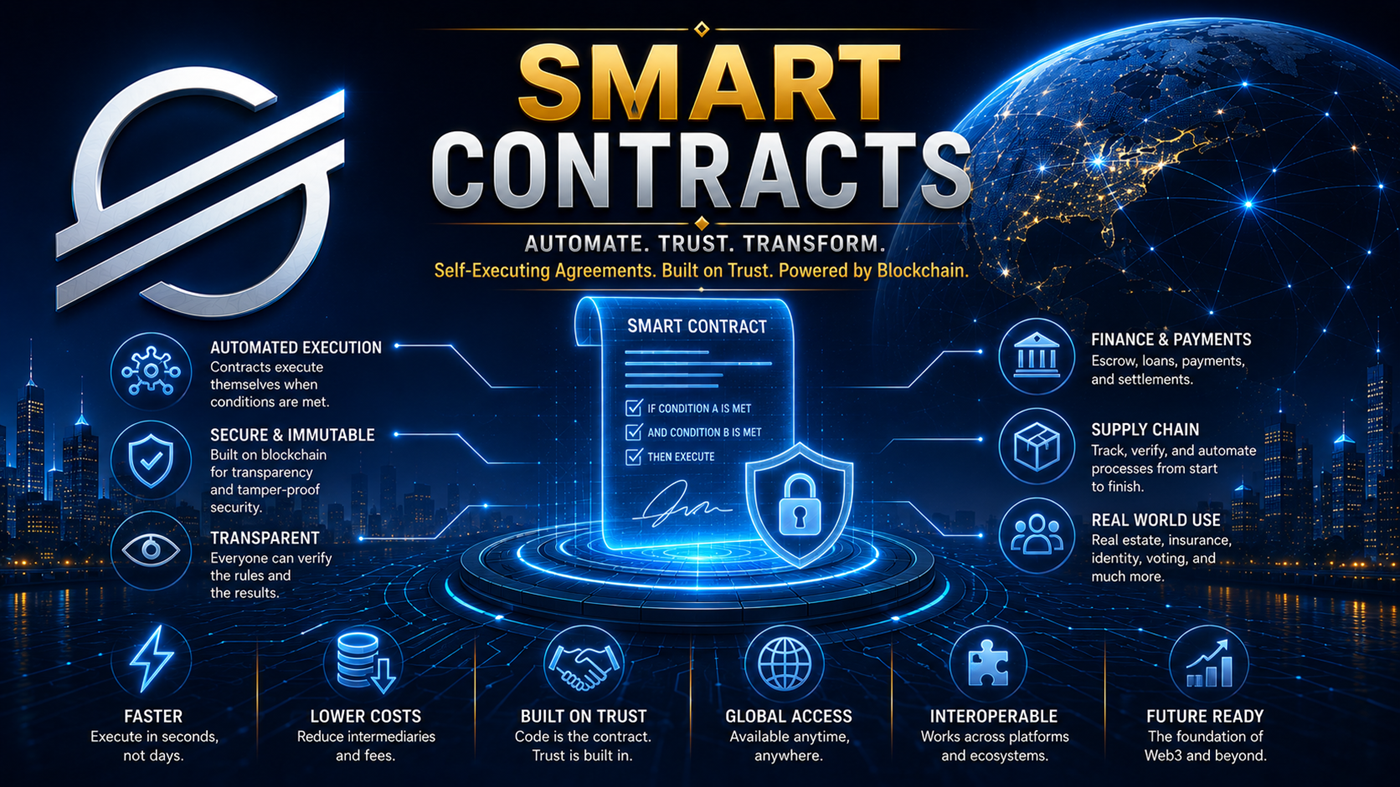
Smart contracts are programs that can run on a blockchain and automatically carry out rules when certain conditions are met. On Stellar, smart contract capability expands what the network can support beyond simple payments and asset transfers.
Stellar’s smart contract platform is known as Soroban. It gives developers a way to build decentralized applications, automate financial logic, and connect smart contracts with Stellar’s existing strengths in payments, stablecoins, tokenization, and financial access.
Simple idea: Stellar moves value. Smart contracts help add programmable rules and automation to that value movement.
A smart contract is code that follows programmed instructions. Instead of relying only on manual processes, a smart contract can help automate financial activity, application logic, asset movement, or agreement rules.
Smart contracts can execute rules automatically when conditions are met.
Developers can build decentralized applications that interact with Stellar assets and users.
Smart contracts can help manage lending, swaps, escrow-like flows, rewards, and other financial functions.
Tokenized assets may connect with rules for movement, access, distribution, or settlement.
Soroban is Stellar’s smart contract platform. It is designed to bring programmable contract functionality to the Stellar ecosystem while connecting with Stellar’s focus on real-world payments, tokenized assets, and financial applications.
For readers, the important point is simple: Soroban allows developers to build more advanced tools on top of Stellar. That may include decentralized applications, financial services, tokenized asset platforms, and systems that use stablecoins or XLM.
Soroban expands Stellar from a fast payment and asset network into a broader platform for programmable digital finance.
Stellar already supports payments, issued assets, stablecoins, anchors, and cross-border value movement. Smart contracts can add more flexible logic to those capabilities.
Developers may build applications that use stablecoins for payments, savings tools, transfers, or settlement.
Smart contracts may help manage rules around tokenized assets, access, rewards, or distribution.
Apps may be created to serve users who need affordable access to digital financial tools.
Smart contracts may support decentralized finance features such as swaps, lending, liquidity, and automated services.
Real-world assets may require more than simple token movement. They may need rules for ownership, transfer limits, distribution, compliance, access, or redemption.
Smart contracts may help support some of these functions by adding programmable logic to tokenized assets and digital finance applications.
Some assets may require eligibility checks or controlled participation.
Contracts may help distribute payments, rewards, interest, or proceeds according to rules.
Tokenized assets may use smart contract logic for lifecycle events and application features.
Contract logic can make certain processes easier to inspect, test, and verify.
Smart contracts can be powerful, but they also introduce risks. Code can contain bugs, integrations can fail, users can misunderstand how an application works, and financial products may still involve market, legal, or liquidity risk.
Smart contracts can automate rules, but they do not eliminate the need for security audits, user education, legal clarity, careful design, and responsible risk management.
Smart contracts may allow Stellar to support more advanced financial tools while still benefiting from the network’s focus on low-cost payments, stablecoins, anchors, and accessibility.
As the ecosystem matures, smart contracts may help connect Stellar to tokenized assets, decentralized finance, wallets, aid payments, institutional applications, and consumer financial tools.
This page is for educational purposes only and is not financial advice. Smart contracts, Soroban, Stellar development, tokenized assets, regulations, applications, and digital asset markets can change over time. Always verify current information through official Stellar resources and independent research.