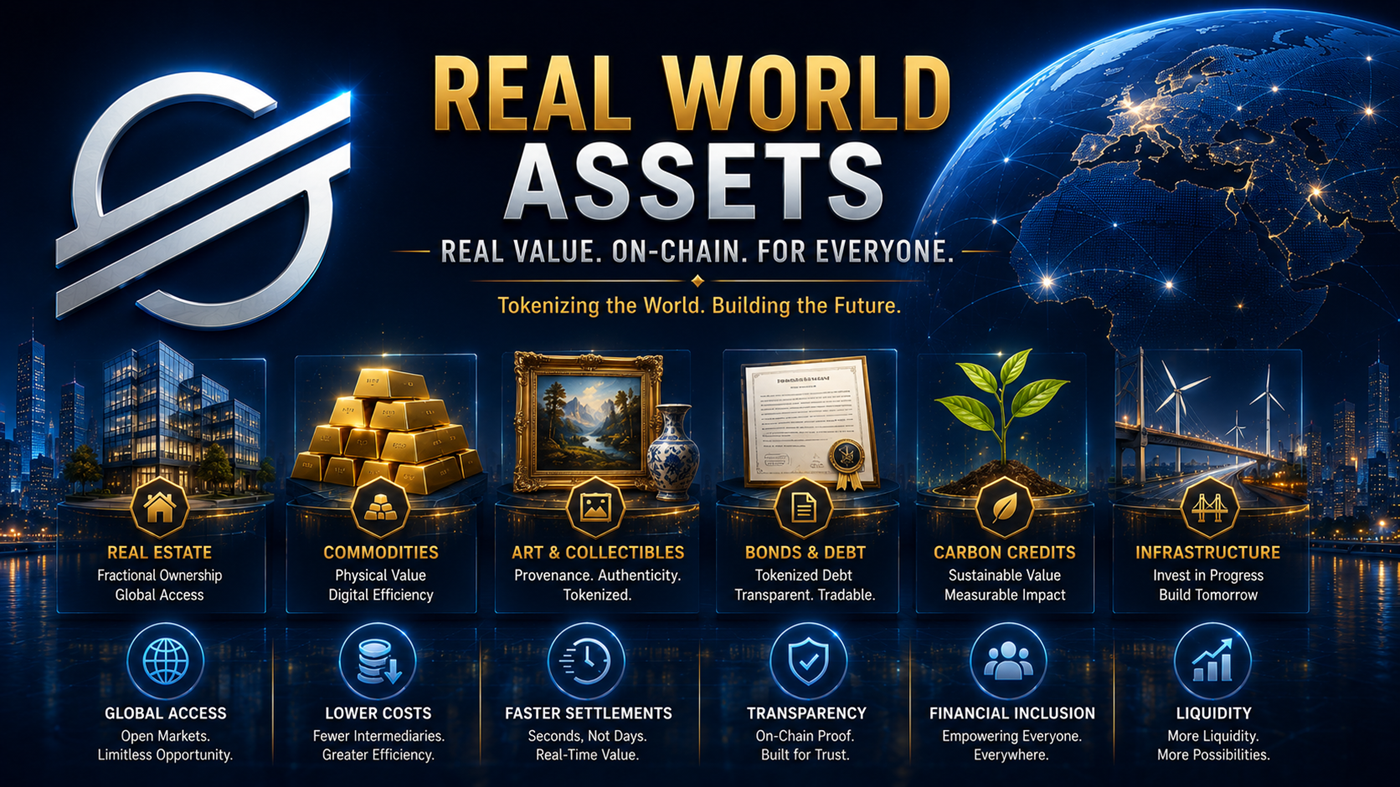
Real-world assets, often called RWAs, are traditional assets represented digitally on a blockchain. These may include treasury products, commodities, fund shares, credits, invoices, or other financial instruments that exist outside the blockchain but are represented on-chain.
Stellar can support issued assets and tokenized forms of value, making it relevant to the growing discussion around real-world asset tokenization and digital finance.
Simple idea: Real-world assets connect blockchain records with value that exists outside the blockchain.
A real-world asset is not just a cryptocurrency. It is a digital representation of something that has value in the traditional financial world or physical economy.
Government securities and treasury-based instruments are often discussed as major candidates for tokenization.
Gold, silver, and other commodities may be represented through tokenized claims when properly structured.
Investment funds may use tokenization to represent ownership or participation in a financial product.
Loans, invoices, and business financing may eventually become part of tokenized credit markets.
Stellar supports issued assets, which means an organization can issue a token representing another form of value. That token may move across Stellar while the real-world asset, reserve, claim, or legal agreement exists outside the blockchain.
This makes issuers, anchors, custody, legal structure, redemption terms, and transparency extremely important. The blockchain can record token movement, but the real-world connection must be trustworthy.
A tokenized asset is only as strong as the issuer, reserves, legal rights, custody, and redemption process behind it.
Tokenizing real-world assets may make financial products easier to move, settle, access, and track. Instead of relying only on slow or fragmented systems, tokenized assets may use digital rails for transfer and settlement.
Digital asset transfers may settle more quickly than many traditional financial processes.
Tokenized assets may eventually become accessible through wallets and platforms where legally allowed.
Blockchain records can provide a transparent history of token transfers and ownership changes.
Tokenized assets may eventually connect with smart contracts, compliance rules, and automated financial processes.
Stablecoins are one of the most common examples of tokenized real-world value. A dollar-backed stablecoin represents a claim or relationship tied to real-world currency reserves or equivalent assets.
This makes stablecoins a bridge between traditional finance and blockchain finance. On Stellar, stablecoins may support payments, remittances, aid distribution, wallets, and cross-border value movement.
Anchors and issuers are essential to real-world asset tokenization. They may help users deposit value, receive tokenized representations, redeem assets, or connect blockchain-based assets to traditional financial systems.
An issuer creates the tokenized asset on Stellar.
The underlying asset or reserve must be held and managed responsibly.
Users need clear rules for redeeming tokenized assets where redemption is offered.
Real-world assets may require legal, regulatory, and identity controls.
Real-world asset tokenization can be powerful, but it can also be misunderstood. A token does not automatically give the holder clear ownership, redemption rights, legal protection, or liquidity.
Research the organization that created and manages the tokenized asset.
Understand whether reserves, assets, contracts, or legal claims support the token.
Review redemption terms, restrictions, fees, and supported jurisdictions.
A token may exist on-chain but still have limited buyers, sellers, or conversion options.
This page is for educational purposes only and is not financial advice. Real-world assets, tokenized assets, issuers, reserves, custody, redemption rights, liquidity, regulations, and platform availability can change over time. Always verify current information before making financial decisions.