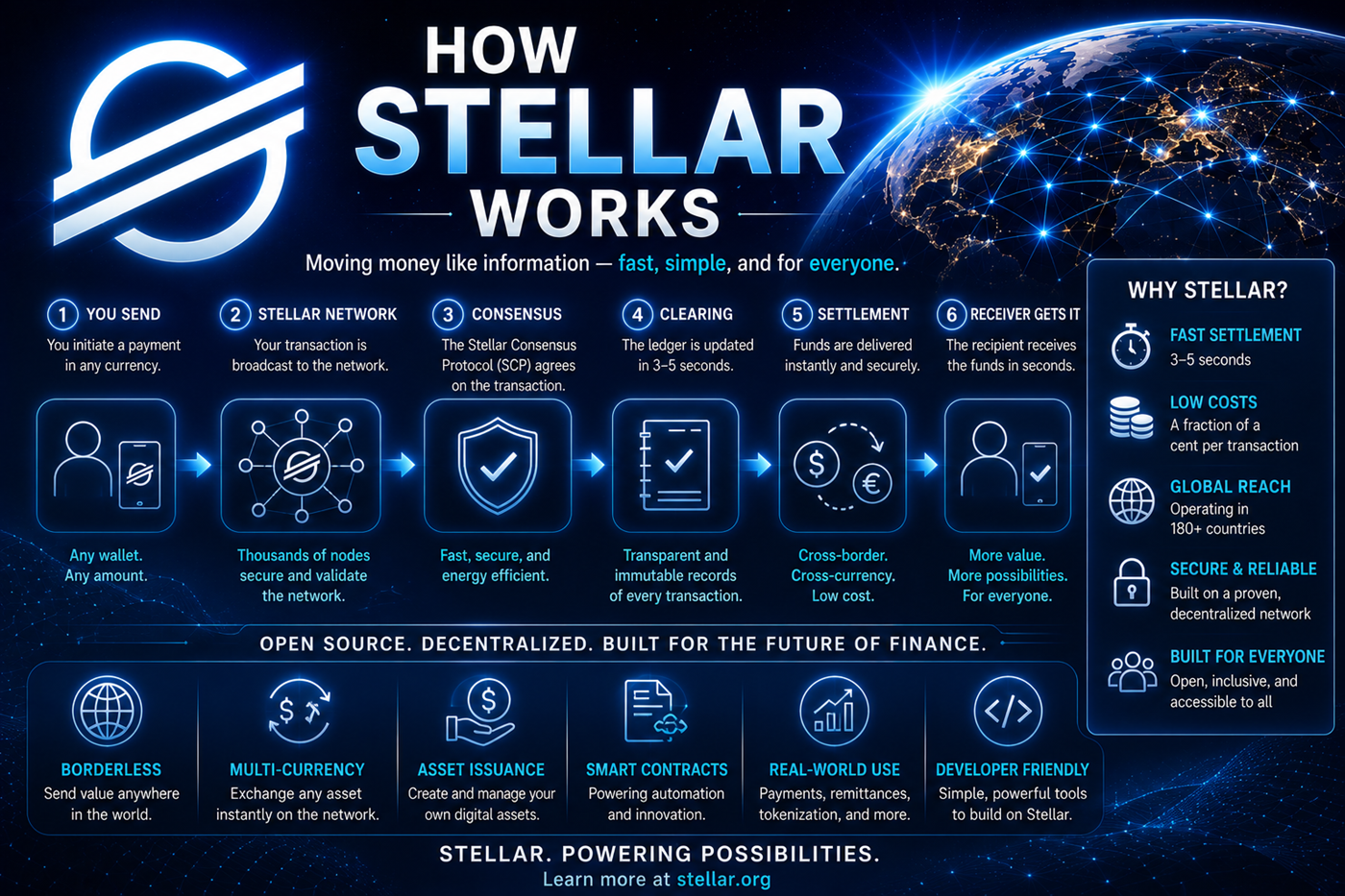
Stellar is a decentralized blockchain network designed to move value quickly and efficiently between people, businesses, wallets, currencies, and financial systems. It is often discussed in connection with remittances, stablecoins, anchors, financial inclusion, and global payments.
The easiest way to understand Stellar is to think of it as a digital financial network that can connect different forms of value. Those forms of value may include XLM, stablecoins, tokenized currencies, and other issued assets.
Simple idea: Stellar helps value move. XLM helps the network operate. Anchors help connect Stellar to traditional money systems.
The blockchain network where accounts, assets, payments, and transactions are recorded.
The native asset of Stellar, used for fees, account minimums, and basic network activity.
Accounts hold XLM and other Stellar-based assets, submit transactions, and interact with the network.
Stellar can support issued assets such as stablecoins, tokenized currencies, and other digital representations of value.
A Stellar transaction is an instruction sent to the network. It might move XLM, send a stablecoin, exchange one asset for another, create an account, or interact with another Stellar feature.
Once the network accepts and confirms the transaction, the ledger updates. This allows payments and asset transfers to settle quickly compared with many traditional systems.
Stellar does not use proof-of-work mining. Instead, the network uses a consensus process designed to help participants agree on the state of the ledger. This allows Stellar to avoid energy-intensive mining while still supporting fast transaction processing.
Consensus is what helps the network decide which transactions are valid and what the latest ledger state should be.
One of Stellar’s most important concepts is the anchor. An anchor is an organization that helps connect traditional money systems to the Stellar network. Anchors may support deposits, withdrawals, issued assets, local currencies, and stablecoin movement.
For example, an anchor may allow a user to deposit local currency and receive a digital representation of that value on Stellar. The user may then send, hold, or exchange that digital value through supported Stellar tools.
Anchors are one reason Stellar is often discussed in connection with remittances, stablecoins, and financial inclusion. They help connect blockchain rails with real-world financial access points.
Stablecoins are digital assets designed to track the value of another asset, often a national currency such as the U.S. dollar. Stellar can support stablecoins and issued assets, making it useful for digital dollars, remittances, payments, and cross-border transfers.
For everyday users, stablecoins may be easier to understand than volatile cryptocurrencies because they are designed to maintain a stable value. That makes them important in Stellar’s financial inclusion story.
Many people around the world face high fees, slow money movement, limited banking access, and difficulty exchanging currencies. Stellar was designed to reduce friction and make value easier to move across borders and financial systems.
Stellar is designed for inexpensive transactions, which can matter for smaller payments and remittances.
Payments can settle quickly compared with many legacy financial systems.
Issued assets and anchors may help users access local currencies, digital dollars, and other forms of value.
Stellar is built for cross-border value movement and financial access across regions.
Stellar is part of a larger shift toward digital finance. That shift includes stablecoins, tokenized assets, remittances, wallets, aid payments, and financial infrastructure that can reach people beyond traditional banking systems.
Stellar is not the only network working on these problems, but it has a clear focus on accessibility, payments, and connecting different forms of value.
This page is for educational purposes only and is not financial advice. Stellar, XLM, stablecoins, anchors, regulations, wallets, and platform availability can change over time. Always verify current information and conduct your own research before making financial decisions.