We Are Still at the Beginning
Artificial intelligence has advanced rapidly, but the story is far from finished.
Today's systems can already help people write, research, analyze information, generate images, create software, learn new subjects and work through complicated problems.
Future systems may become more capable, more reliable, more personalized and more deeply integrated into everyday life.
Nobody can know exactly where that development will lead.
But we can ask better questions about the possibilities.
What happens when extraordinary intelligence becomes ordinary access?
From AI as a Tool to AI as a Capability
Early computer tools required people to learn how the software worked.
You learned menus.
Commands.
Buttons.
File structures.
Programming languages.
Artificial intelligence is beginning to change that relationship.
Increasingly, people can describe what they want in ordinary language.
Instead of learning every technical step first, they can begin with the goal.
"Here is what I'm trying to accomplish. Help me figure out how."
That may become one of the defining characteristics of the next stage of computing.
Intelligence May Become More Personal
Most software has traditionally been built for large groups of users.
Everyone receives roughly the same program.
Intelligent systems can potentially adapt much more closely to the individual.
A person may be able to explain what they already know, what they are trying to accomplish and how they prefer information to be presented.
The system can then adjust its assistance accordingly.
Your Intelligence Interface
The future of computing may become less about learning how to operate software and more about telling intelligent systems what you are trying to accomplish.
The Future of Learning
Education may be one of the areas most affected by increasingly capable intelligence.
Traditional education often requires one teacher to communicate with many students.
Students learn at different speeds.
Some are afraid to ask questions.
Some need another example.
Some need the same idea explained five different ways.
Intelligent tutoring systems could make individualized explanation much more widely available.
A learner could say:
"I don't understand."
And the lesson could change.
Again.
And again.
Until the student understands.
The Future of Work
AI will almost certainly change how many kinds of work are performed.
Some tasks may become automated.
Other tasks may become faster.
Some jobs may change substantially.
New kinds of work may emerge.
But another possibility deserves attention:
Individual workers may gain access to capabilities that previously required teams.
The future worker may not simply compete against AI. The future worker may work with AI.
One Person May Be Able to Do Much More
Think about the resources required to launch an idea twenty years ago.
You might need a writer.
A designer.
A programmer.
A researcher.
A marketing person.
Perhaps a consultant.
Future intelligent systems may allow individuals to perform portions of many of those functions themselves.
That does not mean professionals disappear.
Expertise will continue to matter.
But the minimum resources needed to explore an idea may continue to fall.
The Future Entrepreneur May Start With a Conversation
Imagine having an idea and beginning not with a large investment, but with a conversation.
You explain the idea.
The intelligence asks questions.
You refine the concept.
It helps you research the market.
You challenge the assumptions.
It helps you create a prototype.
You test it.
You improve it.
The barrier between idea and experiment becomes smaller.
The Future Creator May Have an Entire Studio
A person with an idea may increasingly have access to tools for writing, music, video, images, animation, software and design.
One creator may be able to coordinate capabilities that once required an entire production team.
The technology doesn't automatically provide imagination.
It can provide leverage for imagination.
From Consumer to Creator
One of the most interesting possibilities of advanced intelligence is that more people may move from simply consuming technology to using it to create things of their own.
The Great Equalizer Could Become More Powerful
Historically, resources created enormous differences in what individuals and organizations could attempt.
A large corporation could hire specialists.
A wealthy entrepreneur could assemble a team.
A major university could provide access to researchers and libraries.
An ordinary individual often had only their own knowledge, time and resources.
Increasing access to intelligence does not eliminate inequality.
But it may reduce some barriers created by lack of access to specialized intellectual assistance.
What Happens When Everyone Has an Expert Assistant?
Imagine hundreds of millions of people having access to increasingly capable assistance.
Not merely search.
Assistance.
Something that can explain.
Analyze.
Compare.
Challenge.
Organize.
Create.
And collaborate.
The effects could extend far beyond technology companies.
They could affect small businesses, education, creative work, research, entrepreneurship and everyday problem-solving.
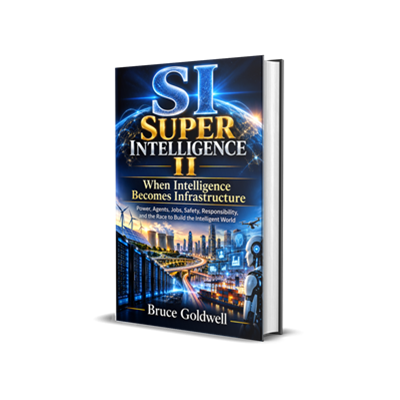
SI — Super Intelligence II
The Super Intelligence conversation doesn't end with what AI can do today.
The next questions are about where increasingly capable intelligence may lead and what happens as humans learn to work with it.
View Book II on AmazonMore Intelligence Does Not Automatically Mean Better Decisions
Powerful intelligence creates possibilities.
It does not automatically create wisdom.
Future AI systems may become better at producing answers, but humans will still face questions about which goals are worth pursuing.
Faster analysis does not determine what matters.
Greater capability does not automatically determine how that capability should be used.
Those remain human questions.
Intelligence may tell us what we can do.
Wisdom asks whether we should do it.
There Will Be Risks
A realistic discussion of Super Intelligence cannot consider only the benefits.
More capable systems can also create new problems.
AI can generate incorrect information.
It can be misused.
It can make convincing mistakes.
Automation can disrupt industries and jobs.
People may become overly dependent on intelligent systems or trust them when they should not.
Questions involving privacy, security, control, accountability and responsible use will remain important as these systems become more capable.
The Human Still Matters
The more powerful intelligence becomes, the easier it may be to assume that human contribution becomes less important.
The opposite may also happen.
When machines can produce thousands of ideas, humans must decide which ideas matter.
When information becomes abundant, humans must decide what to trust.
When creation becomes easier, humans must decide what is worth creating.
When more becomes possible, humans must decide what should be done.
The Future May Be Human + AI
It is easy to imagine the future as a contest.
Humans on one side.
Machines on the other.
But the more immediate future may involve people and intelligent systems working together.
Humans provide goals, context, experience and judgment.
Machines provide speed, scale, analysis and increasingly sophisticated intellectual assistance.
Together, the combination may allow individuals to accomplish things neither could accomplish as effectively alone.
Explore this idea further in Human + AI: The Amplified Human .
Will Machines Become Superintelligent?
Perhaps.
Researchers, technology leaders and thinkers disagree about how advanced artificial intelligence will become, how quickly development may occur and what future systems will ultimately be capable of doing.
Predictions should therefore be treated as predictions, not facts.
But we don't need to know the final destination to recognize the direction of change.
AI systems are becoming more capable.
They are becoming more accessible.
And people are finding more ways to use them.
The More Immediate Question
We may eventually discover whether machines achieve something everyone agrees should be called superintelligence.
But ordinary people don't need to wait for that debate to be settled.
There is another question we can ask today:
What can I accomplish now that I have access to intelligence I didn't have before?
Imagine the Next Generation
Children growing up today may think about intelligent systems very differently from people who encountered them later in life.
They may grow up assuming that when they don't understand something, they can ask for an explanation.
When they have an idea, they can immediately explore it.
When they want to create something, intelligent tools can help them begin.
That could change expectations about what an individual is capable of attempting.
Perhaps We Are Asking the Wrong Future Question
The question most often asked is:
"How intelligent will AI become?"
It is an important question.
But it isn't the only one.
How capable will humans become when extraordinary intelligence is available to almost everyone?
That may ultimately be the more personal question.
The Future Is Not Something We Only Watch
New technology often arrives gradually and then suddenly feels normal.
Computers moved from specialized rooms to desks.
The Internet moved from something people visited to something woven into everyday life.
Smartphones put computing, communication and information into our pockets.
Intelligent systems may represent another transition.
But this transition is unusual because the technology itself can help people learn how to use it.
You can ask the intelligence what it can help you do.
Then you can begin.
The Future Begins With a Question
What would you try if lack of knowledge were no longer the first thing stopping you?
Welcome to the Age of Super Intelligence
The future of Super Intelligence will involve machines.
It will involve new capabilities.
It will involve risks, mistakes, discoveries and questions we have not yet imagined.
But humans will be part of that future too.
Perhaps the most important question isn't whether machines will eventually become extraordinarily intelligent.
Perhaps it is what happens when extraordinary intelligence becomes available to ordinary human beings.
Maybe the future of Super Intelligence isn't only
smarter machines.
Maybe it is more capable humans.
Continue Exploring
Start with What Is Super Intelligence? .
Explore the terminology at What Does Super Intelligence Mean? .
See how the concepts differ at Super Intelligence vs Artificial Intelligence .
Or discover practical possibilities at Super Intelligence for Everyday People .