
What's the Difference Between AI and SI?
Artificial Intelligence (AI) is the broad term used for computer systems designed to perform tasks associated with intelligence.
Those tasks can include understanding language, recognizing patterns, generating text and images, analyzing information, solving problems, making predictions and assisting people with complex work.
Super Intelligence (SI), or superintelligence, generally refers to intelligence that exceeds ordinary human intellectual capability.
So one simple distinction is:
AI describes a technology.
Super Intelligence describes a level of capability.
Artificial Intelligence Is Already Here
Artificial Intelligence is no longer merely a prediction about the future.
Millions of people already interact with AI systems capable of answering questions, generating content, helping write computer code, analyzing documents, translating languages, assisting with research and explaining complicated subjects.
AI is appearing in phones, computers, search tools, productivity software and many of the digital services people use every day.
But calling something AI does not mean that it is superintelligent.
What Does Superintelligence Traditionally Mean?
In traditional discussions of artificial intelligence, superintelligence usually describes a hypothetical system that significantly exceeds human intellectual performance across a very broad range of activities.
Such a system might outperform humans in areas such as reasoning, scientific discovery, planning, invention, problem-solving and other intellectual tasks.
Whether or when AI systems will reach that level remains an open question.
But focusing only on that future threshold can cause us to overlook another transformation taking place today.
There Is Another Way to Think About SI
Imagine a person who suddenly gains access to researchers, writers, analysts, programmers, tutors and brainstorming partners whenever they need them.
That person has not suddenly become biologically more intelligent.
But their ability to accomplish intellectual work may increase dramatically.
This raises an interesting possibility.
Perhaps we should measure intelligence not only by what the machine can do alone—but also by what a human can accomplish with it.
AI + Human Experience
AI has strengths.
Humans have strengths.
They are not always the same strengths.
Artificial intelligence can process and organize large amounts of information quickly.
It can explore alternatives, recognize patterns and generate possible solutions.
Humans bring lived experience, judgment, personal values, goals, imagination and an understanding of why something matters.
AI Brings Capability. Humans Bring Purpose.
The machine can help explore thousands of possibilities. The human still decides which possibilities are worth pursuing.
AI vs SI in Simple Terms
One way to understand the difference is to think of AI as the tool and SI as a possible level of intelligence or capability.
Artificial Intelligence: machines performing tasks associated with intelligence.
Super Intelligence: intelligence or capability that goes significantly beyond ordinary human intellectual ability.
Human + AI: people using artificial intelligence to expand what they can learn, create, analyze and accomplish.
Why the Difference Matters
The terminology matters because words influence how we think about technology.
The word artificial emphasizes the origin of the intelligence.
It tells us that the intelligence is produced by a machine.
The word super shifts the conversation toward capability.
What can this intelligence do?
What can it help humans do?
And what becomes possible when extraordinary intellectual capability becomes widely available?
AI tells us where the intelligence comes from.
SI asks us what becomes possible because of it.
One Person Can Now Work Differently
Consider an author developing a book.
That author can use AI to help explore a subject, organize research, challenge ideas, improve explanations, develop promotional material, create website code and brainstorm entirely new projects.
Consider a small-business owner.
AI may help that person analyze ideas, develop marketing concepts, understand unfamiliar technology or organize information that previously would have required outside assistance.
Consider someone who simply wants to learn.
They can ask a question, ask for a simpler explanation, ask another question and continue until a difficult subject begins to make sense.
None of these people suddenly became experts in every field.
They gained access to intelligence that can help extend their own abilities.
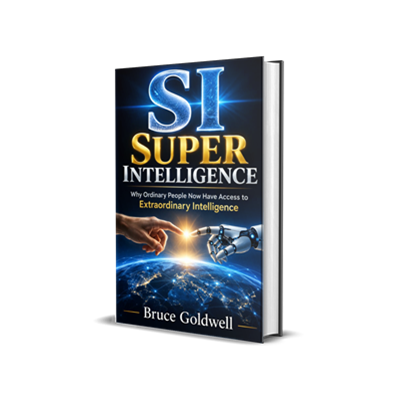
SI — Super Intelligence
Why Ordinary People Now Have Access to Extraordinary Intelligence
Bruce Goldwell explores what happens when increasingly powerful intelligence moves out of laboratories and institutions and becomes available to everyday people.
View on AmazonDoes SI Mean Humans Become Less Important?
Not necessarily.
More capable technology can actually make certain human qualities more important.
When information becomes easier to generate, judgment becomes more valuable.
When thousands of ideas can be produced quickly, deciding which ideas matter becomes more important.
When machines can help perform more tasks, humans still have to decide what those tasks should accomplish.
Intelligence without direction is simply capability.
Humans provide the direction.
Is Super Intelligence the Next Step After AI?
It may be tempting to imagine a simple progression:
computers → AI → Super Intelligence.
Reality may be more complicated.
AI systems are developing along many different paths and becoming integrated into everyday tools at the same time.
There may eventually be systems that meet widely accepted definitions of machine superintelligence.
But long before that question is settled, humans may already experience something profound:
access to intellectual capabilities far beyond what an individual could previously command alone.
The Question May Be Changing
For years the question has been:
How Smart Will Artificial Intelligence Become?
That remains an important question.
But perhaps we should add another:
How capable will human beings become when extraordinary intelligence is available whenever they need it?
AI, SI and the Future
Nobody knows exactly how far artificial intelligence will advance.
There will be benefits, limitations, mistakes, risks and discoveries that are difficult to predict today.
But one change is already visible.
Intelligence that once required access to institutions, specialists and expensive resources is becoming available to ordinary individuals.
That may turn out to be one of the most important technological shifts of our lifetime.
Continue Exploring Super Intelligence
If you're new to the subject, start with What Is Super Intelligence?
Next, explore Human + AI and why the combination of human experience and machine intelligence may be more important than either one alone.
You can also return to the SI — Super Intelligence home page to explore the complete series.