
Super Intelligence Isn't Only for Experts
When people hear terms such as Artificial Intelligence, advanced intelligence or Super Intelligence, it is easy to imagine laboratories, technology companies, programmers and scientists.
But one of the most important changes taking place is that increasingly capable intelligence is becoming available to ordinary people.
You don't need to build an AI system.
You don't need to understand the mathematics behind it.
You don't even need to understand everything it can do.
You can begin with something much simpler.
Start with something you want to know, solve, create or accomplish.
Start With a Question
The easiest way to begin using AI is often simply to ask a question.
Not a special "AI question."
A real question from your real life.
You might ask:
- Can you explain this to me in simple language?
- What am I missing about this problem?
- Help me organize this idea.
- What questions should I be asking?
- Give me several ways I could approach this.
- Help me understand the advantages and disadvantages.
- Teach me this one step at a time.
The important part isn't learning some magical collection of prompts.
It is learning that you can have a conversation with intelligence.
Use SI as a Personal Teacher
One of the simplest uses of artificial intelligence is learning.
Imagine having a teacher who doesn't become impatient when you don't understand something the first time.
You can say:
"Explain that more simply."
Or:
"Give me an example."
Or:
"I still don't understand. Explain it as if I have never heard of this before."
Then keep asking questions.
That ability alone can change the relationship people have with learning.
Use It to Explore Ideas
Maybe you've had an idea sitting in the back of your mind for years.
A business.
A book.
A website.
A community project.
A new hobby.
Something you would like to invent.
Previously, the idea may have stopped at:
"I wouldn't know where to begin."
Now that statement can become a question.
Ask:
"I have this idea, but I don't know where to begin. Help me figure out the first five steps."
That doesn't guarantee the idea will succeed.
But it can help you move from wondering to exploring.
Use It to Think Through Problems
Sometimes the most useful thing isn't getting an answer.
It is seeing a problem from another angle.
You can describe what you're trying to accomplish and ask:
- What options haven't I considered?
- What could go wrong with this plan?
- What assumptions am I making?
- What would someone experienced in this area ask me?
- What is the simplest version of this idea?
AI can become a brainstorming partner that helps you examine possibilities.
Use It to Write More Clearly
Many people know what they want to say but struggle to put it into words.
AI can help turn rough thoughts into clearer communication.
You might provide a rough message and say:
"Make this clearer, but keep it sounding like me."
You can use the same approach with letters, emails, descriptions, announcements, articles and other everyday writing.
The idea remains yours.
The intelligence helps you express it.
Use It to Create
Creativity is another area where access to intelligence can expand what one person can attempt.
Someone may begin with only an idea and use AI to help develop:
- a story
- a book outline
- a song concept
- a website
- a video script
- a business name
- a project plan
- an image concept
- a marketing idea
The person still decides what to keep, what to reject and where the project should go.
Use It to Build Things You Couldn't Build Before
This may be one of the biggest changes.
You may have an idea for a website or simple application without knowing how to program it yourself.
AI can help explain the process, generate code, troubleshoot problems and guide you through individual steps.
That doesn't instantly turn someone into a professional programmer.
But it lowers the barrier between:
"I wish this existed."
and:
"Let's see if I can build it."
Super Intelligence may matter most when it helps ordinary people attempt things they previously believed were beyond their reach.
You Don't Have to Know the Right Prompt
One thing that can intimidate beginners is the idea that they must learn complicated "prompt engineering."
Better instructions can certainly produce better results.
But you don't have to begin there.
Begin by talking naturally.
If the answer isn't useful, say so.
Ask for something shorter.
Ask for more detail.
Correct misunderstandings.
Add information.
Keep going.
A Simple Rule
Don't worry about asking the perfect question.
Start the conversation and improve the question as you go.
AI Can Be Wrong
Access to powerful intelligence does not mean every answer should be trusted.
AI systems can make mistakes.
They can misunderstand what you mean.
They can provide outdated information.
They can sometimes produce information that sounds confident but is incorrect.
Important information should be checked, particularly when decisions involve health, money, legal matters, safety or other serious consequences.
Super Intelligence does not replace common sense.
It makes human judgment even more important.
Ask for a Second Opinion
One useful habit is to challenge the first answer.
Ask:
"What could be wrong with that answer?"
Or:
"Give me the strongest argument against this."
Or take the question to another AI system and compare the responses.
The goal isn't to let a machine make every decision.
The goal is to use intelligence to help you make better informed decisions yourself.
What Should You Try First?
Don't begin by asking what AI can do.
That question is too large.
Instead ask:
What is one thing I would like help with today?
Maybe you want to understand something.
Maybe you need to write something.
Maybe you have an idea.
Maybe you are trying to solve a problem.
Maybe you simply want to learn what is possible.
Start there.
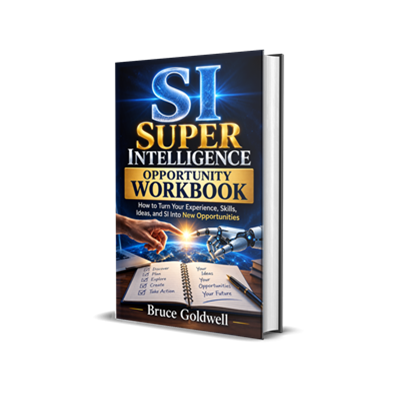
SI — Super Intelligence Workbook
Reading about Super Intelligence is one thing. Discovering what you can actually do with it is another.
The SI — Super Intelligence Workbook is designed to help you explore your own questions, ideas, goals and possibilities.
View the Workbook on AmazonThe Great Equalizer
For generations, extraordinary capability often required extraordinary resources.
Large organizations could hire researchers, programmers, writers, designers, consultants and specialists.
Most individuals could not.
Increasingly capable AI does not eliminate every difference between individuals and large organizations.
But it can give one person access to capabilities that were once much harder to obtain.
That could make intelligence one of the great equalizers of the digital age.
You Bring Something AI Doesn't Have
Your life.
Your experiences.
Your memories.
Your relationships.
Your goals.
Your reasons for caring about something.
Intelligence can help you explore possibilities.
But you decide which possibilities matter.
AI brings intelligence.
You bring purpose.
Super Intelligence Begins With You
You don't have to wait for some future machine to be officially declared superintelligent before exploring what increasingly capable intelligence can help you do.
Start small.
Ask one question.
Solve one problem.
Learn one thing.
Explore one idea.
Then ask another question.
You may discover that the most interesting part of the intelligence revolution isn't simply what the technology can do.
It is what you can do with it.
Continue Exploring
Learn the basics at What Is Super Intelligence? .
Explore the terminology at What Does Super Intelligence Mean? .
Or continue to Human + AI to explore why human experience combined with machine intelligence may be the real story.